
This past Sunday, I met a dear friend at a local coffee shop and what a treat it was! We talked about many topics and our mutual love for nonfiction. My friend is currently listening to Braiding Sweetgrass: Indigenous Wisdom, Scientific Knowledge and the Teachings of Plants by Robin Wall Kimmerer and she highly recommend it to me. Later on, when I got home, I sent her a picture of the nonfiction book I’m reading. The title is, The Neighborhood Project by David Sloan Wilson. I received the book as an ARC many years ago.
This led me to further explore more nonfiction books to add to my to-read wish-list. Below are five new titles I have added. My wish is for you to be encouraged and inspired to read more and to explore nonfiction in a broader sense-if you haven’t already.
Stephanie Hopkins

The Book-Makers
A History of the Book in Eighteen Lives
by Adam Smyth
Description
The five-hundred-year history of printed books, told through the people who created them
Books tell all kinds of stories—romances, tragedies, comedies—but if we learn to read the signs correctly, they can tell us the story of their own making too. The Book-Makers offers a new way into the story of Western culture’s most important object, the book, through dynamic portraits of eighteen individuals who helped to define it.
Books have transformed humankind by enabling authors to create, document, and entertain. Yet we know little about the individuals who brought these fascinating objects into existence and of those who first experimented in the art of printing, design, and binding. Who were the renegade book-makers who changed the course of history?
From Wynkyn de Worde’s printing of fifteenth-century bestsellers to Nancy Cunard’s avant-garde pamphlets produced on her small press in Normandy, this is a celebration of the book with the people put back in.

Twenty Years
Hope, War, and the Betrayal of an Afghan Generation
by Sune Engel Rasmussen
Description
An intimate history of the Afghan war—and the young Afghans whose dreams it enabled and dashed.
No country was more deeply affected by 9/11 than Afghanistan: an entire generation grew up amid the upheaval that began that day. Young Afghans knew the promise of freedom, democracy, and safety, fought with each other over its meaning—and then witnessed its collapse. In Twenty Years, the Wall Street Journal correspondent Sune Engel Rasmussen draws on more than a decade of reporting from the country to tell Afghanistan’s story from a new angle. Through the eyes of newly empowered women, skilled entrepreneurs, driven insurgents, and abandoned Western allies, we see the United States and its partners bring new freedoms and wealth, only to preside over the corruption, war-lordism, and social division that led to the Taliban’s return to power.
Rasmussen relates this history via two main characters: Zahra, who returns from abroad with high hopes for her liberated county, where she must fight to escape a brutal marriage and rebuild her life; and Omari, who joins the Taliban to protect the honor of his village and country and winds up wrestling with doubt and the trauma of war after achieving victory. We also meet Parasto, who risks her life running clandestine girls’ schools under the new Taliban regime, and Fahim, a rags-to-riches tycoon who is forced to flee. With intimate access to these and other characters, Rasmussen offers deep insight into a country betrayed by the West and Taliban alike.

Warsaw Testament
by Rokhl Auerbach, Translated by Samuel Kassow
Description
Born in Lanowitz, a small village in rural Podolia, Rokhl Auerbach was a journalist, literary critic, memoirist, and a member of the Warsaw Yiddish literary community before the Holocaust. Upon the German invasion and occupation of Poland in 1939, she was tasked by historian and social activist Emanuel Ringelblum to run a soup kitchen for the starving inhabitants of the Warsaw Ghetto and later to join his top-secret ghetto archive, the Oyneg Shabes. One of only three surviving members of the archive project, Auerbach’s wartime and postwar writings became a crucial source of information for historians of both prewar Jewish Warsaw and the Warsaw Ghetto. After immigrating to Israel in 1950, she founded the witness testimony division at Yad Vashem and played a key role in the development of Holocaust remembrance. Her memoir Warsaw Testament, based on her wartime writings, paints a vivid portrait of the city’s prewar Yiddish literary and artistic community and of its destruction at the hands of the Nazis.
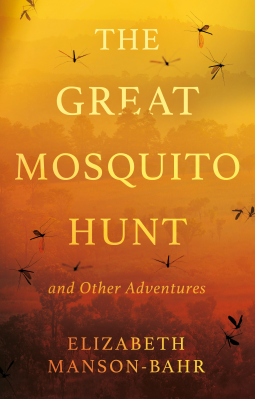
The Great Mosquito Hunt and Other Adventures
by Elizabeth Manson-Bahr
Description
This book is the author’s answer to the question Who do you think you are? set in China, Russia, Egypt, Kenya, Fiji and the US during the 18th to 20th centuries. It describes the battle to discover the causes of malaria. Sir Patrick Manson, the author’s great-grandfather, known as Mosquito Manson, was the first scientist to prove that insects were vectors of disease, a discovery which led to the detection of the malarial parasite. He founded the Chinese Medical School in Hong Kong and the London School of Tropical Medicine. Among his pupils was Sun Yat-sen, the first President of modern China.
It is the story too of plagues and pandemics, of Scottish and German merchants who made their fortunes in 19th century Egypt and 18th century Russia. The author’s mother, orphaned by the Spanish flu, made her way to Africa where she served as a FANY in 1942, marrying Clinton, the third in the family line of tropical medical specialists. The chapters are interspersed with the author’s own childhood memories growing up in Fiji and Kenya.
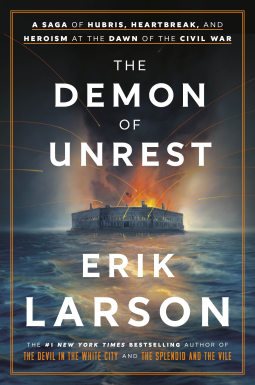
The Demon of Unrest
A Saga of Hubris, Heartbreak, and Heroism at the Dawn of the Civil War
by Erik Larson
Description
The #1 New York Times bestselling author of The Splendid and the Vile brings to life the pivotal five months between the election of Abraham Lincoln and the start of the Civil War—a simmering crisis that finally tore a deeply divided nation in two.
One of Time’s Most Anticipated Books of the Year
On November 6, 1860, Abraham Lincoln became the fluky victor in a tight race for president. The country was bitterly at odds; Southern extremists were moving ever closer to destroying the Union, with one state after another seceding and Lincoln powerless to stop them. Slavery fueled the conflict, but somehow the passions of North and South came to focus on a lonely federal fortress in Charleston Harbor: Fort Sumter.
Master storyteller Erik Larson offers a gripping account of the chaotic months between Lincoln’s election and the Confederacy’s shelling of Sumter—a period marked by tragic errors and miscommunications, enflamed egos and craven ambitions, personal tragedies and betrayals. Lincoln himself wrote that the trials of these five months were “so great that, could I have anticipated them, I would not have believed it possible to survive them.”
At the heart of this suspense-filled narrative are Major Robert Anderson, Sumter’s commander and a former slave owner sympathetic to the South but loyal to the Union; Edmund Ruffin, a vain and bloodthirsty radical who stirs secessionist ardor at every opportunity; and Mary Boykin Chesnut, wife of a prominent planter, conflicted over both marriage and slavery and seeing parallels between them. In the middle of it all is the overwhelmed Lincoln, battling with his duplicitous secretary of state, William Seward, as he tries desperately to avert a war that he fears is inevitable—one that will eventually kill 750,000 Americans.
Drawing on diaries, secret communiques, slave ledgers, and plantation records, Larson gives us a political horror story that captures the forces that led America to the brink—a dark reminder that we often don’t see a cataclysm coming until it’s too late.
 Layered Pages
Pingback: Biographies & Memoirs | Layered Pages