

Hello! I hope you all are having a lovely morning.
Having recently read, “Babylonia” by Costanza Casati and with my current studies of Biblical Culture backgrounds -which usually take years because I tend to go down rabbit holes with history studies-I decided to look at nonfiction reading of the history of the Assyrians and Babylonians. Now, growing up in Sunday School and reading the Bible, I’ve already learned quite a bit about them in the context of wars and interactions with the Hebrews one might say.
Here are three books I discovered and I’m currently reading the first one. I typically choose at least three books with subjects. I may add more the Babylonians once I’ve gotten through these. Also, Joel with Expedition Bible on YouTube has a great archaeological video on the discovery of Nineveh. Expedition Bible is among my favorite YouTube Channels. .
Have you read stories of the Assyrians and Babylonians?
Stephanie
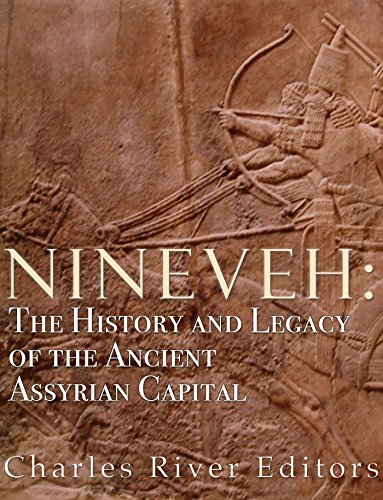
Nineveh: The History and Legacy of the Ancient Assyrian Capital by Charles River Editors
73 pages, Kindle Edition
Published- January 18, 2016 by Charles River Editors
*Includes pictures *Includes ancient descriptions of Nineveh *Includes debate over whether Nineveh was home of the Hanging Gardens of Babylon *Includes online resources and a bibliography for further reading *Includes a table of contents “I captured 46 towns…by consolidating ramps to bring up battering rams, by infantry attacks, mines, breaches and siege engines.” – Sennacherib When scholars study the history of the ancient Near East, several wars that had extremely brutal consequences (at least by modern standards) often stand out. Forced removal of entire populations, sieges that decimated entire cities, and wanton destruction of property were all tactics used by the various peoples of the ancient Near East against each other, but the Assyrians were the first people to make war a science. When the Assyrians are mentioned, images of war and brutality are among the first that come to mind, despite the fact that their culture prospered for nearly 2,000 years. Like a number of ancient individuals and empires in that region, the negative perception of ancient Assyrian culture was passed down through Biblical accounts, and regardless of the accuracy of the Bible’s depiction of certain events, the Assyrians clearly played the role of adversary for the Israelites. Indeed, Assyria (Biblical Shinar) and the Assyrian people played an important role in many books of the Old Testament and are first mentioned in the book of “And the beginning of his kingdom was Babel and Erech, and Akkad, and Calneh, in the land of Shinar. Out of that land went forth Ashur and built Nineveh and the city Rehoboth and Kallah.” (Gen. 10:10-11). Although the Biblical accounts of the Assyrians are among the most interesting and are often corroborated with other historical sources, the Assyrians were much more than just the enemies of the Israelites and brutal thugs. Among all the cities that thrived in the ancient Near East, few can match the opulence and ostentatiousness of Nineveh, the capital of the Assyrian Empire for much of the seventh century BCE. During that time, it became known for its mighty citadels, grand palaces, beautiful gardens, and even its zoos. In fact, the beauty of Nineveh, especially its gardens, impressed later writers so much that they assigned its gardens as one of the original Seven Wonders of the World, except unfortunately for Nineveh’s memory, the location was placed in Babylon. The confusion that assigned one of the Wonders of the World to Babylon instead of Nineveh is in fact a large part of Nineveh’s history – it was a great city during its time, but incessant warfare brought the metropolis to oblivion and eventually its history was forgotten or distorted. An examination of Nineveh demonstrates that in many ways it was the victim of the people who built it. When Nineveh was at its height, they controlled an empire that encompassed Egypt, Anatolia, Mesopotamia, and parts of Iran. Eventually, the Assyrians overextended themselves and their enemies overthrew them and destroyed much of their cities. Nineveh became lost for centuries, only mentioned in fragments by classical Greek historians, but modern archaeological methods were able to bring the lost city back to life in the nineteenth century. Today, through a combination of archaeological reports, classical Greek accounts, and ancient cuneiform inscriptions, the chronology of Nineveh can be reconstructed. An examination reveals that Nineveh played a vital role in the religious and political history of the ancient Near East and despite suffering immense damage at the hands of the Assyrians’ enemies, continued to function as an important city for several centuries after the Assyrian Empire collapsed.
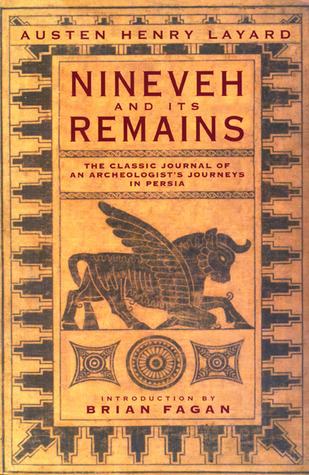
Nineveh and Its Remains by Austen Henry Layard, Brian M. Fagan (Introduction)
432 pages
First published January 1, 1849 by Lyons Pr
An intoxicating stew of compelling characters and sudden crises during the discovery of the ancient ruins of Nineveh by the foremost archeologist of his time.
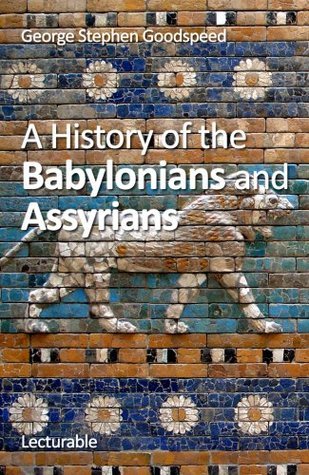
A History of the Babylonians and Assyrians by George Stephen Goodspeed
Format 295 pages, Kindle Edition
Published: January 24, 2013 by Lecturable
“Who were the people by whose energy this region was transformed into so fair and flourishing a land, at a time when elsewhere, with hardly an exception, the upward course of humanity did not yet reveal any trace of orderly and civilized conditions? What are their antecedents, and whence did they come to occupy the alluvial plain?” – George Stephen Goodspeed
“In these regions of Mesopotamia and Babylonia, so diversified in physical characteristics, the one essential unifying element was the rivers. To them a large section of the land owed its existence; the fertility and the prosperity of the whole was dependent upon them; they were the chief means of communication, the main channels of trade, the distributors of civilization. It was in recognition of this that the ancient inhabitants called the Euphrates ‘the life of the land,’ and the Tigris ‘the bestower of blessing.'” – G.S.G.
Introduction – The Lands of the Euphrates and Tigris. The Excavations in Babylonia and Assyria. The Language and Literature. Chronology and History. The City States of Babylonia and Their Unification under Babylon to 2000 B.C. – The Dawn of History. Movements toward Expansion and Unification. Civilization of Old Political and Social Life. Civilization of Old Literature, Science, Art, and Religion. The Times of Khammurabi of Babylon. 2300-2100 B.C. The Rise of Assyria and its Struggles with Kassite Babylonia – The Kassite Conquest of Babylonia and the Appearance of Assyria. 2000-1500 B.C. The Early Conflicts of Babylonia and Assyria. 1500-1150 B.C. Civilization and Culture in the Kassite Period. The Times of Tiglathpileser I. 1100 B.C. The Ascendancy of Assyria – The Ancient World at the Beginning of the First Millennium. 1000 B.C. Ashurnacirpal III and the Conquest of Mesopotamia. 885-860 B.C. The Advance into Syria and the Rise of from Shalmaneser II to the Fall Of His House. 860-745 B.C. The Assyrian Revival. Tiglathpileser III and Shalmaneser IV. 745-722 B.C. The Assyrian Empire at Its Height. Sargon II. 722-705 B.C. The Struggle for Imperial Unity. Sennacherib. 705-681 B.C. Imperial Expansion and Division. Esarhaddon. 681-668 B.C. The Last Days of Splendor. Ashurbanipal 668-626 B.C. The Fall of Assyria. 626-606 B.C. The New Babylonian (or Kaldean) Empire – The Heirs of Assyria. Nebuchadrezzar and His Successors. Babylonia under the Kaldeans. The Fall of Babylon.
 Layered Pages