Book Review: Friend Request by Laura Marshall

Friend Request II

MARIA WESTON WANTS TO BE FRIENDS. BUT MARIA WESTON’S DEAD. ISN’T SHE?

1989. When Louise first notices the new girl who has mysteriously transferred late into their senior year, Maria seems to be everything the girls Louise hangs out with aren’t. Authentic. Funny. Brash. Within just a few days, Maria and Louise are on their way to becoming fast friends

2016. Louise receives a heart-stopping email: Maria Weston wants to be friends on Facebook. Long-buried memories quickly rise to the surface: those first days of their budding friendship; cruel decisions made and dark secrets kept; the night that would change all their lives forever.

Louise has always known that if the truth ever came out, she could stand to lose everything. Her job. Her son. Her freedom. Maria’s sudden reappearance threatens it all, and forces Louise to reconnect with everyone she’d severed ties with to escape the past. But as she tries to piece together exactly what happened that night, Louise discovers there’s more to the story than she ever knew. To keep her secret, Louise must first uncover the whole truth, before what’s known to Maria–or whoever’s pretending to be her–is known to all.

My Thoughts:

When I finished this book, my whole perspective changed about social media and who you accept back into your life after years and years of not hearing from people. I kid you not. After I got through the first chapter I was completely creeped out but I couldn’t stay away. I HAD to know everything that was about to happen. A few times, I had to put the book down because of the suspenseful content. However, that is a good thing, right? I have to admit, I was pretty tense reading this story and as I understand it, this is the authors debut novel. Just, wow! Friend Request is just about the best thriller I have read all year.

The story reminded me how much teenagers can be so cruel and the consequences that come after by that cruelty. Louise boggled my mind as her story unfolds. She is an adult but is still very much stuck in the past and when the past comes a knocking full force, instead of just telling the truth to the police, she creates more danger for herself and the people around her. I’d have to say that is the thrill and suspense of the story however, and it was told really well. There were some twist and turns I didn’t see coming and the ending was so sad but a good conclusion to the story.

I will certainly be more careful what I share to the public!

I have obtained a review copy from the publishers through NetGalley.

I have rated this book four and a half stars.

Stephanie M. Hopkins

Book Review: The Broken Girls by Simone St. James

The Broken GirlsThe Broken Girls by Simone St. James

Berkley Publishing Group

Berkley

Mystery & Thrillers

Pub Date 20 Mar 2018

Description

Vermont, 1950. There’s a place for the girls whom no one wants–the troublemakers, the illegitimate, the too smart for their own good. It’s called Idlewild Hall. And in the small town where it’s located, there are rumors that the boarding school is haunted. Four roommates bond over their whispered fears, their budding friendship blossoming–until one of them mysteriously disappears. . . .

Vermont, 2014. As much as she’s tried, journalist Fiona Sheridan cannot stop revisiting the events surrounding her older sister’s death. Twenty years ago, her body was found lying in the overgrown fields near the ruins of Idlewild Hall. And though her sister’s boyfriend was tried and convicted of murder, Fiona can’t shake the suspicion that something was never right about the case.

When Fiona discovers that Idlewild Hall is being restored by an anonymous benefactor, she decides to write a story about it. But a shocking discovery during the renovations will link the loss of her sister to secrets that were meant to stay hidden in the past–and a voice that won’t be silenced. . . .

My thoughts:

What makes a story? There are several answers to this question. When I read The Broken Girls, several things came to me. Most importantly truth in storytelling and how an author pulls it off. I am all for character development, plot driven stories. They are vital and this story has that but what about truth? Truth in human emotions. Truth in exploring one’s past. Truth in what haunts us. I can honestly say that St. James is an author to follow in these attributes of well-drawn stories. She really connects you to the characters and their story. That is truth. Each character has their own struggles and it brings the plot together in a delicious package of mystery, friendships heartache and meaningful human connections.

I was also delighted to feel a bit creeped out by the small town and the boarding school. The author makes you want to explore the ruins of Idlewild Hall and its past even further. I could easily read another story about the characters and location. Meaning, I didn’t want this story to end!

I can’t really pinpoint which characters stood out to me the most. They were all strong and interesting in this story and I sympathized with them all.

I really like the premise of a journalist who goes to no end to reveal the mystery surrounding her sister’s death and how the present day connects to the past in more than just one way.

I have to say that I feel sorry for the readers who have to wait to read this story when its published. The Broken Girls is truly an amazing story that has captivated me to no end and Simone St. James is my new favorite author! A must read.

I have rated this book five stars!

I obtained a copy of this book from the publishers through NetGalley.

Stephanie M. Hopkins

Characters in Motion With Lindsay Downs

Lady Jolene’s antagonists and how she deals with them.

As the oldest child and senior daughter to The Right Honorable, The Earl and Countess of Hampshire, Lady Jolene Markson is supposed to be able to hold her emotions in check. Nothing should upset or worry her.

Well, that’s not entirely true. There are several people and groups which annoy her to no end. Her antagonists.

At the top of this list is the Metropolitan Police Service, the Met.

As with her parents who had to deal with Bow Street and their runners, Jolene finds the Met to be useless for the most part. Frequently she points out they will find a suspect, guilty or not, and claim they have the criminal. More often than not this person hires her to prove their innocence, which she does with great regularity.

When presented with a case Lady Jolene does her best to make sure they, the Met, learn nothing of what she has found. It’s not that she wishes to make them look bad, they can do that without her assistance.

To Save a Lady by Lindsay GrahamIn the case set forth in To Save a Lady she easily proves to the investigating officer, Thomas Spencer, there was no way his prime suspect, Miss Julia Patrick, could have murdered the young man. He then offers his, without his superiors’ knowledge, assistance in bringing the criminal(s) to justice.

At first Lady Jolene had her reservations about allowing Spencer to partake. Her thoughts change when she notices an affection developing between him and Julia. Eventually Jolene comes to trust him but makes it very clear Spencer is the exception as she will still work to embarrass the Met.

It goes without saying, but I will anyways, her younger brothers and sisters do tend to antagonize her. With them, depending on what they do she usually doesn’t tell on them but deals with the troublesome one on her own.

Without a doubt, though, Lady Jolene’s worst antagonist is none other than The Most Honorable, The Marquis of Lange aka. Brendon.

They had first met years ago and for the most part grew up together. The reason, his parents and her godparents are His and Her Grace, The Duke and Duchess of Clarion.

For Lady Jolene his most annoying trait, sticking his nose into things that aren’t any of his business. He tries to steer her away from possible danger and she constantly resists. Even though they tend to be at each other’s throats at times it is in reality more of a love-hate-love relationship.

She does have one way, and it’s priceless, of keeping him in line. Her collie, Samson. More often than not the dog achieves the desired purpose. Annoy Brendon by his presence.

Well, my good ladies and gentlemen those are the primary antagonists in Lady Jolene’s life. Yes, Stephanie asked for five of them and I presented three. Well, actually more if you were to count her siblings, the officers at The Met along with Brendon and the years of antagonism between him and Jolene.

If I was a nice guy, of course then I wouldn’t be driving my readers crazy with red herrings and cliffhangers I would tell you a secret. Then again, if I did that then it would be a secret. You’ll have to buy To Save a Lady.

Buy Links-

US

UK

About me-

Lindasy Graham II

I’ve been an avid reader ever since I was old enough to hold a red leather bound first edition copy of Sir Walter Scott’s The Lady of the Lake in my lap.

So, it only seemed natural at some point in my life I take up pen and paper to start writing. Over time my skills slightly improved which I attribute to my English teachers.

My breakthrough came about in the mid 1970’s when I read a historical romance written by Sergeanne Golon, Angelique. This French husband and wife team opened my eyes to the real world of fiction. Stories about romance, beautiful damsels, handsome heroes and plots which kept me hooked. Of course, being a man, I had to keep my reading hidden from others as that wasn’t appropriate reading for men.

With this new-found appreciation of the written word I took up other books and devoured them as a starving person would a plate of food. I them attempted to write again. I still wasn’t satisfied so I put it aside for years as other events entered my life.

Finally, in the early years of the new millennium I tried again to write and once again met with limited success. At least now I was able to get past the first page or two. Then, in 2006 a life changing event brought me back to my love, I took a job as a security officer. This allowed me plenty of time to read different genres.

My favourite was regency. As I poured through everyone I could get my hands on I knew this could be something I wanted to attempt.

Since 2012 when my debut regency romantic suspense released I was hooked and have, except for a few contemporaries, focused on this genre.

Since 2012 I’ve lived in central Texas. I’m also a member of Romance Writers of America and the Austin, TX chapter.

Where you can find me-

Facebook

Facebook Pages

Twitter- @ldowns2966

LinkedIn

Goodreads

Lindsay Downs-Romance Author

Amazon

Characters in Motion with Meghan Holloway

“Often times the best inspiration comes within us.” Writer Meghan Holloway shares with us how she fleshes out her characters to drive the plot.

************

Storytelling is, at heart, an exploration of the human condition. More than evocative imagery or lyrical prose or a captivating plot, a story must have a character at its center in whom I can invest.

Achieving a fully-fleshed character is one of the most challenging aspects in writing. Creating a paragon or a villain is a simple thing, but also a flat and unsatisfying achievement. Building a well-rounded character—humane, flawed, fallible, and nuanced—is a task as formidable as it is rewarding.

We writers tend to be a solitary lot for we pursue a sequestered craft. We are watchers, though, sentinels of interaction, cartographers of existence. It is through this lifelong pursuit of observation that we find the lens through which to view the human experience and the clay with which to build our characters.

When I tell a story, I have a two-fold beginning:  I have a plot arch in mind first or a particular setting and event in history I want to explore; but the key piece that moves this germ from idea to tale is character. The plot is what creates the arc of storytelling; the character is the vehicle in which the reader is transported.

Meghan Holloway

About Author:

Meghan Holloway

“My dearest darling …” That was how my grandfather began all of his letters to my grandmother while he was stationed in Okinawa in World War II. I never knew my grandfather, but I’ve poured over his letters. I used to draw lines up the back of my legs, just as my grandmother had as a young woman whose nylons had been donated to make parachutes, and I’ve endlessly pestered my paternal grandfather for stories of his childhood and service. The worn letters and patiently-told stories cemented my interest in history, especially in the WWII era.

I found my first Nancy Drew mystery in a sun-dappled attic at a friend’s house and subsequently fell in love with the grip and tautness of a well-told mystery. I flew an airplane before I learned how to drive a car, did my undergrad work in a crumbling once-all girls school in the sweltering south, spent a summer and fall in Maine picking peaches and apples, finished my graduate work in an all-girls school in the blustery north, and traveled the world for a few years. Now I’m settled down in the foothills of the Appalachians, writing my third and fourth novels, and hanging out with my standard poodle.

Author Links:

Facebook

Twitter

Website

Cover Crush: A Darker Sea: Master Commandant Putnam and the War of 1812 (A Bliven Putnam Naval Adventure) by James L. Haley


Cover Crush banner

I am not a cover designer but I can agree that cover layouts play an important role in the overall presentation of stories and I must admit, often times I first judge a book by its cover.

**********

A Darker SeaAbout the book:

A Darker Sea: Master Commandant Putnam and the War of 1812 (A Bliven Putnam Naval Adventure)

by James L. Haley

400 pages

Publisher: G.P. Putnam’s Sons (November 14, 2017)

The second installment of the gripping naval saga by award-winning historian James L. Haley, featuring Commander Bliven Putnam, chronicling the build up to the biggest military conflict between the United States and Britain after the Revolution—the War of 1812.

At the opening of the War of 1812, the British control the most powerful navy on earth, and Americans are again victims of piracy. Bliven Putnam, late of the Battle of Tripoli, is dispatched to Charleston to outfit and take command of a new 20-gun brig, the USS Tempest. Later, aboard the Constitution, he sails into the furious early fighting of the war.

Prowling the South Atlantic in the Tempest, Bliven takes prizes and disrupts British merchant shipping, until he is overhauled, overmatched, and disastrously defeated by the frigate HMS Java. Its captain proves to be Lord Arthur Kington, whom Bliven had so disastrously met in Naples. On board, he also finds his old friend Sam Bandy, one of the Java’s pressed American seamen kidnapped into British service. Their whispered plans to foment a mutiny among the captives may see them hang, when the Constitution looms over the horizon for one of the most famous battles of the War of 1812 in a gripping, high-wire conclusion. With exquisite detail and guns-blazing action, A Darker Sea illuminates an unforgettable period in American history.

My thoughts on the cover:

My good friend and fellow book blogger Erin shared a book at her Flashlight Commentary Facebook Page that caught my eye instantly! I told her I wanted to use the cover for my cover crush. Not only does the cover capture my attention but the history and premise does as well in a big way. I have not read any books by this author and I am trying to figure why I haven’t before!

I am really into American and British History and the time period- so this story is perfect for me. The cover is really powerful and full of color, depth and action. I hope it is as good as it looks and sounds! 

Stephanie M. Hopkins

 **********

Cover Crush is a weekly series that originated with Erin at Flashlight Commentary. Other great book bloggers who cover crush:

Heather @ The Maiden’s Court

Magdalena @ A Bookaholic Swede

Holly @ 2 Kids and Tired Books

Colleen @ A Literary Vacation

Meghan @ Of Quills & Vellum

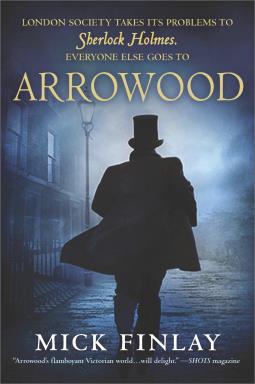
Book Review: Arrowood by Mick Finlay

Arrowwood new bookReview Arrowood by Mick Finlay

Harlequin (US & Canada)

MIRA

Historical Fiction

Pub Date 18 Jul 2017

Description

1895

London Society takes their problems to Sherlock Holmes. Everyone else goes to Arrowood.

The Afghan War is over and a deal with the Irish appears to have brought an end to sectarian violence, but Britain’s position in the world is uncertain and the gap between rich and poor is widening. London is a place where the wealthy party while the underclass are tempted into lives of crime, drugs and prostitution. A serial killer stalks the streets. Politicians are embroiled in financial and sexual scandals. The year is 1895.

The police don’t have the resources to deal with everything that goes on in the capital. The rich turn to a celebrated private detective when they need help: Sherlock Holmes. But in densely populated south London, where the crimes are sleazier and Holmes rarely visits, people turn to Arrowood, a private investigator who despises Holmes, his wealthy clientele and his showy forensic approach to crime. Arrowood understands people, not clues.

My thoughts:

Sherlock Holmes is not the only private detective in London and if he has competition, it still remains to be seen. Arrowood and Barnett are hard press for a client and when a woman appears at their office seeking help to find her brother, the two detectives reluctantly decide to help her. Before they know it, they find the case more of a challenge than they thought. One of their potential witnesses ends up dead early on in the investigation and things get really heated after that.

Arrowood is an arrogant, silly man in many ways in my opinion. He annoyed me to no end. I have a feeling this might be the author’s goal for this character. As least I hope since I’ve been brutally honest about how I feel about him. The question is Arrowood’s characterization important for the story? There were a few times I wanted Barnett to slap him stupid. Though I have to admit his method in finding clues and questioning witnesses is an interesting one. He seemed to pride himself in being the opposite of Sherlock and had no problems in expressing that-too often in my opinion. Having said that, there were times I felt sympathy for him. Maybe just a little. If it weren’t for Barnett, the story wouldn’t hold much weight for me. I wish Sherlock had come along to shake things up.

I would like to add that I felt there were too many characters in the story. At times, it was a bit of a challenge to keep up. However, I do understand that in order for detectives to solve a case, they must interact and talk to a lot of people. Still…

The ending was satisfactory. In a nutshell, this was just an okay read for me. I expected more…

I rated this book a generous three stars.

I obtained a copy of this book from the publishers through NetGalley.

Stephanie M. Hopkins

DNF: Girl in Snow by Danya Kukafka

Girl in SnowGirl in Snow

by Danya Kukafka

When a beloved high schooler named Lucinda Hayes is found murdered, no one in her sleepy Colorado suburb is untouched—not the boy who loved her too much; not the girl who wanted her perfect life; not the officer assigned to investigate her murder. In the aftermath of the tragedy, these three indelible characters—Cameron, Jade, and Russ—must each confront their darkest secrets in an effort to find solace, the truth, or both.

************
My thoughts:

I was excited about starting this book over Labor Day weekend. I wasn’t working and had carefully chosen the books I wanted to read. Girl in Snow was second on my list. When I first started reading this book, I really found the characters interesting except for Lucinda. The story starts off with her being dead but you really don’t connect to her and you don’t feel sympathy-at least I didn’t.

As I got further in the story it started to fizzle and fizzle quick. I got about 20% in and realized this probably won’t be a finish read for me but I rallied on a little longer to see if it got better. Half way through the book, I gave up. When a person writes a thriller and there is nothing thrilling about it…ahem, go back to revisions! I know that sounds really harsh but it needed to be said. Don’t get me wrong, the premise is great and the characterization had potential for a physiological thriller but it missed its mark.

Another thing, I needed more dialogue and action coming from the characters! Showing in is very important in story-telling.

I am not rating this book since I did not finish it.

I received a copy of this book from the publishers through NetGalley. I feel bad for not liking this story but felt necessary to give my honest opinions why I did not finish the book.

Stephanie M. Hopkins

Characters in Motion with Historical Fiction Writer Judith Arnopp

Judith Arnopp II

Margaret Beaufort – The Beaufort Chronicles Books 1 – 3

Hi Stephanie, I am so happy to be part of your new series of blogs; thank you so much for including me.

As you know the characters in my books are historical figures from English history, mostly of the late medieval and Tudor period. They have all been written of before, many, many times but I enjoy adding my own version to the traditional view. Although I wouldn’t call myself a revisionist, I do like to find a different perspective. Instead of recording what they did, I like to consider why they did it. This is often difficult to judge from the outside; I like to hone in on the inner self and reveal the part of us that we often prefer to keep hidden from the world.

By far my most challenging protagonist so far has been Margaret Beaufort. Margaret appears in many novels set around the Wars of the Roses and is usually depicted as a negative character, a schemer and plotter. She has even been cast as a potential murderer of the missing princes in the Tower although my research has thrown up nothing to suggest that was so. My novels that comprise The Beaufort Chronicles illustrate the events of the Wars of the Roses through Margaret’s eyes, and trace the changes in her character as she grows from a child of eight to a woman of mature years, the mother and grandmother of kings and queens.

Before I began writing I had to consider why Margaret has been depicted so negatively and this research brought me to her portraits. The only surviving representations of Margaret were taken in later life, after her son won his crown. She presents a pious pose, in the attitude of prayer, or clutching a book, the symbol of great learning. I think this dour image may explain why she has not been the heroine of many novels but Margaret clearly wasn’t born old. Even old women have known youth and love. She was once young, records indicate she possessed a sense of humour, favoured red gowns, and had a great love of finery both in clothing and furnishings. Margaret’s resilience is astonishing. She puts me in mind of a beetle that can’t be crushed. Her journey from the child bride of Edmund Tudor to whom she bore a son at the age of thirteen, to the mother of the first Tudor king is really quite incredible.

At the beginning of the wars between Lancaster and York, Margaret and Henry were relatively insignificant members of the House of Lancaster. After Henry VI’s demise and the death of the Prince of Wales, Edward of Lancaster, Margaret and Henry were suddenly thrown into the spotlight. While Henry was exiled, Margaret began to fight her son’s battles – and she fought ceaselessly to that end for the rest of her life.

Under the reign of Edward IV she petitioned the king for her exiled son’s properties and titles to be restored. She was on the brink of obtaining this when Edward died suddenly in 1483 and England was cast once again into chaos. Margaret was at the centre of activities during Richard III’s acquisition of the crown, she served him loyally at first but at some point midway during his reign, she changed tack and began to plot with Elizabeth Woodville. Together they raised money and support for an army to bring Henry Tudor home. But, on the eve of the Battle of Bosworth Margaret had no idea what the outcome would be. Under house arrest she could only pray, her nerves in tatters as she waited to discover if her actions had resulted in triumph for the Tudors or in the death of her only son.

Most women, especially on the winning side, would be applauded for these actions, hailed as a heroine but Margaret is always seen rather differently. She has become the archetypal interfering mother in law, the cold hearted pious busy body, a critic of the etiquette of the royal court. To some extent these things are true but there was also another side. She was loyal, forgiving, careful of the welfare of her household, and a great benefactress of churches and colleges throughout the realm. I felt it appropriate that she be given the opportunity to present her own version of events.

Margaret prays a lot – most people did in the middle ages. She meditates. She likes to garden and is interested in healing, her still room is well supplied with remedies. She passed this habit on to her grandson, Henry VIII, who was terrified of contagion, and also liked to dose his household when they fell ill.

Margaret possessed a dry humour and I have embellished this in my books. She has a wicked wit, and when she chooses, she can make the most biting of replies. During her years of struggle she is often a victim but she plays the long game. She serves Elizabeth Woodville faithfully, gains her friendship, visits her in sanctuary and comes to know the royal children, including her future daughter in law, Elizabeth of York and the younger of the princes, Richard of Shrewsbury. After becoming involved in Buckingham’s rebellion her life was in King Richard’s hands but he chose leniency and placed her under house arrest, in the custody of her husband, Thomas Stanley. But she didn’t give up.  Margaret had absolute faith that God was on her side. When the time came for her to move against Richard III, she financed Henry, risking both her security and position. Without doubt, Margaret Beaufort is the most heroic women I have ever written about.

Her insecure environment sometimes makes her prickly, defensive and seemingly proud. In public she adopts a confidence that she doesn’t really feel. Each decision she makes, she makes blindly – the reader and I are privileged by hindsight and know she will triumph but when I am writing, I have to remember Margaret was on a knife edge, in dangerous times and her life was often in peril. Throughout The Beaufort Chronicles Margaret is isolated, in conflict with the world but she is possessed of such courage and strength that she achieves all her desires. On reaching her goal however, she discovers that fate isn’t done with her just yet.

Because I write in the first person, I am in a sense, stepping into Margaret’s shoes and moving through the events of the Wars of the Roses. When I am writing I become Margaret. I don’t always stick to the traditional motivations because I am writing from the inside. Her relationships are varied. Her devotion to her son, from whom she is exiled for fourteen years until the day after Bosworth, is unswerving. Although she serves Edward IV’s queen her loyalty to Lancaster does not change but self-preservation is her only way forward. Records indicate that she and Elizabeth Woodville worked together in Henry’s cause and I have developed the relationship into a cautious friendship. She wants to trust Elizabeth but she is wary, never sure. Margaret finds it difficult to trust anyone which is not surprising when you consider her experience.

After Henry finally made good his promise to marry Elizabeth of York, Margaret’s relationship with her daughter in law develops over time into friendship and admiration. This may not have been the case had Elizabeth not been so compliant for there is no doubt that Margaret liked to be in charge. She ordered how Henry’s court should be run, how the apartments should be furnished, how the children should be raised – and Elizabeth seems not to have minded too much, although there are a few instances when she rebelled, or stood her ground.

In my books it is Margaret’s innermost thoughts and opinions that flesh her character. For instance when she encounters someone or something she shares her private opinion with the reader, criticizes manners, the style of dress, assesses each man’s loyalty to her son, their possible usefulness in her quest. In these books Margaret’s opinions are the only ones that are relevant because she is telling her own story. This way, Margaret’s experiences (hopefully) become the reader’s and her joys, happiness, fears and grief are immediate.

Her relationship with her four husbands took some consideration on my part. Margaret was first married as an infant to John de la Pole, the seven year old son of the Earl of Suffolk. After the Earl’s disgrace, the marriage was annulled and she was married instead to Henry VI’s half-brother Edmund Tudor, Earl of Richmond who was in his mid-twenties. Her second marriage took place when she was just twelve or thirteen years old. Usually the marriage would not have been consummated but Edmund could not take possession of her lands until she bore a son. I could have taken the route of an unhappy forced union but there are no records of Margaret ever showing resentment toward Edmund; she spoke gently of him and in her will she asked to be interred with him at Grey Friars in Carmarthen but the request was ignored. Had she born him any ill will I don’t think she would have asked to be laid with him. I chose to develop the relationship. Edmund is her protector, her husband, the father figure she lacked, and Margaret forms a sort of teenage crush for a man her senior by around thirteen years. Some authors have chosen to demonize Edmund Tudor and turn him into a child abuser but it was the fifteenth century – a different world, we shouldn’t judge by modern day standards.

Her third husband, Henry Stafford, was her own choice. Not a love match but chosen for protection and to prevent her being married off politically for a second time. Although her son, Henry, remained in the custody of his uncle, Jasper Tudor, she and Stafford visited him several times in Wales and sent regular letters and gifts. Stafford died from wounds sustained at the Battle of Barnet where he fought for York. Their marriage seems to have been content, with a slight breach when he declined to fight for Lancaster but supported Edward IV. During this period I allowed Margaret to become stronger, more headstrong and determined to be accepted at the Yorkist court so she could win back her son’s lands.

Stafford’s death after the Battle of Barnet left her vulnerable and, once more at the mercy of fortune hunters, she made the tactical choice of allying herself with Thomas Stanley, a powerful baron, high in the king’s favour. This opened the way for Margaret at court and all that came after. There is very little about her relationship with Stanley but it seems they were tolerant of each other. They lived apart for much of the time but visited and remained on good terms. I had some fun with this relationship. Margaret took control of my pen and showed a Thomas who was a bit of a likeable fool with an abrasive manner and little patient with the niceties of court. He reveals to Margaret a sensuous side of her nature she had previously ignored, a complexity that she wrestles to come to terms with. At the time of their marriage they needed each other, once Henry became king and Margaret was no longer in need of Stanley’s influence or protection, their relationship settles into one of irritated tolerance.

Each step Margaret takes along the path to her destiny is littered with difficulties. Even after her son has won his crown and she has the highest position at his court, she is still beset with doubt. She and Henry find it hard to trust – little wonder at the mire of treason and betrayal they have negotiated. Henry Tudor’s reign, particularly the early part, is beset with uprisings, pretenders to his throne, traitors in his court. Neither he nor his mother can rest easy. Every curtain conceals a dagger, and every closed door hides another plot against them.

At one point Henry finds some consolation. He has three sons to follow him and he has just secured the longed for alliance with Spain by marrying his heir to the Infanta, Catherine of Aragon. The Tudor dynasty is at last secure, their bloodline stretching endlessly ahead. But, one by one, the children begin to die.

Child mortality was commonplace in the middle ages but devastating nonetheless. Having already lost a daughter, Elizabeth, in 1495, tragedy struck again. First, sixteen month old baby Edmund died in 1500. The royal couple would scarcely have recovered when their pride and joy, the royal heir, Prince Arthur of Wales died at Ludlow in 1502. Henry and Elizabeth with just one son to follow them, immediately began to try for another. A daughter was born to Elizabeth in 1503 but tragically Elizabeth herself did not survive. She was taken ill a few days later and died suddenly, her newborn daughter followed soon after. Henry Tudor was left with just one son, his heir who was later crowned King Henry VIII.

The king died in 1509. Seemingly, at the age of sixty-six, Margaret’s reason for living had ended and she survived him by just two months.

About Judith:

Judith lives on the coast of Wales in the UK with her husband John. She studied creative writing and Literature at university and went on to study for a master’s degree in medieval studies. She now combines those skills to craft historical novels, short stories and essays.

Judith Arnopp website

Amazon Profile Page

Judith A banner