Inerview with Author Deborah Swift

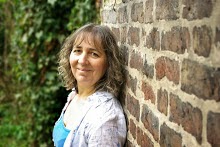
Author  Deborah Swift

Stephanie: Deborah Swift used to work in the theatre and at the BBC as a set and costume designer, before studying for an MA in Creative Writing in 2007. She lives in a beautiful area of Lancashire near the Lake District National Park.  She is the author of The Lady’s Slipper and is a member of the Historical Writers Association, the Historical Novel Society, and the Romantic Novelists Association.


Hello Deborah! It is a pleasure to chat with you again. Please tell me about your book, A Divided Inheritance. 


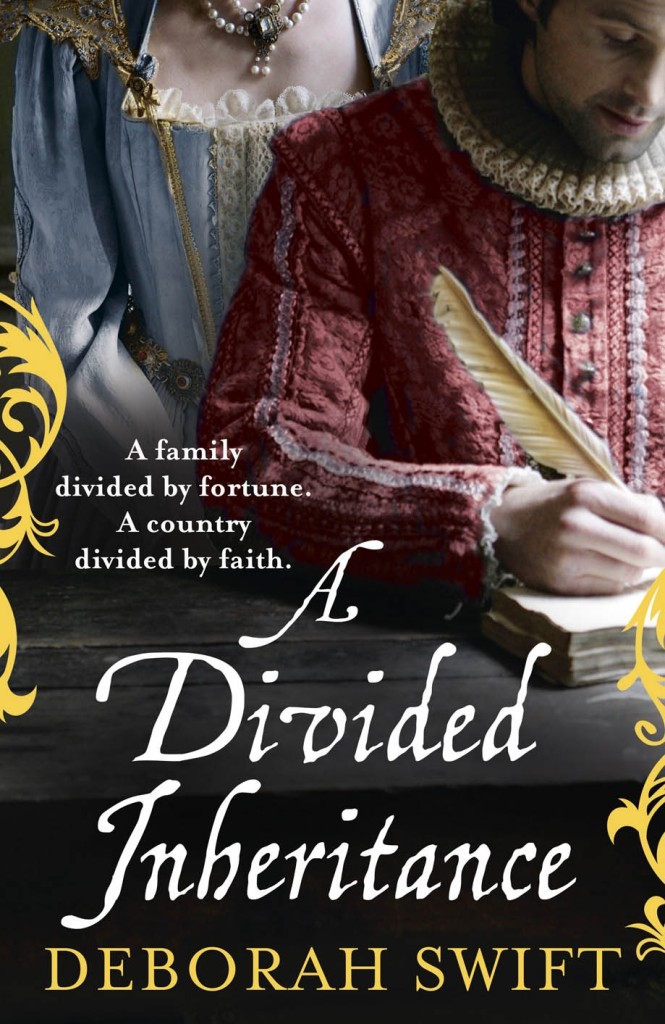
A Divided Inheritance is about Elspet Leviston, a lace-trader’s daughter who loses her inheritance to a mysterious cousin – the hot-headed swordsman Zachary Deane. Elspet must leave her beloved English home and go to Seville to confront him. On the way she finds courage persistence, and much greater self-reliance. She also finds love in unexpected places.

 deborah's book

Stephanie: How much research was involved and will you please tell me a little about it?


Each of my novels takes about eighteen months. For this novel I researched by using archives and museums for the part set in London, and then I travelled to Seville to take photographs and visit locations for the Spanish part of the book. I also corresponded with various experts on swordplay, the almost-forgotten Morisco culture, and the art of lace-making.


Stephanie: What was your inspiration for this story?


I wanted a strong female protagonist, but found it was hard to give my heroine much of importance to do in the shuttered society of seventeenth century London. In the end I decided I would have to make her grow strong through the events of the book. This proved to be a much more satisfying arc to write.

At the same time as I was mulling over this, I came across a fascinating book about 17th century fencing masters and thought it would be interesting to research women who fought using rapiers and to find out more about whether any women used these training techniques. I have an interest in this through practising swordplay through martial arts. The particular Spanish training method I was researching is an esoteric system designed to produce a kind of ‘Renaissance man’ – or in this case, woman. I was also interested in a period of history in Spain where there was massive cultural change and Phillip II expelled a large population of Spanish citizens – an act that divided families and was to impoverish Spain for generations. So this seemed an ideal backdrop for my family drama.

Stephanie: Tell me a little about Elspet Leviston. What are her strengths and weaknesses?


At the beginning of the book she fits into a role cast for her by her old-fashioned scholarly father. When things go wrong she must find persistence and courage to get what she wants. Her journey leads her to discover there are many ways to live, and opens her eyes to new possibilities.


Stephanie: If your story was to become a movie. Which actor/actress would you like to see playing the lead character from your book?


I was very impressed with the film ‘Alatriste’ which I watched for some of my research into the Spanish fighting arts, and so I’d go for Viggo Mortensen. I also loved him in Lord of the Rings. For the female lead role I would choose Anne Hathaway who when she played Jane Austen had the quality of Englishness appropriate for my female lead Elspet Leviston..


Stephanie: Where is your favorite place in your home to write?


Generally I write from my home office on an ancient computer, but my favourite time of year is the summer when you can find me with my stack of notebooks and research books in our garden summerhouse.


Stephanie: Do you have a favorite coffee or tea by your side while writing?


Tetley tea and a chocolate brownie (I hope!)


Stephanie: Who are your influences?


Anything and everything. I read voraciously – all sorts of things, not just historical. I’m in a book club too, so I read stuff for that. I analyse what works and what doesn’t in terms of storytelling to try to improve my craft. I like listening to radio and reading poetry too, so I guess it all seeps in somehow.


Stephanie: What book project are you currently working on?


I’m working on a Teen novel about a real 17th century character. I’ve never attempted a teen novel before, but thought it would be nice to tempt some younger readers with a love of English history!


Stephanie: Where can readers buy your book?


e-book from Amazon US http://www.amazon.com/A-Divided-Inheritance-ebook/dp/B00CYM19CA/

e-book from Amazon UK http://www.amazon.co.uk/A-Divided-Inheritance-Deborah-Swift-ebook/dp/B00CYM19CA/


UK Paperback from Amazon UK or bookshops http://www.amazon.co.uk/A-Divided-Inheritance-Deborah-Swift/dp/033054344X/

US Paperback from Book Depository http://www.bookdepository.co.uk/Divided-Inheritance-Deborah-Swift/9780330543446


Many thanks to Stephanie!

You can find me on twitter @swiftstory

Or at www.deborahswift.com


Link to Tour Schedule: http://hfvirtualbooktours.com/adividedinheritancetour
Twitter Hashtag: #DividedInheritanceTour

banner for deborahs tour


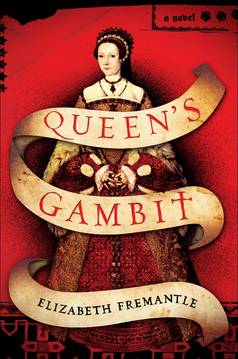
Interview with Author Elizabeth Fremantle

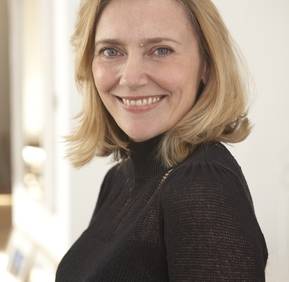
Elizabeth F

Elizabeth Fremantle holds a first class degree in English and an MA in Creative Writing from Birkbeck College London. She has contributed as a fashion editor to various publications including Vogue, Elle and The Sunday Times. QUEEN’S GAMBIT is her debut novel and is the first in a Tudor trilogy. The second novel, SISTERS OF TREASON, will be released in 2014. She lives in London.

For more about Elizabeth and her future projects see www.elizabethfremantle.com.  You can also find her on Facebook, Twitter and Goodreads.

Hello Elizabeth! Welcome and thank you for chatting with me today. Please tell me about your book, Queen’s Gambit. I’ve heard nothing but wonderful things about your story.

Elizabeth Hello to you, and thank you so much for hosting QUEEN’S GAMBIT on your blog. I’m obviously delighted that you have heard such good things about it. When you launch a first novel it’s impossible to imagine how people will react, so the lovely things people have said are a source of great joy.

QUEEN’S GAMBIT tells the story of Katherine Parr, the wife who ‘survived’ Henry VIII, describing the period from when she first catches the eye of the King until the demise of her disastrous fourth marriage. It is told from three points of view: that of Katherine Parr, her doctor Robert Huicke and her maid Dot Fownten, giving a prism of perspectives on the Tudor court at a time of great turbulence.

When did you fist become interested in this period and when did you know you wanted to write your story?

I have always enjoyed reading history and read Jean Plaidy voraciously as a child, which is when the seeds were sown for my own historical fiction. It was when I first read Stephan Zweig’s two wonderful historical biographies (of Marie Antoinette and Mary Queen of Scots) in my early twenties that my desire to discover more about the lives of women from history was born. However having studied English as a degree, I felt I wasn’t qualified to write about history. So my first (unpublished) novels were contemporary fiction but I failed to find my voice, until I decided to try my hand at writing the past. Once I began work on QUEEN’S GAMBIT everything seemed to fall into place – it was as if I’d unlocked something in myself and began to realize that much of what I had learned reading English was also history. It all comes down the study of texts.

Queens Gambit

What is some of the research you did and what fascinates you most about the royal court surrounding this story?

So much of my research is textual and there are some extraordinary biographies of Katherine Parr but I also explored renaissance etiquette books, recipe books and social histories as I felt it was of great importance to create as close to an authentic world for my characters to inhabit. I spend a great deal of time wandering around old houses and castles, trying to imagine myself back in time. A course I took in Tudor and Stuart clothing, looking at all aspects of dress, from its construction to its symbolic value, was invaluable as I have used clothing to represent the restricted lives of women in the book. Research is an on-going process and inspiration can come from the most unlikely places. A documentary series about Amish women, for example, gave me insights into the lives and beliefs of Tudor women, as they operate under some of the same social restrictions.

As for the court, it is the constant sense of impermanence and danger that I find particularly fascinating. These people, however privileged, were living on a constant knife-edge and I wanted to articulate that in QUEEN’S GAMIT.

You have certainly done a lot of research and I’m sure it’s paid off. I love visiting old homes and hope to visit castles one day. I often wonder at times how the people at court could stand it for so long and the pressure they were constantly under….

Katherine Parr is my favourite among King Henry’s wives.  What sets your book apart from others about her? And were there any challenges writing about her?

Katherine Parr was a gift in the sense that her life is a perfect narrative arc with drama, romance and ultimately tragedy. I have tried to show her as the vibrant, politically astute and intelligent woman she was, rather than the dull nursemaid that history has remembered her as. But one of the things that interested me most about her is the essential contradiction in her character, in that she, a clever, canny woman, makes a disastrous decision in the name of love. For me this is what makes her story resonate with modern women.

To be honest, I have never read another novel about Katherine Parr, only historical biographies, so I am not the person to ask about comparisons, but each novelist will have created her in her own particular way. What I have tried to do is get beneath her skin and understand how she might have thought and felt (how might it have truly felt to be the wife of such a tyrant) whilst adhering as much as possible to the historical facts as we know them.

What is the most challenge thing to write about Historical Fiction and what advice would you give someone who is considering writing in this genre?

I suppose the challenge is getting the balance of fiction and history. For me it was important to remain faithful to history but it is the inner worlds of characters that make for good fiction and creating characters, even those based on real people, is an act of imagination. I find having a restrictive framework of history to work within forces you to explore different narrative possibilities more deeply, but it can be frustrating at times. In QUEEN’S GAMBIT, for example, a main character dies half-way through the narrative – that is something I couldn’t change and had to find a way for that death to make sense within the arc of the story.

My advice is to do all your research, then set it aside and write your story without trying to pack it full of evidence of your knowledge. One of the greatest complements I have received is that QUEEN’S GAMBIT wears its research lightly.

How long did it take you to write your story? Will you write others that take place in this period?

From start to finish QUEEN’S GAMBIT took about eighteen months but it came at the end of a ten-year period of writing fiction (an MA in Creative Writing and three unpublished novels). I had said to myself that I would have to stop if I didn’t find a publisher for it. Happily it has worked out for the good and I have realized that the wilderness years all contributed to honing my skill as a writer.

I have written the second in my Tudor trilogy. SISTERS OF TREASON is out next year and is about the two younger sisters of Lady Jane Grey, a pair of girls who were born dangerously close to the throne at a time of great instability. It begins in Mary Tudor’s bloody reign but when Elizabeth comes to the throne things become increasingly difficult for the Grey girls. In SISTERS OF TREASON, though we don’t revisit any of the main characters from QUEEN’S GAMBIT we are reacquainted with some of the characters in the background, and of course the two Tudor princess, watching their rise to the throne and the consequences of this.

Tough question. What are your thoughts on the Reformation and how the Church of England was established?

I find it impossible to have a straightforward opinion on this because in many ways the Reformation was a force for good, in that it counteracted a deeply corrupt Catholic church and offered ordinary people a way to think, read and learn about faith in a personal and intimate way. Some of the violent acts perpetrated in the name of religious reform though, were unconscionable. But then again religion and politics were inextricably linked in those days and faith was used as a means to control people. You only have to think of the horrors of the Spanish Inquisition or the 280 odd Reformers who were burned in Mary Tudor’s reign to understand that terrible things were done in the name of both Catholicism and reform, but such acts were political at heart. It does make me deeply sad though, when I visit the ruins of the great monasteries and abbeys in England and wonder about the violent erasure of a tradition that had persisted for centuries and all the beauty and tradition that was lost forever.

I agree with you. How often do you get a chance to read for pleasure and what is the name of the book you have just read?

All reading is a pleasure for me, even if it is work, but I am on holiday at the moment, with a stack of novels on my Kindle to read without having to make notes.  The book I am reading today is Blood Royal by Vanora Bennett, about Catherine de Valois and I’m thoroughly enjoying it.

Are you a paperback or r-reader sort-of gal?

Elizabeth: I have a reader for convenience and for reading when I’m traveling but I do prefer a good paperback if I’m honest.

Same here. I love my e-readers but prefer a paperback. Do you write reviews for all the books you read?

If there were time enough…

Also, if I particularly enjoy a book I often want to share that with other people even if it’s just via a Tweet. I don’t think wholly negative reviews are helpful, unless there is something very specific to say. But then I’m a writer so I would think that.

Where is your favourite reading/writing spot in your home?

I have a study, filled to the gunnels with books and I sit at my desk beside the window to write, with my dogs by my side to keep my company. As for reading, my favourite place is in bed, in the morning!

Stephanie: I to have my desk by the window. It’s a beautiful spot to write. There is a beautiful Maple Tree right outside my window and just beyond that great big Holly Bushes….and love all my books around me and my dog loves to sit beside me when writing.

 Elizabeth it was a pleasure chatting with you! Thank you!


Interview with Author Mona Rodriguez

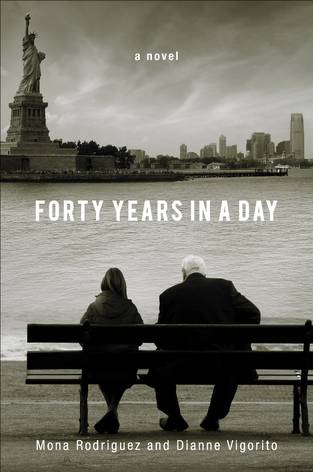
Forty years in a day book cover

Hello Mona! I read Forty Years In A Day and was absolutely intrigued with your story. Could you please tell your audience about your book?

Mona: Thank you, Stephanie, for hosting us today. It’s a pleasure. Our story begins in Italy, 1900. After years of torment and neglect, Victoria and her four small children immigrate to Hell’s Kitchen, New York, to escape her alcoholic, abusive husband. On the day they leave, he tragically dies, but she does not learn of his death for several years—a secret that puts many lives on hold.

Quickly, they realize America’s streets are not paved with gold, and the limits of human faith and stamina are tested time and time again. Poverty, illness, death, kidnapping, and the reign of organized crime are just some of the crosses they bear.

Victoria’s eldest son, Vincenzo, is the sole surviving member of the family and shares a gut-wrenching account of their lives with his daughter during a visit to Ellis Island on his ninetieth birthday. He explains how the lives of he and his siblings have been secretly intertwined with an infamous Irish mob boss and ends his unsettling disclosure with a monumental request that leaves Clare speechless.

The story takes the Montanaro family through several decades, providing the reader an opportunity to stand in the shoes of a past generation and walk in search of their hopes and dreams. It is layered with the struggles and successes of each family member, illuminating the fact that human emotions have been the same throughout generations; the difference is how people are molded and maneuvered by the times and their situations.

Stephanie: Is this story based on anyone you know or who you have come across?

Mona: The characters are based on family members, both deceased and living. I’ve had this particular story churning in my head for many years, sparked by the stories of my family’s past. Forty Years In A Day begins in 1900 and follows the incredible journey of a young mother and her four children as they escape from Italy into the streets of Hell’s Kitchen, New York. That woman was my grandmother. The story ends with a woman who knows the father of her children is living a double life with another, but she loves him so much that she overlooks the arrangement rather than forfeit the man. Those were my parents. In between are the stories that I had heard from family members, intertwined with a twist of fiction and sensationalism to have some fun.


Stephanie:  Were there any challenges you faced while writing this story?

Mona: There were many challenges that I had faced undertaking this project. First and foremost, I had the idea of the story in my head before I had the skills to share it. I’m a mathematician and an environmentalist so this challenged the other side of my brain. While writing is something I always admired, to me, the passion was in the story and the writing was the vessel to get it told.

Second, people ask me how much of our book is realistic; especially family members who want to know if this is the actual story of what had happened. They try to draw a parallel between family members’ personalities and our characters’ personalities. The truth is that no one can totally piece together that puzzle of tales; there are parts to every family’s story that were pushed under the rug for fear it would tarnish the family’s reputation. The elders think they are doing their family justice by taking some of the more scandalous stories with them to the grave. When, as a writer, you realize all this, you are forced to conjure your own conclusions from the pieces of stories that you gather.

Third, I coauthored the book with my cousin Dianne Vigorito. She gave me the support and validation I needed to pursue this project. I was lucky to find a family member to work with, and she had an immediate interest in the idea. She grew up hearing the same crazy stories, some of which were almost unbelievable, that were told by our ancestors.  Working with another has taught me the power of more than one and the art of compromise.

Stephanie: Was there a particular scene you felt difficult to write?

Mona: The story of Vinny and Ava represents my parent’s story and the story that resonates closest to my heart. When they were alive, I had discovered secrets about their past that they didn’t want my siblings and me to know. When they died, I felt more compelled to delve into their past, but no one could (or would) tell me the whole story. I realized that I should have asked more questions when they were alive, been more adamant to learn the truth. I questioned aunts and uncles, but I sensed there were bits of their lives, and everyone’s in our story, that would never be unearthed. The story of Vinny and Ava is conjured from the pieces of stories I had put together, and my interpretation, especially emotionally, of what had happened between my parents.

Stephanie: What was the inspiration for your story?

Mona: We don’t realize what our ancestors went through to make life better for themselves and for us. What they faced was incredible—the living conditions, poverty, disease—and their work ethic was admirable. Although I had started with the intention of writing a story about my father’s family, it turned into a novel. There was so much more I wanted people to know about this fascinating era.


Stephanie How long did it take to write, Forty Years In A Day?

Mona: I started by writing down the stories I had heard and interviewing the elders that were still alive. It took seven years—researching, attending seminars, workshops, conferences, and reading everything from books on how to write dialogue to reading mainstream fiction and rereading classics. I also studied the history and lifestyles of the era.  Dianne and I worked on our own, and we also worked together several days a week, collaborating, rewriting, and editing. I had a story to tell and I knew it had to be told.


Stephanie: You did a fantastic job with your research. It’s truly a beautiful and thought provoking story. And I believe it’s written in such a way that the story transcends you into that period and gives you a wonderful picture of the human conditions.  


Is there a sentiment you hope readers come away with after reading your story?

Mona: Forty Years In A Day is more than an immigration story about an Italian family; it epitomizes the immigration experience and coming to America in the early 1900s. It reignites curiosity and admiration for what our ancestors had endured and accomplished to make our lives better. There are many themes that run throughout the story—the loss and rebound of hope, honesty, perseverance, forgiveness, survival, the list goes on—but I think the main theme is the importance of family. Forty Years In A Day also reminds us that every family has hidden secrets and that the choices one person makes echoes through generations.

Stephanie: The different themes in your story was well written and I felt that some of them hit home with me. Your story has given me a lot to think about. Especially about family and relationships.


Is there a character that you feel connected to in any way?

Mona: I have a connection to all the characters, but the one I admire the most is Victoria. She was an amazing woman who wanted to do the right thing for her children. Without giving away the story, I often wonder how she summoned the strength to do what she did, and if I would have been so courageous. She did it not so much for herself, but for her children. She was the ultimate mother.

Stephanie: I admired Victoria as well. She certainly pulled at my heart strings. What book project is up next for both?

Mona: There are six cousins at the end of our story. The idea is to take that next generation into the next era.

Stephanie: Ooo…I’m really looking forward to reading your next book! What advice would you give to an aspiring author?

Mona: Read the works of authors you enjoy and respect, study and practice the craft, and try to develop a personal style and formula for success.  When reading a diverse collection of books, you take away, along with the story, a little of each author’s craft.

Thank you, Mona!

About the Authors

Mona & Dianne


Mona Rodriguez coauthored Forty Years in a Day with her cousin Dianne Vigorito.
Throughout their lives, they had heard many stories from family members that
were fascinating, sometimes even unbelievable, and decided to piece together
the puzzle of tales. Through research and interviews, their goal was to create
a fictional story that follows a family through several decades, providing the
reader an opportunity to stand in the shoes of a past generation and walk in
search of their hopes and dreams. What they realize in the process is that
human emotions have been the same throughout generations – the difference is
how people are molded and maneuvered by the times and their situations.

Mona Rodriguez has her MS in environmental Management from Montclair State
University. She is presently a trustee on the board of directors of a nonprofit
foundation created to benefit a local public library and community. She lives
with their husband in New Jersey, and they have two grown sons.

For more information, please visit the official website.

http://www.fortyyearsinaday.com/

BOOK TRAILER:  http://www.youtube.com/watch?v=AfJ5p4qCzmM&feature=youtu.be

forty years in  a day tour banner

Link to Tour Schedule: http://hfvirtualbooktours.com/fortyyearsinadaytour/
Twitter Hashtag: #FortyYearsTour

Interview with Author Evan Ostryznuik

Stephanie: Hello Evan, thank you for chatting with me today. Please tell me about your book, “Of Fathers and Sons.”

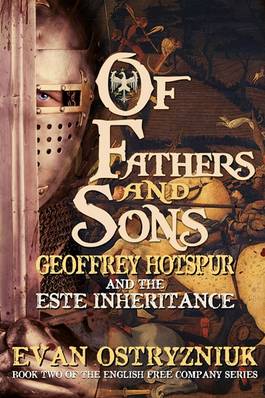
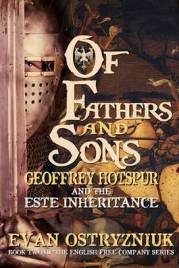
Evan: A pleasure to be here. Well, the novel takes place in 1395 in northern Italy, where tensions among the great regional powers were running high – the schism in the Catholic Church had not yet closed; Florence and Milan were gearing up for another war; Venice was starting to show interest in the mainland; in other words, there was a fine balance of power in the region and just about any conflict could ignite a war that would engulf the whole peninsula. The ruler of the strategically located Marquisate of Ferrara had just died and left a minor in his place. This uncertainty was enough to attract the attention of the great powers, and each of them knew that the territory’s occupation by one or another power would tip that fragile balance. Also, the Este family was popular as wise rulers and excellent soldiers, and so keeping them as an ally was good policy. This is the broad picture. Specifically, the story is about how that minor, the twelve-year-old Niccolo d’Este, fought his uncle and tried to overcome his own insecurities and challenges. And the English Free Company arrives to help.
evans book

Stephanie: Sounds really fascinating and I enjoy reading novels that take place during that time period in history. What was your inspiration for this story?


Evan: The inspiration for this story came from the Este Inheritance itself, which included not just land and lakes, but also a legacy of strong and wise rule. The boy had a lot to live up to. Until this time, the city of Ferrara and its surrounding area comprised more or less a backwater in Italian politics, but the Este family was able transform this marginal territory into one of the great Renaissance centers, politically, socially and culturally. They introduced a number of administrative innovations that secure their, fostered economic progress, and patronized progressive thinkers. The events of 1395, specifically the civil war between the two main branches of the Este family, were pivotal in this regard. Not just the fate of the city was involved, but also the legacy of the Este family, since had things turned out differently, Ferrara would have likely taken another direction or been absorbed by one of the neighboring powers. There was a lot riding on this war.

Also, the fact that a child on the cusp of adolescence was at the heart of intrigue gave me a change to pursue writing about the High Middle Ages from a different angle. Character interactions have to be plotted with especial care to make them convincing, juvenile understanding and expectations had to be considered and integrated into the plot, and even parents must be found a role. In some ways, Geoffrey Hotspur is just a boy himself.

Stephanie: How long did it take you to write this novel?

Evan: Since Of Fathers and Sons is a part of a series, I could say that they novel can be traced back to the literary birth of Geoffrey Hotspur 3-4 years ago. It grew out of the great mass of research I did on the 14th-15th centuries. The actual setting of this story down on paper took about a year, after several fits and starts. While I have the story lodged in my head, finding the right voice required several shots at the target.

Stephanie: What was some of the research involved?

Evan: I was fortunate to get my hands on a few key texts that really helped bring to life the Este clan and the Marquisate of Ferrara, which meant that I had few gaps to fill with what I like to call ‘oblique research’. By this I mean reading up on related period settings, families, events, and the like and making educated assumptions about how my story might have looked like. All genuine historians do this, since the historical record is never close to being complete or satisfying. I always find the researching for a novel a lot of fun, whether access is easy or difficult. I not only learn so much about the people and the period, but so many ideas for the novel manifest themselves from the research – details, information, relationships, and even dialog just pour themselves into the gaps of the story’s structure. I think, like most writers, I could spin the story out indefinitely and it would be no less engrossing.

Stephanie: What are some of the fictional aspects?

Evan: The two leaders of the English Free Company are fictional, or rather they are composites of a number of historical personages. To some degree, they are archetypes. Just read Chaucer! As a result, their journey is necessarily fictional, although the setting and the major events of their adventure are well grounded in historical reality. The point is to reflect the zeitgeist as closely as possible through an independent literary agent. No historical figure was ever able to visit all the great moments of their time! Geoffrey Hotspur and his companion can do that and bring both the events and those who truly made them to vibrant light.

Stephanie: What intrigues you the most about Geoffrey Hotspur and John of Gaunt?

Evan: What most intrigues me about these men is their relationship to fatherhood and patriarchy. Hotspur is an orphan of unknown provenance and a ward of Gaunt, while the great duke had a troubled relationship with his own son, the eventual King Henry IV and was poor father figure to the last Plantagenet king, his nephew Richard II. The tensions inherent in patriarchal relationships, particularly in the Middle Ages, are some of the main themes of the English Free Company series. Geoffrey in particular is troubled by it, for reasons of fear and insecurity, and as a result many of his decisions and views are strongly colored by this question. Both men had strong determined characters, yet long-term success always seemed to elude them. Family was crucial, but difficult. The role of the father was particularly important at this time and crucial in the lives of his sons. A poor or unsuccessful father could have dire consequences for the entire family and its descendants.

Stephanie: Will there be a third book in this series?

There will be a third, fourth and fifth book of the series! The next adventure of Geoffrey Hotspur follows hard on the heels of this one, but takes place in exotic locales in the Outremer, or the Levant. 1396 was the year of the very last European Crusade in the Holy Land, and there is no way Geoffrey is going to miss it! Hospitaller knights, Hungarian lords, Grand Constables of France, and poor squires with gather to drive the Ottoman Turks out of Christendom.

Stephanie: How exciting! What is the most challenging aspect of writing Historical Fiction?

Evan: The most challenging aspect of writing Historical Fiction is filling in the blank spots. Finding the stories is easy. The historical record is by nature fragmentary, especially for the Middle Ages, and so I must make convincing, educated assumptions about so many things. Some are inferred, such as personal motivations, based on the historical consequences. For example, battlefield tactics, which are crucial to my novels, have been recorded, but the application of these tactics by this or another company sometimes require backward projection based on the result of the battle or the observations of contemporary chroniclers. On more than one occasion I have had to delete large chunks of text because what I wrote either could not fit in with what History had to say or was contradicted by a newly discovered piece of research.

Stephanie: When did you first begin to write and knew you wanted to be an author?  

Evan: Funny enough, in elementary school I began creating stories through pictures with no words attached. I would take a sheet of 8.5X11 and draw a scene of…whatever. Then I would take more paper and draw the same collection of figures and setting in another way, and again, until I had a sort of film that I would tape together to produce a single visual narrative. This was fun until the teacher said enough was enough and I had to get back to work. Proper writing I did not start until college, when I would write short stories and vignettes from my life, mainly for myself, but also for others to be amused. I continued writing these vignettes until after I completed my doctorate at Cambridge, when I gave myself that challenge of writing a novel based on my interests in history. I did, and no one wanted to publish it. However, the very process of writing generated many other ideas for different novels and stories, which I found very gratifying. Now, the ideas are running out of control!

Stephanie: What advice would you give to someone who wanted to write in this genre?

Evan: Getting the facts straight is the most obvious suggestion, but if I hard to offer a single piece of key advice regarding historical fiction, I would have to say that the writer had better make sure that his or her story cannot take place at any other era. Otherwise, it loses its purpose. What I mean by that is that character, setting, motivations, mentality, even speech needs to be grounded in the historical period. Always fear anachronisms. If the work is sloppy or unconvincing, the author will swiftly lose credibility. This threat is particularly great for historical fiction because nothing can be taken for granted. The reader wants to believe he or she is proverbially going back in time. Other genres have their own challenges, but they are less dependent on good, hard technical research. Fantasy and science fiction can have whatever set of internally logical rules they want; contemporary fiction is easy to portray by virtue of direct experience; detective novels have well established structures. For historical fiction, you are only as good as your research and your ability to transfer it convincingly to the blank page.

Stephanie: What is your favorite quote?

Evan: This is a tough question because I live in fear of unconscious plagiarism. But one that has stuck with me for its humor and hard truth is a few words attributed to Oscar Wilde: “Be yourself; everyone else is already taken.”

Stephanie: Evan, it was an honor to chat with you! Thanks!

evanEvan Ostryzniuk was born and raised on the prairies of western Canada. After graduating   from the University of Saskatchewan with a B.A. in History and Modern Languages and an M.A. in Modern History, Evan crossed the ocean to do post-graduate work at the University of Cambridge, concluding four years of research with a doctoral thesis on the Russian Revolution. He then found his way to Eastern Europe, where he took up positions as a magazine editor, university lecturer and analyst in the financial services sector before rising in the ranks of the local publishing industry to become Editor-in-Chief of a popular weekly.

Evan Ostryzniuk currently resides in Kyiv, Ukraine near a very large candy factory. He has travelled extensively, including the locations of his novels. Of Fathers and Sons: Geoffrey Hotspur and the Este Inheritance is his second novel.

http://www.evanostryzniuk.com/[SH1]

Link to Tour Schedule: http://hfvirtualbooktours.com/offathersandsonsvirtualtour/
Twitter Hashtag: #FathersAndSonsTour
evans tour banner