Book Review: The Silent Girl by Kelly Heard

Published April 9th 2021 by Bookouture

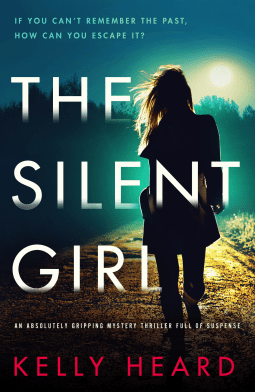
I wake in a bed, with a stranger leaning over me. She asks my name and I realise I don’t know what it is. I don’t know who I am or why I’m here…

I’m grateful to the police who found me on the remote stretch of highway, covered in blood, with crimson flowers in my hair. To the doctors, too, who brought me back from the brink of death.

But I see the suspicion in their eyes.

They don’t believe me when I say I don’t remember who I am. They are unsure if I can be trusted.

Am I the innocent victim? Or guilty of a terrible crime?

No one has reported me missing or come looking for me. But today, a bouquet of blood-red roses has been delivered to my room.

Am I in danger? Or is someone trying to help me?

Searching for anything in this town that might seem familiar, I’m cornered by a woman with wild eyes who calls me I name I don’t know. She tells me my brother is in danger and only I can save him.

But how do I know if I can trust her, if I can’t even trust myself?

My thoughts:

Imagine being found on the side of the road with flowers in your hair, beaten badly and a few days later, you wake up with no memory of who you are. That is what happened to Sophie and it becomes apparent, rather quickly, that she is in danger. She starts to remember things from her childhood and she knows she has a brother named Miles and she has strong emotions about him.  After the doctors and police give her permission to leave the hospital, she must find food and shelter. Sophie lands a job at an historic home, that is known to be haunted, as a landscaper. She develops a relationship of sorts with the overseer and his son. As the chapters continue, she slowly gains more memories and her continued thoughts of her brother become stronger. She is certain that she needs to find him and that he will resolve everything.

For someone who woke up with that kind-of trauma and not knowing you are, I thought Sophie would be a bit more disturbed and concerned about her well-being. She wasn’t and I found that to be strange for this type of story. The reader is shown glimpses of her apparent personality as the story unfolds but you’re still not sure who she really is and what she has gotten herself involved with.  

I did like many of the aspects of the story but felt things weren’t fleshed out at a good pace throughout book and the whole “haunted house” part seemed contrived. Twist and turns in a thriller are important but sometimes those can take too many turns before you start to totally veer off in the wrong different. There were times, I began to wonder if that was happening. But then everything falls in your lap at the conclusion.

Despite those issues, I kept on reading because I needed to know what was going on and who she really was!

Stephanie Hopkins

I obtained a copy from the Publishers through NetGalley for an honest review.

Book Review: The Nature of Fragile Things by Susan Meissner

Published February 2nd 2021 by Berkley Books

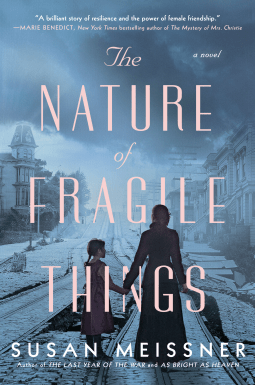
Sophie Whalen is a young Irish immigrant so desperate to get out of a New York tenement that she answers a mail-order bride ad and agrees to marry a man she knows nothing about. San Francisco widower Martin Hocking proves to be as aloof as he is mesmerizingly handsome. Sophie quickly develops deep affection for Kat, Martin’s silent five-year-old daughter, but Martin’s odd behavior leaves her with the uneasy feeling that something about her newfound situation isn’t right.

Then one early-spring evening, a stranger at the door sets in motion a transforming chain of events. Sophie discovers hidden ties to two other women. The first, pretty and pregnant, is standing on her doorstep. The second is hundreds of miles away in the American Southwest, grieving the loss of everything she once loved.

The fates of these three women intertwine on the eve of the devastating earthquake, thrusting them onto a perilous journey that will test their resiliency and resolve and, ultimately, their belief that love can overcome fear.

My thoughts:

The Nature of Fragile Things is without a doubt, my favorite book by Meissner. The different elements and themes are engaging and her story is unique, and although you are transported to time and place, you feel connected to the characters as if they were living today.

The 1906 San Francisco earthquake devastated the city and left well over 200,000 homeless and a high death toll. A fire broke out and quickly spread through parts of the city making it even more unsafe. Meissner’s historical telling of the earthquake and fire is wonderfully woven into the story.

What I liked most about Sophie is that she is a complex protagonist. She is not what you would call a goody-two-shoe heroine, but a woman with flaws and at times, doubt is cast about her motives and her life. Meissner steps out of the norm of one- dimensional characters I often see in stories. Readers need to see the characters battle their own demons, grow and learn from them. You get that and more from this story.

A compelling story blended with history and fiction.

I couldn’t put this book down.

Stephanie Hopkins

I obtained a copy from the Publishers through NetGalley for an honest review.

Book Review: A Conventicle of Magpies by L.M.R. by LMR Clarke

(The Bloodskill Duology Book 1)

BooksGoSocial

Sci Fi & Fantasy

Pub Date 06 Jan 2021  

About the Book:

Rook is an unapologetic thief, determined to do anything to ensure her mother and siblings survive the squalid and dangerous streets of Stamchester.

Rook slips, like a shadow, in and out of the homes of the ruling elite, the Avanish, and steals what she needs. She feels no regret, afterall, the Avanish have enslaved her people, the Saosuíasei, and worse, have now determined the Saosuíasei to be disposable and worthy of nothing other than death. 

However, Rook is not the only shadowy figure in Stamchester. And far more deadly one haunts the filthy streets, striking fear into Avanish and Saosuíasei alike. A serial killer who drains every ounce of blood from his victims, and satisfies the elite’s demand for blood to burn in the magical art of Bloodskill and enhance their own natural, and sometimes unnatural, abilities. 

How can Rook outfox the serial killer and raise her people from the ashes left by the Avanish oppression? 

My Thoughts:

Conventicle girls never surrender.” – Rook

I stepped out of my comfort zone picking up this story and glad I did! I recommend starting with the prologue. You get a clear understanding of just how despicable the people in power AKA the rich are to people who are different from them. The prologue is written as letters between Governor Dredchain and Viscount Trass. They viewed these people as animals that needed to be dealt with swiftly. As you read on, you soon discover their plans are much more sinister and you become further absorbed in the story.

I really enjoyed getting to know a few of the characters and their quirky names. For example: Rook, Pit, Crake, Billy Drainer, and Pigeon- to name a few. That said, there are too many characters introduced and not enough information about them to form any lasting connection or impression, me thinks. Which is important, especially, in a story like this one. Though I felt like I began to know Rook pretty good seeing she is a protagonist.

There is also too many things going on in the story that I felt pushed and pulled -a bit- in different directions. Nonetheless, I kept ready on because the premise itself was so fascinating and the writing engaging! A few interesting aspects include the Victorian setting, conflicts between the characters and the bloodskill.

Fans of Neil Gailman and Suzanne Collins will enjoy this story. Not only that, Clarke gives a bird’s eye view of discrimination and the people who stand up to adversity. I look forward to reading the next book in this series!  

Stephanie Hopkins

I obtained a copy from the Publishers through NetGalley for an honest review.

Book Spotlight: The Family Plot by Megan Collins

A secluded island mansion deep in the woods and a missing teen. Years after a death in the family, they make a gruesome discovery. I would say this family has been through it and then some!

Mystery/thriller stories are among my favorite genres to read! With the right elements, or pieces like a puzzle, you watch the mystery unfold and develop to the very end. Or would it be, develop and then unfold? Either way, along with other fellow readers and bloggers, I’m excited about this book coming out! Thank you, Atria Books for a copy.

Now it’s time to go grab that second cup of coffee. It is going to be a reading marathon the next two days! What are your bookish plans this weekend? Happy reading! -Stephanie Hopkins

The Family Plot by Megan Collins

Atria Books

Mystery & Thrillers

Pub Date 17 Aug 2021  

Description

When a family obsessed with true crime gathers to bury their patriarch, horrifying secrets are exposed upon the discovery of another body in his grave in this chilling novel from the author of Behind the Red Door and The Winter Sister.

At twenty-six, Dahlia Lighthouse remains haunted by her upbringing. Raised in a secluded island mansion deep in the woods and kept isolated by her true crime-obsessed parents, she has been unable to move beyond the disappearance of her twin brother, Andy, when they were sixteen.

After several years away and following her father’s death, Dahlia returns to the house where the family soon makes a gruesome discovery: buried in their father’s plot is another body—Andy’s, his skull split open with an ax.

Dahlia is quick to blame Andy’s murder on the serial killer who terrorized the island for decades, while the rest of the Lighthouses react to the revelation in unsettling ways. Her brother, Charlie, pours his energy into creating a family memorial museum, highlighting their research into the lives of famous murder victims; her sister, Tate, forges ahead with her popular dioramas portraying crime scenes; and their mother affects a cheerfully domestic facade, becoming unrecognizable as the woman who performed murder reenactments for her children. As Dahlia grapples with her own grief and horror, she realizes that her eccentric family, and the mansion itself, may hold the answers to what happened to her twin.

Weird Wednesday: An Exploration of Our Quirky World

Facts of Daily Life in the 19th-Century England.

We live in an extraordinary quirky world that often times we forget to pause in our busy lives to notice. During these times many cannot venture outside-another great reason to pick up a book-so we are bringing our explorations to you.

As many of you already know, I’m obsessed with history and cultures from all walks of like. Today, I’m exploring, What Jane Austen Ate and Charles Dickens knew by Daniel Pool. A book on the facts of daily life in the 19th-Century England. The book as a whole is mighty interesting but we are going to examine some of the information in its glossary. Needless to say, there are a little over a couple hundred pages but we won’t be covering it all. Let’s get started.

Quirky Meanings:

Abigail: A Lady’s maid.

Carking: Having the ability to worry someone or make them careworn.

Sounds about right.

Chine: A term applied to the spin of animals like pigs when they were being chopped up for cooking.

Gross.

Fly: A horse and carriage that was rented, usually by the day.

Who would have thought.

Glee: In music, the glee was a vocal piece for three people or more. In Jane Eyre, singers gather around the piano while Jane” the solo over, a duet followed and then a glee.”  and her pupil listen:

Jane Eyre was written by Charlotte Bronte and published in 1847.

Ha-ha: A landscaping device that consisted of a trench dug at some point in the view where it could not be seen unless one were very close to it. Also, called a sunken fence.

Ha ha! Too funny!

Ladybird: Not a bird at all but what we call the ladybug. Also, called a lady clock.

Had no idea that Ladybugs where ever refereed as that.

Milch cow: One that was giving milk.

Nob: Someone with a good deal of status. Used often in conjunction with “snob” in the sense snob initially had of someone of no status or pretensions.

Huh.

Rasher: A not very slice of ham or bacon.

I love the way this is worded.

Sell-out: To leave the army by selling the commission one had purchased to someone.

Skittles: Basically, bowling. One set up nine skittles or pins and then tried to knock them down with a ball.

When I hear the word “Skittles” I think of candy. Ha!

Snipe: A bird with a long bill that lives in marshes.

Is this the type of bird that is hard to hunt? Hmm… I wonder if this is the same name that referred to as Snipers? Or where it partly originated? I do believe Sniper was coined by the British Military in the 1700s? Need to look more into this. Can’t wait!

Stewpond: A special fishpond kept by manor houses in medieval days so as to have a supply of fresh fish.

That is actually a good idea. I wonder if people still actually do that?

Twelfth cakes: Cakes made for Twelfth Night. They contained a coin or bean that made the finder the “King” or “queen” of celebration.

I get the coin part but not entirely sure why a bean is used for this. Maybe it is explained in the book and I messed it. I haven’t read this book on quite sometime.

Whiting: A good-tasting small fish. Also, pulverized fine chalk used for cleaning or whitewashing.

Talk about two different meanings altogether!

This post was fun to but together. I highly recommend adding this book to your to-read list.

Stephanie Hopkins

About the book:

A “delightful reader’s companion”; (The New York Times) to the great nineteenth-century British novels of Austen, Dickens, Trollope, the Brontës, and more, this lively guide clarifies the sometimes bizarre maze of rules and customs that governed life in Victorian England.

For anyone who has ever wondered whether a duke outranked an earl, when to yell “Tally Ho!” at a fox hunt, or how one landed in “debtor’s prison”; this book serves as an indispensable historical and literary resource. Author Daniel Pool provides countless intriguing details (did you know that the “plums” in Christmas plum pudding were actually raisins?) on the Church of England, sex, Parliament, dinner parties, country house visiting, and a host of other aspects of nineteenth-century English life—both “upstairs” and “downstairs.”

An illuminating glossary gives at a glance the meaning and significance of terms ranging from “ague” to “wainscoting,” the specifics of the currency system, and a lively host of other details and curiosities of the day.

Weird Wednesday: An Exploration of Our Quirky World

Weird Wednesday: Butterflies

Cover Crush: The Girl in His Shadow by Audrey Blake

About the Cover: I love the lady’s reflection in the water and how her red dress and bad contrast with the blue. I do wish we could see more of her face. One can tell her walk shows determination. If you look closely, you’ll notice medical instruments on either side of the book title. I do like the flourishes in the corners of the layout. It does give the image a bit of a mirror affect. Which compliments the reflection scene.

About the Book: Clearly the story takes place in the 19th century but the description of the story does not state that. I believe that needs to be added so it won’t leave readers guessing until they read the book. Another issue I have is that it doesn’t mention where the story takes place. I’m guessing, England because of the doctor’s name. Though many Americans have English names. Most likely, I could find out the time and period by seeing if there are any reviews written that state the information, but I rather wait to see if I am able to get a copy of the book for review.

I did, however, do a little digging on the name Croft. Did you know that the surname Croft, has pre 6th century origins and emerged as a notable English name? From what I read; the name originates from English northern counties

I’m really interested in the premise and I will definitely be reading this book one way or another.

Stephanie Hopkins.

Sourcebooks Landmark

Historical Fiction

Pub Date 04 May 2021

Description

The story of one woman who believed in scientific medicine before the world believed in her

Raised by the eccentric surgeon Dr. Horace Croft after losing her parents to a deadly pandemic, the orphan Nora Beady knows little about conventional life. While other young ladies were raised to busy themselves with needlework and watercolors, Nora was trained to perfect her suturing and anatomical illustrations of dissections.

Women face dire consequences if caught practicing medicine, but in Croft’s private clinic Nora is his most trusted—and secret—assistant. That is until the new surgical resident Dr. Daniel Gibson arrives. Dr. Gibson has no idea that Horace’s bright and quiet young ward is a surgeon more qualified and ingenuitive than even himself. In order to protect Dr. Croft and his practice from scandal and collapse Nora must learn to play a new and uncomfortable role—that of a proper young lady.

But pretense has its limits. Nora cannot turn away and ignore the suffering of patients even if it means giving Gibson the power to ruin everything she’s worked for. And when she makes a discovery that could change the field forever, Nora faces an impossible choice. Remain invisible and let the men around her take credit for her work, or let the world see her for what she is—even if it means being destroyed by her own legacy.

Book Review: The Princess Spy: The True Story of World War II Spy Aline Griffith, Countess of Romanones by Larry Loftis

Published February 9th 2021 by Atria Books

When Aline Griffith was born in a quiet suburban New York hamlet, no one had any idea that she would go on to live “a life of glamour and danger that Ingrid Bergman only played at in Notorious” (Time). As the US enters the Second World War, the young college graduate is desperate to aid in the war effort, but no one is interested in a bright-eyed young woman whose only career experience is modeling clothes.

Aline’s life changes when, at a dinner party, she meets a man named Frank Ryan and reveals how desperately she wants to do her part for her country. Within a few weeks, he helps her join the Office of Strategic Services—forerunner of the CIA. With a code name and expert training under her belt, she is sent to Spain to be a coder, but is soon given the additional assignment of infiltrating the upper echelons of society, mingling with high-ranking officials, diplomats, and titled Europeans, any of whom could be an enemy agent. Against this glamorous backdrop of galas and dinner parties, she recruits sub-agents and engages in deep-cover espionage to counter Nazi tactics in Madrid.

Even after marrying the Count of Romanones, one of the wealthiest men in Spain, Aline secretly continues her covert activities, being given special assignments when abroad that would benefit from her impeccable pedigree and social connections.

Filled with twists, romance, and plenty of white-knuckled adventures fit for a James Bond film, The Princess Spy brings to vivid life the dazzling adventures of a remarkable American woman who risked everything to serve her country.

My thoughts:

I’ve read a lot of World War II stories but I must say, The Princess Spy is the first book I’ve read, that really delves into the espionage world. The research alone that went into this book is impressive! I obtained a physical copy and enjoyed marking lots of details I want to go back and read and do a bit of my own research. I also enjoyed the images throughout the book. That was a nice touch and really helped bring it all to reality.

I don’t think I’ve paid attention to just how many different government agencies had spies in Europe during World War II until reading about it in these pages. Absoultuly fascinating and absorbing. I found it all incredible, really, because I’m still trying to wrap my head around the ins and outs of how it all worked. Could anyone? That said, Loftis does a marvelous job with drawing you in and gives you an understanding how much of it operated.

I’m impressed with Loftis taking on this project and telling Aline’s role during the war. Too often, throughout our history, women’s roles were largely ignored. She lived an astonishing life, and went from your average American girl to being a spy, and becoming friends with and related to the elitist society. I was amazed with how many people she knew and her, “schedule,” to say the least. The energy she had, I’m sure, is part of what made her a great spy. What a brave woman.

I immensely enjoyed reading about her friendship with Juanito Belmonte. He was a Spaniard and a wealthy Matader-Bullfighter who spotted Aline when she first arrived to Madrid and sought her out.

Before reading about Bullfighting in this book, I was turned off by the sport-if you will. Well, I’ve changed my mind and found the details of Bullfighting to being an art and intriguing.

Be sure to read the epilogue and notes at the back of the book. You’ll get more insight into the people Loftis wrote about and what he had left out.

A must read!

Stephanie Hopkins

My thanks to Artria Books for providing me with an ARC.

Book Review: The Sign of the Gallows (A Lucy Campion Mysteries, #5) by Susanna Calkins

About the book:

London, 1667. On her way to a new market to peddle her True Accounts and Strange News, printer’s apprentice Lucy Campion quickly regrets her decision to take the northwestern road. Dark and desolate, the path leads her to the crossroads – and to the old hanging tree. She doesn’t believe in ghosts, but she’s not sure ghosts don’t believe in her. But before she even reaches the crossroads, she’s knocked off her feet by two men in a hurry. What were they running from? To her dismay, she soon discovers for herself: there, dangling from the tree, is the body of a man. Did he commit self-murder, or is there something darker afoot? The more Lucy learns, the more determined she is to uncover the truth. But this time, even the help and protection of magistrate’s son Adam, and steadfast Constable Duncan, may not be enough to keep her safe from harm . . .

My thoughts:

Seventeenth Century, London was a calamity to say the least! With the century brought the Great fire of London, the plague and co-conspirators plotting to blow up the Houses of Parliament including the King. My word, I’d say that in itself is brutal enough. However, there are other dark forces at work.

Author Susanna Calkins brings the century to life through her Campion series of murder, mayhem and intrigue. Lucy, finds herself in the center of another murder investigation and the search for the murderer reveals that there are darker forces at work.

Lucy is an apprentice-of sorts for a printer and bookseller, Master Aubrey. While all his staff are important to his business, I find Lucy to be the most spirited and undoubtedly clever at telling stories and selling book. I believe Aubrey know Lucy’s value and its why I think he gives her a pass quite to bit to aid in the investigation.  She is quite the social warrior and truly cares for people.

I’m really pleased with the support system Lucy’s has among her friends and formal employees, the Hardgraves. I admire the Hargraves respect and affection they have for Lucy despite their class distinction. What lively, caring and intelligent people.

Banner and painting by Stephanie Hopkins

Every single character in the story is fascinating and fun to read about, even the villains. Calkins does a marvelous job in showing the reasons people act on things due to their own situations in life. Regardless if we agree with them or not, its important to know the reasons. The human mind is an extortionary and often times, dark place. We can learn much from it.   

The investigation in the murder at the crossroads had lots of great twist and turns and it was an enjoyable read and one feels caught in trying to figure out who done it right along Lucy and the others.

The two men she ran into before making her way to the crossroads are something else. While their actions are suspicious at best, their grievance is understandable as the story unfolds.

I appreciate the story-line of Aubrey’s print shop and the reading material he sells. It has inspired me to look further into how books were printed during the 17th century.

I started this series at book four because I agreed to review it and find myself wanting to go back and read the first book and on…Despite that, I believe from the two books I’ve read, they are good stand-alone stories.

Calkins is a creative and imaginative story-teller and she weaves a story marvelously at a wonderful pace that keeps you engrossed. -Stephanie Hopkins

I obtained a galley copy from the publishers through NetGalley for an honest review.

Review: A Death Along the River Fleet (Lucy Campion Mysteries #4) by Susanna Calkins

Book Review: Mind of a Killer (Alec Lonsdale #1) by Simon Beaufort

In London 1882, a new reporter for the Pall Mall Gazette, Alec Londale, comes across a house fire, that is not uncommon in those times, approaches the scene to watch the firemen hard at work to prevent the fire from spreading to the other houses.  Looking around for someone to tell him who lives there and how the fire started, he approaches a woman, asking her questions. A body has been discovered. Alex begins to take notes and shortly after speaking with the first woman, another woman, who appears distraught, approaches him and ask him to meet her at a later date. She has information for him that can’t be shared at the scene. Alex is unobservant to her emotions and what she is saying or not saying. It is quite clear to him what she is and he dismisses her from his mind. Alex is young and is portrayed as a naive and green around the quills-if you will- about the ins and outs of being a reporter.

When the post-mortem on the fire victim comes back as something other than an accident, it isn’t long before a second body is found and this time the person’s throat is cut and then the bodies start to pile up.

Alex’s feisty female colleague, Hula Friederrichs is assigned to help him investigate the case. He isn’t happy about it but he needs all the help he can get! The further they investigate, they delve into the mystery and start to uncover a conspiracy so sinister, that it takes them to the upper classes of Victorian Society. The threat of their own lives become a reality as they get closer to the murder plot and they begin to question whom can they trust.

My fascination with the Victorian era’s class-based society, the stereotypes and double standards of the period, journalism, and the murder mystery genre prompted me to read this book. Those elements combined make for a gripping story. There is also the fact, I’m always curious how writers today portray the culture of the period.

Darwin’s theories are introduced in the story and taken to an unspeakable dark and evil height that will have you wondering how far will these people go to advance their objective. I don’t think I have ever been so thoroughly taken back by a theme that pushes the boundaries of this nature. In fact, it makes this story all too realistic and chilling.

Highly entertaining, and a thought-provoking read.

Stephanie Hopkins

I obtained a copy of Mind of a Killer from the publishers through NetGalley for an honest review.

New Book Release: Madam C.J. Walker by Erica L. Ball

Congrats to Erica L. Ball’s

book publication of, “Madam C.J. Walker

The Making of an American Icon!”

I discovered Madam C.J. Walker a few years ago during my in-depth study of 19th Century Post Civil War. I thought at the time that it would be wonderful to watch a movie or read a book based on her life. I wanted to know more about this woman. Her story needs to be told. To my delight, I learned that Author Erica L. Ball wrote about Walker and have added the book to my reading list. I have not read any of Ball’s published works but have learned that she is a professor of History and Black Studies. Very cool.  -Stephanie Hopkins

About the book:

Rowman & Littlefield

Biographies & Memoirs | History | Nonfiction (Adult)

Pub Date 15 Jan 2021

Description

Madam C. J. Walker—reputed to be America’s first self-made woman millionaire—has long been celebrated for her rags-to-riches story. Born to former slaves in the Louisiana Delta in the aftermath of the Civil War, married at fourteen, and widowed at twenty, Walker spent the first decades of her life as a laundress, laboring in conditions that paralleled the lives of countless poor and working-class African American women. By the time of her death in 1919, however, Walker had refashioned herself into one of the most famous African American figures in the nation: the owner and president of a hair-care empire and a philanthropist wealthy enough to own a country estate near the Rockefellers…

In this biography, Erica Ball places this remarkable and largely forgotten life story in the context of Walker’s times.