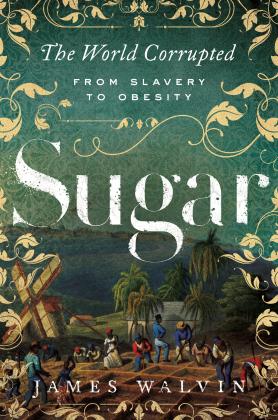
Book Spotlight: Sugar The World Corrupted: From Slavery to Obesity James Walvin

SugarSugar

The World Corrupted: From Slavery to Obesity James Walvin

The modern successor to Sweetness and Power, James Walvin’s Sugar is a rich and engaging work on a topic that continues to change our world.

How did a simple commodity, once the prized monopoly of kings and princes, become an essential ingredient in the lives of millions, before mutating yet again into the cause of a global health epidemic? Prior to 1600, sugar was a costly luxury, the domain of the rich. But with the rise of the sugar colonies in the New World over the following century, sugar became cheap, ubiquitous and an everyday necessity. Less than fifty years ago, few people suggested that sugar posed a global health problem.  And yet today, sugar is regularly denounced as a dangerous addiction, on a par with tobacco. While sugar consumption remains higher than ever—in some countries as high as 100lbs per head per year—some advertisements even proudly proclaim that their product contains no sugar. How did sugar grow from prize to pariah? Acclaimed historian James Walvin looks at the history of our collective sweet tooth, beginning with the sugar grown by enslaved people who had been uprooted and shipped vast distances to undertake the grueling labor on plantations.  The combination of sugar and slavery would transform the tastes of the Western world. Masterfully insightful and probing, James Walvin reveals the relationship between society and sweetness over the past two centuries—and how it explains our conflicted relationship with sugar today.

James Walvin is the author of several books on slavery and modern social history. including Crossings and A Jamaican Plantation. He is a Fellow of the Royal Society of Literature and in 2008 he was awarded an OBE for services to scholarship. He lives in England.

I rate the cover five stars now if I can get my hands on a copy of this book! Everything about the premise interest me! -Stephanie M. Hopkins

Pegasus Books

The Gilded Age

The late 19th Century and early 20th Century are a deep fascination of mine and I have studied the history for years as part of my own research for my WIP’s. I was delighted when Janet Stafford posted these two posts-below-on her site, “Squeaking Pips.” I’ve read her articles on the Gilded Age several times and I was impressed and intrigued with what she wrote and how concise she is with her knowledge in the era.

Janet Stafford is an author with the wonderful, “Saint Maggie Series” I recommend. She and I are currently working on a project so moving that in the first phase of it, I was moved to tears. What is the project that has me so worked up? More to come on that soon! Meanwhile, please be sure to take the time to read both posts and comments are appreciated. We would love to hear your thoughts! -Stephanie M. Hopkins

The Gilded Age

gilded-age-cover-1873

In 1873, Mark Twain and Charles Dudley Warner published a book that became the name of an era: The Gilded Age.  This period, generally believed to be between 1870 and 1900, was marked by rapid industrialization, economic growth, and immigration, most notably in the North and West. The South, however, after defeat in the Civil War and the punishment of the Reconstruction, suffered from economic depression. This is an important difference to note. The successes and excesses of the Gilded Age did not touch the United States in its entirety.

Twain and Dudley’s book is set in the United States at the very beginning of the Gilded Age. Marvin Felheim[i], who wrote the introduction to my yellowed paperback copy of the book, notes that the story’s primary criticism was focused on “the greed and lust – for land, for money, for power – of an alliance of Western land speculators, Eastern capitalists, and corrupt officials who dominated the society and appreciably altered its character.”[ii] He goes on to say:

The “Gilded Age” was a “peaceful” era following the horrors of the Civil War. The North, industrialized and righteous, had won. One consequence was the westward extension of institutions representing its victorious value system. Expansion was in the air. Capital was available and bankers were looking avidly for investments. The West, with all its rich potentialities, both of wealth and adventure, lay ready to be exploited. Colonel Sellers’ [a principle character] ambitious schemes were not merely the idle dreams of a satirist’s euphoric imagination: they represented the hopes and beliefs of a nation.[iii]

It is true wages for the average worker rose during this period. However, there was a dark side to all this growth and expansion, and that was an alarming disparity in income and wealth. Briefly put, the gulf between the wealthy class and everyone else began to widen. According to Steve Fraser…Read more HERE

Whispers of the Gilded Age in SEEING THE ELEPHANT

Gold Bars

To recap, the Gilded Age was a period in the United States that roughly spanned 1870-1900. An era of rising industrialization, urbanization, and immigration, it also saw a rising disparity between the wealthiest Americans and those who were “regular” folks.

Although it was a time of conspicuous consumption, some industrialists sought to moderate their public image by engaging in civic works, such as the building of libraries, hospitals, schools, and other institutions beneficial to the populace. In that era, the wealthy still feared hell – and if they didn’t, at least they were willing to hedge their bets by doing something good for those who had little.

The big wigs (or “big bugs,” as Eli calls them) were living well, but many workers in the Gilded Age routinely got injured or killed on the job and had little in the way of compensation. Is it any wonder that this era also saw the rise of the union movement?

New discoveries in science drove improve patient treatment and housing. A reform movement, led by Dorothea Dix, sought to change mental “hospitals” from dank jails where “patients” were put in chains and lived in their own filth to healthy environments that embraced more humane treatment methods.

I enjoyed putting early whispers of the changing landscape in American society into the fourth book in the Saint Maggie series. In 1864, they are felt in the little town of Blaineton, New Jersey. So, when Maggie and her family return to their hometown, they find not only their own lives changing, but also the life of their town, and these changes are borne out in the following storylines…Read more HERE

***Illustration: Cover of the first edition of The Gilded Age by Mark Twain and Charles Dudley Warner, 1873


On This Day in History

This slideshow requires JavaScript.

On a blustery April 7, 1844, Joseph Smith stepped to the podium to address the congregation gathered for the general conference. Smith’s friend, Elder King Follett, had died a month earlier from accidental injuries. As Joseph scanned the more than twenty thousand gathered on the banks of the Mississippi, they expected he would eulogize his friend’s tragic death. Smith splayed his arms and said, “May the Lord strengthen my lungs and stay the winds.”

Smith went on to deliver his most important sermon. In Richard Lyman Bushman’s book Joseph Smith: Rough Stone Rolling, he notes that literary critic Harold Bloom called the sermon ‘one of the truly remarkable sermons ever preached in America’. As Smith concluded, the clouds had parted, sun shone on Nauvoo, and the winds had been stayed. Within three months of his eloquence, an angry mob murdered Smith and his brother while they were in a Carthage jail cell.

In The Believers in the Crucible Nauvoo, amid controversy swirling in Nauvoo on 26 May 1844, George Taggart reflected on his prophet’s words delivered earlier. Below is the relevant part of the chapter.

************

As George waited to hear from Joseph Smith, he reflected. Several weeks earlier, he had attended a general conference, which occurred shortly after the death of Elder King Follett. Joseph took the occasion to speak about death in general rather than eulogize his friend’s tragic demise. George had hoped for inspiration since at the time he was still grieving his father’s and Oliver’s deaths. He received more, which now replayed as he waited.

On that day, Joseph approached the podium as dark clouds loomed and trees swayed. He gripped his lapels and said. “May the Lord strengthen my lungs and stay the winds.” The leaves continued to flap, yet George heard every word Joseph had said.

“God himself was once as we are now, an exalted man, who sits enthroned in yonder heavens. If the veil were rent today, and God was made visible, you would see him like a man — like yourselves.”

When George first heard those words, he was confused. “How can I or any man become a God?” But as quickly as he had questioned, the Prophet answered.

“When you climb a ladder, you must begin at the bottom and ascend step by step until you arrive at the top; and so it is with the principles of the gospel—you must begin with the first, and go on until you learn all the principles of exaltation.”

As the Prophet continued to expound, George reflected on his life. He had taken his first step toward exaltation when he was baptized, and his father’s and brother’s deaths had brought him higher up the ladder, closer to God. “Am I becoming more Godlike?” He had pondered, still unconvinced and hoping for answers.

“The mortal body has a beginning and an end. Thus, here is your eternal life; to know the only wise and true God. Learn to be Gods yourselves by going from a small degree to another, from grace to grace, from exaltation to exaltation, until you sit in glory with those who sit enthroned in everlasting power.”

As Joseph continued, George had realized mortal existence is brief and the spirit is eternity, a spirit the same as God. As the sermon ended, the clouds had parted, creating darkness on either side of the blue skies above Nauvoo; and the winds had been stayed. As George left, he had an enriched view on living his life – as he was now, God once was; and as God is now, he could be.

Soon after Joseph’s King Follett sermon, the apostates had proclaimed Joseph a fraud saying, “Mortal men becoming Gods is utter blasphemy.” The apostates’ rhetoric continued, and William Law, the most outspoken, accused Joseph of adultery, creating deeper church schisms and fanning anti-Mormon flames. The hullabaloo that followed continued to trouble George.

Now as Joseph arose to speak, George prayed he would respond and vanquish the apostates’ mistruths. Joseph’s stride lacked its usual vigor. His smile seemed contrived. He appeared as beset upon as George was feeling. He didn’t grip the podium with authority, but slouched, using it as a crutch. His opening remarks were barely audible. George feared his Prophet’s recent tribulations had taken their toll. But Joseph cleared his throat, and a vigor came into his voice. . . .

By Alfred Woollacott

Previously published on My Four Legged Stool

About the Author:

Alfred Woollacott, III retired from KPMG after a career spanning 34 years, choosing to reside full time at his summer residence on Martha’s Vineyard. Being “45 minutes from America” and with a 50 – 60 hour per week void to fill, he began dabbling into his family history. His dabbling grew into an obsession, and he published several genealogical summaries of his ancestors. But certain ones absorbed him such that he could not leave them. So he researched their lives and times further while evolving his writing skills from “just the facts ma’am” to a fascinating narrative style. Thus with imagination, anchored in fact and tempered with plausibility, a remote ancestor can achieve a robust life as envisioned by a writer with a few drops of his ancestor’s blood in his veins.

When not writing, Al serves on several Boards, and keeps physically active with golf, tennis, and hockey. He and his wife of 44 years, Jill, have four children and ten grandchildren.

Layered Pages Interview with Alfred Woollacott HERE

Alfred’s second book. The Believers In Crucible Nauvoo is on sale for 99 cents on the Amazon Kindle for a short time. Get your copy today!

About the Book:

From the author of The Immigrant, another stimulating novel that will linger with you regardless of your faith or beliefs.

After enduring early parental deaths, Naamah Carter discovers renewed meaning to her strong Christian beliefs through Joseph Smith’s testaments. His following in Peterborough, New Hampshire flourishes, yet Naamah, her beloved Aunt Susan, and other believers suffer family strife and growing community resentment. She leaves her unfriendly situation and journeys to Nauvoo to be among thousands building their Prophet‘s revelation of an earthly Zion on a Mississippi River promontory. There, her faith is tested, enduring loss of loved ones and violence from those longing to destroy Nauvoo. With the western exodus imminent, she faces a decision that runs counter to her soul and all she holds sacred – whether to become Brigham Young’s plural wife.

This meticulously researched novel weaves the momentous events of Joseph Smith’s martyrdom and Brigham Young’s succession with Naamah’s story and offers differing perspectives to create a mosaic of Nauvoo, the crucible out of which arose today’s Church of Jesus Christ of the Latter-day Saints.

Read the first chapter of The Believers In Crucible Nauvoo HERE 

Research & Writing Historical Fiction

Today Judith Arnopp talks about her research, writing and her collaboration on Sexuality and its Impact on British History with me. Judith’s life-long passion for history eventually led her to the University of Wales where she gained a B.A. in English and Creative Writing, and a Masters in Medieval History. Her first novel, Peaceweaver was published in 2009, quickly followed by two others. Her best-selling Tudor novel, The Winchester Goose lead her to create five more novels covering the lives of Anne Boleyn, Katheryn Parr and Elizabeth of York. The King’s Mother is the third book in The Beaufort Chronicles a trilogy following the fascinating life of Margaret Beaufort. She is researching her eleventh novel. Judith’s non-fiction work has been published in various historical anthologies and she is active online at her website and at Facebook  and Twitter @juditharnopp

This slideshow requires JavaScript.

During the course of research for my novel The Kiss of the Concubine: a story of Anne Boleyn I constantly came up against intriguing suggestions of some sort of romantic attachment between Anne and Thomas Wyatt. Historians are divided as to the nature of the relationship and at the time, since it had no part in my novel I wasn’t able to pursue the matter. So, when I was approached by Hunter Jones to write a piece for a forthcoming anthology to be published by pen and Sword books, Sexuality and its Impact on British History, I jumped at the chance.

The project is a collaborative project between authors: Hunter S Jones, Annie Whitehead, Jessica Cale, Gayle Hulme, Dr Beth Lynne and Emma Haddon-Wright and myself, examining how romance and sex has impacted upon history. It looks at relationships from the Anglo Saxon period right through to the Victorian, throwing up some surprising facts and details.

I love researching the Tudors. I love Anne Boleyn and I also love Thomas Wyatt’s poetry so it wasn’t long before I was fully immersed, my study piled high with books and snippets of verse stuck around the room.

Wyatt’s presence in Anne’s social circle and the fact of his arrest at the same time as Smeaton, Norris, Brereton, Rochford and Weston, is often overlooked. It is only Wyatt’s surviving poems that give us pause, make us stop and consider if perhaps he was too close to the queen; perhaps he was the lucky one, the one that got away.

Even if their affection was platonic, they were friends and moved in the same circles for most of their lives. The queen’s companions were also his, he drank with them, laughed with them, jousted with them and later, in May 1536, he watched from his prison in the Bell Tower as they died on the scaffold. He may or may not have deserved to die with them but the experience was riven into his heart and coloured his poetry ever afterwards. It is clear he could not forget.

The bell tower showed me such sight

That in my head sticks day and night.

There did I learn out of a grate,

For all favour, glory, or might,

That yet circa Regna tonat.

Whether he was guilty of adultery with Anne or not, the remainder of Wyatt’s life was difficult; he spent most of his time abroad, involved in intrigue and espionage, leading to capture and ransom by the Spanish. His involvement in the attempted assassination of Reginald Pole led a second spell in the Tower of London. His marriage to Elizabeth Brooke failed and eventually he left her and lived openly with his mistress, Elizabeth Darrell. We all know how Anne died but Wyatt died of virulent fever at the home of his friend Sir John Horsey in Sherborne, at the age of thirty nine.

My chapter on Anne and Wyatt, named These Bloody Days in honour of one of his best poems, took a great deal of time and consideration. One day I’d hold one view, the next I felt differently but the more I read the more I became immersed in the desperate sorrows of that time. My personal life took a back seat and I fell behind with my novel The King’s Mother – Book Three of The Beaufort Chronicles, the life of Margaret Beaufort. I distinctly remember one afternoon sitting on the floor surrounded by books and documents and realising that I just had to stop researching and get something on paper or I was going to miss the deadline. Once I began to write it, things became easier, as I slowly made order out of chaos I began to feel better and when it was time to send it off to the editor, I knew it was going to be all right.

As luck would have it, once Anne and Thomas were out of my head I was able to return to Margaret’s story and met the deadline on that project too. All the authors involved are in a fever of excitement and the book has been received with a great deal of enthusiasm and we are all set to go.

Author Judith Arnopp

 Sexuality and Its Impact on History: The British Stripped Bare 

Banner II Final for Sexuality and its imapct on history

Would you swig a magic potion or plot to kill your husband in order to marry your lover? These are just two of the many romantic and sexual customs from British history that you will explore as seven authors take us through the centuries, revealing that truth is stranger than fiction when it comes to love. From bizarre trivia about courtly love, to techniques and prostitution, you’ll encounter memorable nuggets of provocative information that you’ll want to share.

It’s all here: ménage a trois, chastity belts, Tudor fallacies, royal love and infidelity, marriage contracts (which were more like business arrangements), brothels, kept women, and whorehouses. Take a peek at what really happened between the sheets. Each story provides you with shocking detail about what was at the heart of romance throughout British history.

Sexuality and Its Impact on History: The British Stripped Bare chronicles the pleasures and perils of the flesh, sharing secrets from the days of the Anglo-Saxons, medieval courtly love traditions, diabolical Tudor escapades—including those of Anne Boleyn and Mary Queen of Scots—the Regency, and down to the ‘prudish’ Victorian Era. This scholarly yet accessible study brings to light the myriad varieties of British sexual mores.

Available on Amazon 

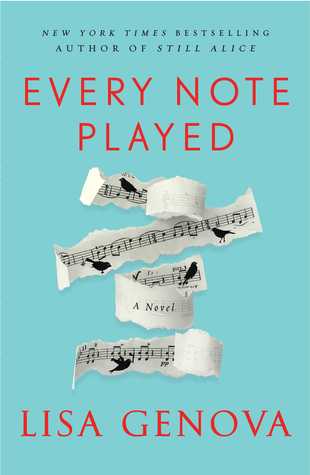
Cover Crush: Every Single Note by Lisa Genova

I am not a cover designer but I can agree that cover layouts play an important role in the overall presentation of stories and I must admit, often times I first judge a book by its cover.

Every Note PlayedAbout the Book:

Hardcover, 320 pages
Published March 20th 2018 by Scout Press

An accomplished concert pianist, Richard received standing ovations from audiences all over the world in awe of his rare combination of emotional resonance and flawless technique. Every finger of his hands was a finely calibrated instrument, dancing across the keys and striking each note with exacting precision. That was eight months ago.

Richard now has ALS, and his entire right arm is paralyzed. His fingers are impotent, still, devoid of possibility. The loss of his hand feels like a death, a loss of true love, a divorce—his divorce.

He knows his left arm will go next.

Three years ago, Karina removed their framed wedding picture from the living room wall and hung a mirror there instead. But she still hasn’t moved on. Karina is paralyzed by excuses and fear, stuck in an unfulfilling life as a piano teacher, afraid to pursue the path she abandoned as a young woman, blaming Richard and their failed marriage for all of it.

When Richard becomes increasingly paralyzed and is no longer able to live on his own, Karina becomes his reluctant caretaker. As Richard’s muscles, voice, and breath fade, both he and Karina try to reconcile their past before it’s too late.

Poignant and powerful, Every Note Played is a masterful exploration of redemption and what it means to find peace inside of forgiveness.

Cover Crush is a weekly series that originated with Erin at Flashlight Commentary.

My thoughts:

 I love the clean lines, color choice and how the cover designer took images of torn sheet music and created a look as if the paper was dancing or flowing across the layout. I’ve added this book to my to-read list. 

Stephanie M. Hopkins

Other great cover crushes from my fellow book bloggers: 

Magdalena at A Bookaholic Swede
Colleen at A Literary Vacation
Heather at The Maiden’s Court
Holly at 2 Kids and Tired
Meghan at Of Quills & Vellum


My Four Legged Stool

War Banner 3-27-18

Layered Pages interview with Alfred Woollacott HERE

L.A.P. it Marketing

About the Author:

Alfred W

Alfred Woollacott, III retired from KPMG after a career spanning 34 years, choosing to reside full time at his summer residence on Martha’s Vineyard. Being “45 minutes from America” and with a 50 – 60 hour per week void to fill, he began dabbling into his family history. His dabbling grew into an obsession, and he published several genealogical summaries of his ancestors. But certain ones absorbed him such that he could not leave them. So he researched their lives and times further while evolving his writing skills from “just the facts ma’am” to a fascinating narrative style. Thus, with imagination, anchored in fact and tempered with plausibility, a remote ancestor can achieve a robust life as envisioned by a writer with a few drops of his ancestor’s blood in his veins.

When not writing, Al serves on several Boards, and keeps physically active with golf, tennis, and hockey. He and his wife of 44 years, Jill, have four children and ten grandchildren.

Author Website

Amazon Profile Page

Bookish Happenings!

Me in March 2018

Today I was going to post my review of The House on Foster Hill by Jaime Jo Wright but it doesn’t look like it’s going to happen. I’m hoping tomorrow to post my review and finish up a couple of review drafts. I’ve been trying to catch up on my backlog of reviews and let me tell you it is a LOT of work! When will I be caught up? To tell you the truth, I’m not sure. The industry needs more book bloggers and readers!


The House on Foster Hill

There are so many wonderful things about why a person should read every day. On March 31 I wrote on Facebook, “I love stories and the growth of one’s self that comes from the craft. Words are beautiful. Words are harsh. Words are emotional and often times they feel unforgiving and undeserving. Words together tell us about many things. What we come away with those words matter greatly. Remember, each reader experiences something different and sometimes the same.” This is just glimpse at what the written words means to readers and writers. I’ve thought about expanding the quote and perhaps write an essay on the topic. What do you think? The quote certainly gives a good outline to start with. Okay, I’m rambling. I blame the lack of coffee this morning. Ha!

I want to encourage you to carve out time in your day to pick up a book and read a few lines, pages and if you can, a couple of chapters. Then take the time to reflect on what you read and maybe jot your thoughts down on paper. This is a great exercise and will add meaning to your life. *Smiles*

Have a beautiful day and don’t forget to read from a book today and every day!

Stephanie M. Hopkins

How Does One Make Money Blogging?

LAP it Facebook Banner

Today I am blogging over at L.A.P. it Marketing and I’m talking about how one makes money blogging! -Stephanie M. Hopkins

Read the Post HERE 


Book Review: Every Single Secret by Emily Carpenter

Every Single Secret II

Pub Date 01 May 2018

Emotionally guarded Daphne Amos always believed she’d found a kindred spirit in her fiancé, Heath. Both very private people, they’ve kept their pasts hidden from the world, and each other, until Heath’s escalating nightmares begin to put an undeniable strain on their relationship. Determined to give their impending marriage the best chance of succeeding, Heath insists that Daphne join him on a seven-day retreat with Dr. Matthew Cerny, a psychologist celebrated for getting to the root of repressed memories. Daphne reluctantly agrees—even though the past is the last place she wants to go.

The retreat’s isolated and forbidding location increases her unease, as do the doctor’s rules: they must relinquish their keys and phones, they’ll be monitored at all hours by hidden cameras, and they’re never to socialize with the other guests.

One sleepless night, Daphne decides to leave her room…and only then does she realize that the institute is not at all what it seems—and that whatever’s crying out from Heath’s past isn’t meant to be heard. It’s meant to be silenced.

My Thoughts:

I love reading psychological thrillers and I admire writers who pen them because to really get in the mind of a sociopath or psychopath, one has to explore the dark side and in this particular case, it’s beyond creepy! Doing so is not always easy and coming up with a premise for these stories, you want to have quite the imagination to keep your readers hooked. Carpenter’s stories do this for me, and she out did herself with Every Single Secret. There is also the fact that this story is set in my state which makes it all the more intriguing.

This story has so many surprises and unexpected twist and turns that keeps you in suspense throughout the book.  Carpenter is great at setting the stage for a gothic southern story and she does it with such flare that I am always curious as to what she will write next. Her characters are so complex and at times you feel like you might not want to get too deep into their minds…I say this in a good way. She also has you question the characters actions and motives throughout the story and I find this thoroughly engaging.

When I first saw the book cover and title, I knew I had to get my hands on this story quickly! I had wondered about the cover and how it related to the story and when I got to that part, I was stunned! It’s a whopper and intensely chilling and had me a bit freaked out!

There are monsters all around us…

I rated this book four stars.

I obtained a copy of this book through NetGalley for an honest review.

Stephanie M. Hopkins

A Time to Mourn: 19th Century by Janet Stafford

Today at Layered Pages I am featuring Saint Maggie by Janet Stafford.

Saint Maggie is currently $1.99 for the Kindle ebook, free on Kindle Unlimited and $11.90 in paperback at Amazon

A while back, Janet and I were talking about death in the 19th Century and how important it was to people how one died and how they were mourned during the Victorian era. The Victorians took death serious and rightfully so. Our conversation was so fascinating I wanted to learn more about this subject. I am pleased that Janet has provided passages from her story, “Saint Maggie”, that depicts a little of what we discussed. Below you will read about Janet’s book, entries from the story and view images of the cover, house that reminds Janet of Maggie’s Boarding House, the Locktown Stone Church” in Locktown, NJ (Delaware Township). But it once was known as “The Old School Baptist Church.”, the Delaware River by Lumberton, PA and a woman that reminds Janet of her character Maggie. -Stephanie M. Hopkins 

This slideshow requires JavaScript.

About Saint Maggie:

Maggie Blaine, a widow with two teenage daughters, runs a rooming house smack dab on the town square. In 1860 this makes her a social outcast. Boarding houses are only semi-respectable and hers has a collection of eclectic boarders – a failed aging writer, an undertaker’s apprentice, a struggling young lawyer, and an old Irishman. In addition, she has a friendship with Emily and Nate, an African-American couple with whom she shares her home and chores. It is a good thing the town doesn’t know that Maggie, along with Nate, Emily, and Eli Smith (the free-thinking editor of the weekly newspaper) are involved in the Underground Railroad. When she is asked to house handsome, gifted Jeremiah Madison, the new Methodist minister, Maggie hopes that he will both revive the little church she attends and provide her boarding house with a bit of badly-needed respectability. But Jeremiah comes with some dark secrets that challenge Maggie’s resolve to love and respect all people. As the town’s people reel from a series of shocking events, the compassionate, faithful Maggie searches for truth and struggles to forgive and love. (Based on a historical event.)

 Entries from SAINT MAGGIE:

Maggie’s Journal, 7 December 1860

 Patrick McCoy and the undertaker have laid Leah out in the front parlor. She lies, wearing her best silk dress of rose as if she were asleep. But she is not lying in bed. She is lying on a cooling board with ice below.

According to custom, our family has gathered to sit and mourn. Samuel, Abigail, and their two sons have been weeping sedately and properly before the coffin, but I know that beneath the propriety their hearts have been torn to shreds. Jeremiah Madison, too, prays and weeps softly. But beneath his veneer, I know that he also is housing an utterly broken heart. He does love Leah. It is obvious to my eyes now. How could I have doubted his devotion to her? There is nothing left inside him. That is so clear. I find myself struggling with memories of how it had been when John and Gideon died – the empty shock, the complete loss of mooring for my soul. And now I have a dead, empty hole within me from my miscarriage. Why does death leave such hollowness, such nothingness, such aloneness? No words, no actions, nothing can touch the aching solitude.

There is little I can do for my brother and his family and for Mr. Madison but to sit, watch, and pray. I feel weary and battered in spirit.

I have found some comfort, though. The Bible says that the Holy Ghost will intercede when we cannot find words, and, oh, how I cling to that promise and rest in the hope that the Spirit is at work when I am unable to do a blessed thing!

Maggie’s Journal, 9 December 1860

 Leah Beatty Madison was buried in the cemetery behind the Methodist Church this shivery, cloudy day. We sent invitations – funerals are private affairs for mourners only and not for curiosity-seekers – and family and close friends came to hear the Presbyterian minister’s prayers and sermon. Everyone was in black, as is proper. As for me, I will wear black for the next three months. Leah was my niece, and I must go into mourning for her.

The procession was slow and solemn, as the four black-plumed horses drew the hearse toward the cemetery. We all followed quietly on foot. Our eyes were downcast and tear-filled. Eli, Nate, Edgar, Robert Beatty and Joshua Beatty served as pallbearers. The rest of us stood, braced against a cold, sharp wind, as they shifted the coffin from the hearse and carried it to the grave. The bleakness of the weather matched the bleakness of our spirits: a fitting setting for the loss of a life so young and another life unborn.

When the family tossed clods of dirt on the coffin, the finality of the act echoed through us all. I know that in the future we will be comforted by the knowledge that Leah is with her Savior in heaven and that we shall all see her again someday. But now, at this moment, there is only death and cold and damp.

About the Author:

Janet R Stafford

Janet Stafford is a Jersey girl, book lover and lifelong scribbler. She readily confesses to being overly-educated, having received a B.A. in Asian Studies from Seton Hall University, as well as a Master of Divinity degree and a Ph.D. in North American Religion and Culture from Drew University. Having answered a call to vocational, but non-ordained ministry, Janet has served six United Methodist Churches, working in spiritual formation, communications, and ministries with children, youth, and families. She also was an adjunct professor for six years, teaching college classes in interdisciplinary studies and world history.

Writing, history, and religion came together for Janet when she authored Saint Maggie, an historical novel set in 1860-61 and based on a research paper written during her Ph.D. studies. She thought the book would be a single novel, but kept hearing readers ask, “What happens next?” In response, Janet created a series that follows the unconventional family from the first book through three other novels and three short stories, all set in the traumatic years of the American Civil War. Janet also ventured into the contemporary romance genre, going closer to home (the church) for her source material. Heart Soul & Rock ’n’ Roll tells the story of 40-year-old Lindsay Mitchell, who led a rock band in college but for the past fifteen years has worked as an assistant minister. Besieged by mid-life crisis, Lins wonders if perhaps she isn’t called to something new. But could that “something new” be a relationship with Neil, a man with a messy life and a bar band called the Grim Reapers?

Author Website

Layered Pages Interview with Janet

L.A.P. it Marketing