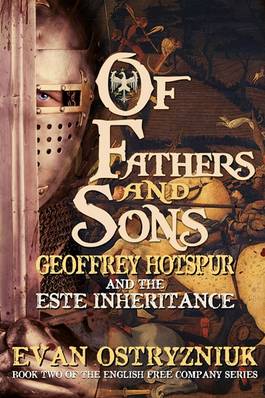
Stephanie: Hello Evan, thank you for chatting with me today. Please tell me about your book, “Of Fathers and Sons.”
Evan: A pleasure to be here. Well, the novel takes place in 1395 in northern Italy, where tensions among the great regional powers were running high – the schism in the Catholic Church had not yet closed; Florence and Milan were gearing up for another war; Venice was starting to show interest in the mainland; in other words, there was a fine balance of power in the region and just about any conflict could ignite a war that would engulf the whole peninsula. The ruler of the strategically located Marquisate of Ferrara had just died and left a minor in his place. This uncertainty was enough to attract the attention of the great powers, and each of them knew that the territory’s occupation by one or another power would tip that fragile balance. Also, the Este family was popular as wise rulers and excellent soldiers, and so keeping them as an ally was good policy. This is the broad picture. Specifically, the story is about how that minor, the twelve-year-old Niccolo d’Este, fought his uncle and tried to overcome his own insecurities and challenges. And the English Free Company arrives to help.
Stephanie: Sounds really fascinating and I enjoy reading novels that take place during that time period in history. What was your inspiration for this story?
Evan: The inspiration for this story came from the Este Inheritance itself, which included not just land and lakes, but also a legacy of strong and wise rule. The boy had a lot to live up to. Until this time, the city of Ferrara and its surrounding area comprised more or less a backwater in Italian politics, but the Este family was able transform this marginal territory into one of the great Renaissance centers, politically, socially and culturally. They introduced a number of administrative innovations that secure their, fostered economic progress, and patronized progressive thinkers. The events of 1395, specifically the civil war between the two main branches of the Este family, were pivotal in this regard. Not just the fate of the city was involved, but also the legacy of the Este family, since had things turned out differently, Ferrara would have likely taken another direction or been absorbed by one of the neighboring powers. There was a lot riding on this war.
Also, the fact that a child on the cusp of adolescence was at the heart of intrigue gave me a change to pursue writing about the High Middle Ages from a different angle. Character interactions have to be plotted with especial care to make them convincing, juvenile understanding and expectations had to be considered and integrated into the plot, and even parents must be found a role. In some ways, Geoffrey Hotspur is just a boy himself.
Stephanie: How long did it take you to write this novel?
Evan: Since Of Fathers and Sons is a part of a series, I could say that they novel can be traced back to the literary birth of Geoffrey Hotspur 3-4 years ago. It grew out of the great mass of research I did on the 14th-15th centuries. The actual setting of this story down on paper took about a year, after several fits and starts. While I have the story lodged in my head, finding the right voice required several shots at the target.
Stephanie: What was some of the research involved?
Evan: I was fortunate to get my hands on a few key texts that really helped bring to life the Este clan and the Marquisate of Ferrara, which meant that I had few gaps to fill with what I like to call ‘oblique research’. By this I mean reading up on related period settings, families, events, and the like and making educated assumptions about how my story might have looked like. All genuine historians do this, since the historical record is never close to being complete or satisfying. I always find the researching for a novel a lot of fun, whether access is easy or difficult. I not only learn so much about the people and the period, but so many ideas for the novel manifest themselves from the research – details, information, relationships, and even dialog just pour themselves into the gaps of the story’s structure. I think, like most writers, I could spin the story out indefinitely and it would be no less engrossing.
Stephanie: What are some of the fictional aspects?
Evan: The two leaders of the English Free Company are fictional, or rather they are composites of a number of historical personages. To some degree, they are archetypes. Just read Chaucer! As a result, their journey is necessarily fictional, although the setting and the major events of their adventure are well grounded in historical reality. The point is to reflect the zeitgeist as closely as possible through an independent literary agent. No historical figure was ever able to visit all the great moments of their time! Geoffrey Hotspur and his companion can do that and bring both the events and those who truly made them to vibrant light.
Stephanie: What intrigues you the most about Geoffrey Hotspur and John of Gaunt?
Evan: What most intrigues me about these men is their relationship to fatherhood and patriarchy. Hotspur is an orphan of unknown provenance and a ward of Gaunt, while the great duke had a troubled relationship with his own son, the eventual King Henry IV and was poor father figure to the last Plantagenet king, his nephew Richard II. The tensions inherent in patriarchal relationships, particularly in the Middle Ages, are some of the main themes of the English Free Company series. Geoffrey in particular is troubled by it, for reasons of fear and insecurity, and as a result many of his decisions and views are strongly colored by this question. Both men had strong determined characters, yet long-term success always seemed to elude them. Family was crucial, but difficult. The role of the father was particularly important at this time and crucial in the lives of his sons. A poor or unsuccessful father could have dire consequences for the entire family and its descendants.
Stephanie: Will there be a third book in this series?
There will be a third, fourth and fifth book of the series! The next adventure of Geoffrey Hotspur follows hard on the heels of this one, but takes place in exotic locales in the Outremer, or the Levant. 1396 was the year of the very last European Crusade in the Holy Land, and there is no way Geoffrey is going to miss it! Hospitaller knights, Hungarian lords, Grand Constables of France, and poor squires with gather to drive the Ottoman Turks out of Christendom.
Stephanie: How exciting! What is the most challenging aspect of writing Historical Fiction?
Evan: The most challenging aspect of writing Historical Fiction is filling in the blank spots. Finding the stories is easy. The historical record is by nature fragmentary, especially for the Middle Ages, and so I must make convincing, educated assumptions about so many things. Some are inferred, such as personal motivations, based on the historical consequences. For example, battlefield tactics, which are crucial to my novels, have been recorded, but the application of these tactics by this or another company sometimes require backward projection based on the result of the battle or the observations of contemporary chroniclers. On more than one occasion I have had to delete large chunks of text because what I wrote either could not fit in with what History had to say or was contradicted by a newly discovered piece of research.
Stephanie: When did you first begin to write and knew you wanted to be an author?
Evan: Funny enough, in elementary school I began creating stories through pictures with no words attached. I would take a sheet of 8.5X11 and draw a scene of…whatever. Then I would take more paper and draw the same collection of figures and setting in another way, and again, until I had a sort of film that I would tape together to produce a single visual narrative. This was fun until the teacher said enough was enough and I had to get back to work. Proper writing I did not start until college, when I would write short stories and vignettes from my life, mainly for myself, but also for others to be amused. I continued writing these vignettes until after I completed my doctorate at Cambridge, when I gave myself that challenge of writing a novel based on my interests in history. I did, and no one wanted to publish it. However, the very process of writing generated many other ideas for different novels and stories, which I found very gratifying. Now, the ideas are running out of control!
Stephanie: What advice would you give to someone who wanted to write in this genre?
Evan: Getting the facts straight is the most obvious suggestion, but if I hard to offer a single piece of key advice regarding historical fiction, I would have to say that the writer had better make sure that his or her story cannot take place at any other era. Otherwise, it loses its purpose. What I mean by that is that character, setting, motivations, mentality, even speech needs to be grounded in the historical period. Always fear anachronisms. If the work is sloppy or unconvincing, the author will swiftly lose credibility. This threat is particularly great for historical fiction because nothing can be taken for granted. The reader wants to believe he or she is proverbially going back in time. Other genres have their own challenges, but they are less dependent on good, hard technical research. Fantasy and science fiction can have whatever set of internally logical rules they want; contemporary fiction is easy to portray by virtue of direct experience; detective novels have well established structures. For historical fiction, you are only as good as your research and your ability to transfer it convincingly to the blank page.
Stephanie: What is your favorite quote?
Evan: This is a tough question because I live in fear of unconscious plagiarism. But one that has stuck with me for its humor and hard truth is a few words attributed to Oscar Wilde: “Be yourself; everyone else is already taken.”
Stephanie: Evan, it was an honor to chat with you! Thanks!
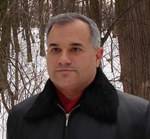 Evan Ostryzniuk was born and raised on the prairies of western Canada. After graduating from the University of Saskatchewan with a B.A. in History and Modern Languages and an M.A. in Modern History, Evan crossed the ocean to do post-graduate work at the University of Cambridge, concluding four years of research with a doctoral thesis on the Russian Revolution. He then found his way to Eastern Europe, where he took up positions as a magazine editor, university lecturer and analyst in the financial services sector before rising in the ranks of the local publishing industry to become Editor-in-Chief of a popular weekly.
Evan Ostryzniuk currently resides in Kyiv, Ukraine near a very large candy factory. He has travelled extensively, including the locations of his novels. Of Fathers and Sons: Geoffrey Hotspur and the Este Inheritance is his second novel.
http://www.evanostryzniuk.com/[SH1]
Link to Tour Schedule: http://hfvirtualbooktours.com/offathersandsonsvirtualtour/
Twitter Hashtag: #FathersAndSonsTour