Biographies & Memoirs

This past Sunday, I met a dear friend at a local coffee shop and what a treat it was! We talked about many topics and our mutual love for nonfiction. My friend is currently listening to Braiding Sweetgrass: Indigenous Wisdom, Scientific Knowledge and the Teachings of Plants by Robin Wall Kimmerer and she highly recommend it to me. Later on, when I got home, I sent her a picture of the nonfiction book I’m reading. The title is, The Neighborhood Project by David Sloan Wilson. I received the book as an ARC many years ago.  

This led me to further explore more nonfiction books to add to my to-read wish-list. Below are five new titles I have added. My wish is for you to be encouraged and inspired to read more and to explore nonfiction in a broader sense-if you haven’t already.

Stephanie Hopkins

The Book-Makers

A History of the Book in Eighteen Lives

by Adam Smyth

Description

The five-hundred-year history of printed books, told through the people who created them

Books tell all kinds of stories—romances, tragedies, comedies—but if we learn to read the signs correctly, they can tell us the story of their own making too. The Book-Makers offers a new way into the story of Western culture’s most important object, the book, through dynamic portraits of eighteen individuals who helped to define it.  
 
Books have transformed humankind by enabling authors to create, document, and entertain. Yet we know little about the individuals who brought these fascinating objects into existence and of those who first experimented in the art of printing, design, and binding. Who were the renegade book-makers who changed the course of history?  
 
From Wynkyn de Worde’s printing of fifteenth-century bestsellers to Nancy Cunard’s avant-garde pamphlets produced on her small press in Normandy, this is a celebration of the book with the people put back in. 

Twenty Years

Hope, War, and the Betrayal of an Afghan Generation

by Sune Engel Rasmussen

Description

An intimate history of the Afghan war—and the young Afghans whose dreams it enabled and dashed.

No country was more deeply affected by 9/11 than Afghanistan: an entire generation grew up amid the upheaval that began that day. Young Afghans knew the promise of freedom, democracy, and safety, fought with each other over its meaning—and then witnessed its collapse. In Twenty Years, the Wall Street Journal correspondent Sune Engel Rasmussen draws on more than a decade of reporting from the country to tell Afghanistan’s story from a new angle. Through the eyes of newly empowered women, skilled entrepreneurs, driven insurgents, and abandoned Western allies, we see the United States and its partners bring new freedoms and wealth, only to preside over the corruption, war-lordism, and social division that led to the Taliban’s return to power.

Rasmussen relates this history via two main characters: Zahra, who returns from abroad with high hopes for her liberated county, where she must fight to escape a brutal marriage and rebuild her life; and Omari, who joins the Taliban to protect the honor of his village and country and winds up wrestling with doubt and the trauma of war after achieving victory. We also meet Parasto, who risks her life running clandestine girls’ schools under the new Taliban regime, and Fahim, a rags-to-riches tycoon who is forced to flee. With intimate access to these and other characters, Rasmussen offers deep insight into a country betrayed by the West and Taliban alike.

Warsaw Testament

by Rokhl Auerbach, Translated by Samuel Kassow

Description

Born in Lanowitz, a small village in rural Podolia, Rokhl Auerbach was a journalist, literary critic, memoirist, and a member of the Warsaw Yiddish literary community before the Holocaust. Upon the German invasion and occupation of Poland in 1939, she was tasked by historian and social activist Emanuel Ringelblum to run a soup kitchen for the starving inhabitants of the Warsaw Ghetto and later to join his top-secret ghetto archive, the Oyneg Shabes. One of only three surviving members of the archive project, Auerbach’s wartime and postwar writings became a crucial source of information for historians of both prewar Jewish Warsaw and the Warsaw Ghetto. After immigrating to Israel in 1950, she founded the witness testimony division at Yad Vashem and played a key role in the development of Holocaust remembrance. Her memoir Warsaw Testament, based on her wartime writings, paints a vivid portrait of the city’s prewar Yiddish literary and artistic community and of its destruction at the hands of the Nazis.
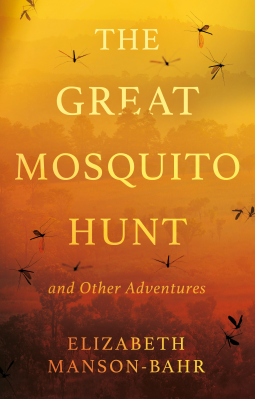
The Great Mosquito Hunt and Other Adventures

by Elizabeth Manson-Bahr

Description

This book is the author’s answer to the question Who do you think you are? set in China, Russia, Egypt, Kenya, Fiji and the US during the 18th to 20th centuries. It describes the battle to discover the causes of malaria. Sir Patrick Manson, the author’s great-grandfather, known as Mosquito Manson, was the first scientist to prove that insects were vectors of disease, a discovery which led to the detection of the malarial parasite. He founded the Chinese Medical School in Hong Kong and the London School of Tropical Medicine. Among his pupils was Sun Yat-sen, the first President of modern China.

It is the story too of plagues and pandemics, of Scottish and German merchants who made their fortunes in 19th century Egypt and 18th century Russia. The author’s mother, orphaned by the Spanish flu, made her way to Africa where she served as a FANY in 1942, marrying Clinton, the third in the family line of tropical medical specialists. The chapters are interspersed with the author’s own childhood memories growing up in Fiji and Kenya.
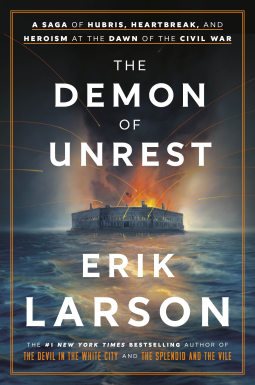
The Demon of Unrest

A Saga of Hubris, Heartbreak, and Heroism at the Dawn of the Civil War

by Erik Larson

Description

The #1 New York Times bestselling author of The Splendid and the Vile brings to life the pivotal five months between the election of Abraham Lincoln and the start of the Civil War—a simmering crisis that finally tore a deeply divided nation in two.

One of Time’s Most Anticipated Books of the Year


On November 6, 1860, Abraham Lincoln became the fluky victor in a tight race for president. The country was bitterly at odds; Southern extremists were moving ever closer to destroying the Union, with one state after another seceding and Lincoln powerless to stop them. Slavery fueled the conflict, but somehow the passions of North and South came to focus on a lonely federal fortress in Charleston Harbor: Fort Sumter.

Master storyteller Erik Larson offers a gripping account of the chaotic months between Lincoln’s election and the Confederacy’s shelling of Sumter—a period marked by tragic errors and miscommunications, enflamed egos and craven ambitions, personal tragedies and betrayals. Lincoln himself wrote that the trials of these five months were “so great that, could I have anticipated them, I would not have believed it possible to survive them.”

At the heart of this suspense-filled narrative are Major Robert Anderson, Sumter’s commander and a former slave owner sympathetic to the South but loyal to the Union; Edmund Ruffin, a vain and bloodthirsty radical who stirs secessionist ardor at every opportunity; and Mary Boykin Chesnut, wife of a prominent planter, conflicted over both marriage and slavery and seeing parallels between them. In the middle of it all is the overwhelmed Lincoln, battling with his duplicitous secretary of state, William Seward, as he tries desperately to avert a war that he fears is inevitable—one that will eventually kill 750,000 Americans.

Drawing on diaries, secret communiques, slave ledgers, and plantation records, Larson gives us a political horror story that captures the forces that led America to the brink—a dark reminder that we often don’t see a cataclysm coming until it’s too late.

My Journey of Continual Education

My current reads and for the next few years, my main reading focus is nonfiction and studying diverse cultures-how they evolve in-depth- government entities, world history and economics.

I’ve studied and read quite a few books on American history (particular 19th Century) but lately I’ve discovered so much I’ve sorely missed out on. That said, one’s education should be a life long journey. I’m looking forward to reading and studying these books.

The Americans, Vol 1: The Colonial Experience

(The Americans #1) by Daniel J. Boorstin

Winner of the Bancroft Prize. “A superb panorama of life in America from the first settlements on through the white-hot days of the Revolution.” – Bruce Lancaster, Saturday Review

The Americans, Vol 2: The National Experience Paperback – by Daniel J. Boorstin

This second volume in “The Americans” trilogy deals with the crucial period of American history from the Revolution to the Civil War. Here we meet the people who shaped, and were shaped by, the American experience—the versatile New Englanders, the Transients and the Boosters.  Winner of the Francis Parkman Prize.

The Americans, Vol 3: The Democratic Experience Paperback by Daniel J. Boorstin

Winner of the Pulitzer Prize. A study of the last 100 years of American history.

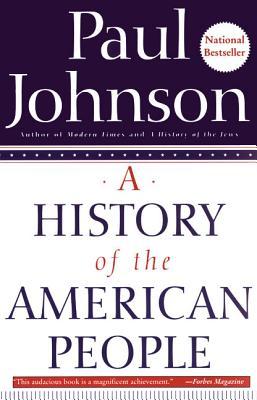
A History of the American People by Paul Johnson

“The creation of the United States of America is the greatest of all human adventures,” begins Paul Johnson. “No other national story holds such tremendous lessons, for the American people themselves and for the rest of mankind.”

In his prize-winning classic, Johnson presents an in-depth portrait of American history from the first colonial settlements to the Clinton administration. This is the story of the men and women who shaped and led the nation and the ordinary people who collectively created its unique character. Littered with letters, diaries, and recorded conversations, it details the origins of their struggles for independence and nationhood, their heroic efforts and sacrifices to deal with the ‘organic sin’ of slavery and the preservation of the Union to its explosive economic growth and emergence as a world power. Johnson discusses contemporary topics such as the politics of racism, education, the power of the press, political correctness, the growth of litigation, and the influence of women throughout history. He sees Americans as a problem-solving people and the story of their country as “essentially one of difficulties being overcome by intelligence and skill, by faith and strength of purpose, by courage and persistence… Looking back on its past, and forward to its future, the auguries are that it will not disappoint humanity.”

Sometimes controversial and always provocative, A HISTORY OF THE AMERICAN PEOPLE is one author’s challenging and unique interpretation of American history. Johnson’s views of individuals, events, themes, and issues are original, critical, and in the end admiring, for he is, above all, a strong believer in the history and the destiny of the American people.

Other recent relevant posts:

Cultural Nonfiction Books

A Better Understanding of Political and Social Controversies of Our Times

I’m looking forward to sharing more books I’ve discovered and as I read them, I will be writing down my thoughts on them in future posts.

Stephanie Hopkins

A Better Understanding of Political and Social Controversies of Our Times

I’ve known about Thomas Sowell for a few years now and have listened to many of his interviews’ and recently started listening to his audio books on YouTube. I first became interested in his work on two scores. The first, his research on the history of slavery and two, his journey with Marxism in his twenties. His clear cut, intellectual thoughts are enlightening to say the least. He reacts on information rather than feelings. Sowell’s writings should be mandatory study in the school system.

His lectures on the history of slavery validated a passage I read on the subject over fifteen years ago. I was over at a friend’s house, scrap-booking and mentioned what I had read about slavery in Africa and the said “friend” proceeded to shut me down and was appalled at what I had stated. I was taken back by her reaction and to my dismay, I dropped the subject entirely. It is as if she thought I had some sort of agenda in what I said and refused to have an objective conversation. Though, I dare say, she did not have an intelligent response at anytime. In hindsight, I should have asked her about her sources and why she is dismissing my discovering.

I’m currently re-reading, The Communist Manifesto by Karl Marx & Engels (which is pure propaganda in my opinion but an important to read) and have just started, The Naked Communist by W. Cleaon Skousen. After I read those books and finish listening to Sowell’s audio books, I want to purchase a few of his physical books for further study.

Here are the titles I want to acquire by Sowell:

Intellectuals and Society

Economic Facts and Fallacies

The Housing Boom and Bust

A Conflict of Visions: Ideological Origins of Political Struggles

Black Rednecks and White Liberals

The Quest for Cosmic Justice

Bio:

Thomas Sowell is an American economist, social commentator, and author of dozens of books. He often writes from an economically laissez-faire perspective. He is currently a senior fellow of the Hoover Institution at Stanford University. In 1990, he won the Francis Boyer Award, presented by the American Enterprise Institute. In 2002 he was awarded the National Humanities Medal for prolific scholarship melding history, economics, and political science.

Sowell was born in North Carolina, where, he recounted in his autobiography, A Personal Odyssey, his encounters with Caucasians were so limited he didn’t believe that “yellow” was a hair color. He moved to Harlem, New York City with his mother’s sister (whom he believed was his mother); his father had died before he was born. Sowell went to Stuyvesant High School, but dropped out at 17 because of financial difficulties and a deteriorating home environment. He worked at various jobs to support himself, including in a machine shop and as a delivery man for Western Union. He applied to enter the Civil Service and was eventually accepted, moving to Washington DC. He was drafted in 1951, during the Korean War, and assigned to the US Marine Corps. Due to prior experience in photography, he worked in a photography unit.

After his discharge, Sowell passed the GED examination and enrolled at Howard University. He transferred to Harvard University, where he graduated magna cum laude with a Bachelor of Arts degree in Economics. He received a Master of Arts in Economics from Columbia University, and a Doctor of Philosophy in Economics from the University of Chicago. Sowell initially chose Columbia University because he wanted to study under George Stigler. After arriving at Columbia and learning that Stigler had moved to Chicago, he followed him there.

Sowell has taught Economics at Howard University, Cornell University, Brandeis University, and UCLA. Since 1980 he has been a Senior Fellow of the Hoover Institution at Stanford University, where he holds a fellowship named after Rose and Milton Friedman.

Bio and picture used from goodreads

What I’m Reading and Pondering

Servants of the Storm by Delilah S. Dawson

My thoughts so far:

I am deeply fascinated with Southern Gothic stories and I decided to give Servants of the Storm by Delilah S. Dawson a go. This is more of a young adult book, which I don’t normally read, but still find it compelling. I do have a few complaints but will reserve sharing those thoughts at a later time since I’m not quite at the half way mark.

About the book:

Dovey learns that demons lurk in places other than the dark corners of her mind in this southern gothic fantasy from the author of the Blud series.

A year ago, Hurricane Josephine swept through Savannah, Georgia, leaving behind nothing but death and destruction—and taking the life of Dovey’s best friend, Carly. Since that night, Dovey has been in a medicated haze, numb to everything around her.

But recently she’s started to believe she’s seeing things that can’t be real…including Carly at their favorite café. Determined to learn the truth, Dovey stops taking her pills. And the world that opens up to her is unlike anything she could have imagined.

As Dovey slips deeper into the shadowy corners of Savannah—where the dark and horrifying secrets lurk—she learns that the storm that destroyed her city and stole her friend was much more than a force of nature. And now the sinister beings truly responsible are out to finish what they started.

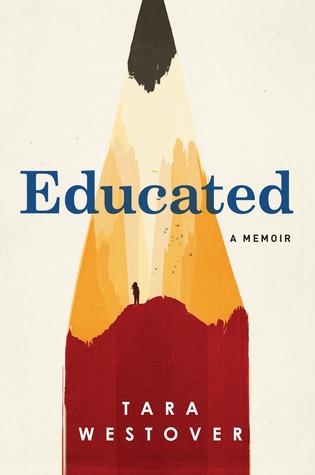
Educated by Tara Westover

My thoughts so far:  

I find this story fascinating and find Tara’s father to be sorely misguided in the fact that you can have your beliefs about Government, know the tools of survival, live off the land (which is important) or almost completely off grid in this case and still be educated, well-read and knowledgeable in the ways of the world through literature and self-learning without compromising your beliefs. After-all, education in many different areas gives one an advantage. Not allowing his children to learn how to read is heart breaking in my opinion. Now, I don’t believe everything I read, see or hear and that is where my critical thinking comes into play but I still need to know what is out there. I firmly believe that is a major part in our survival and it does sharpen the mind.

A few of Mark Twain’s quotes about education comes to mind.

“The man who does not read books has no advantage over the man that cannot read them.”

“It is noble to teach oneself, but still nobler to teach others – and less trouble.”

“I never let my schooling interfere with my education.”

While I believe our school system is failing and lacking in many ways, I discovered that if I wanted to be “educated” by my own terms and definitions of the word, that I needed to read as many books as I can, try new things, listen to as many people’s outlook as I can and their experiences on life. I also, look at things with a critical mind, while keeping an open mind. That is important. I consider school a jump start into one’s education. Learn the tools that are given to you and branch out from there. You should never stop learning. Tara’s parents could have home schooled their children if they did not believe in the public education system, while holding to their beliefs!

I am still in the early stages of this story and Tara is still living with her family. With the thoughts I’ve already formed about the story, I look forward to discovering more. -Stephanie Hopkins

About the book:

Tara Westover was 17 the first time she set foot in a classroom. Born to survivalists in the mountains of Idaho, she prepared for the end of the world by stockpiling home-canned peaches and sleeping with her “head-for-the-hills bag”. In the summer she stewed herbs for her mother, a midwife and healer, and in the winter, she salvaged in her father’s junkyard.

Her father forbade hospitals, so Tara never saw a doctor or nurse. Gashes and concussions, even burns from explosions, were all treated at home with herbalism. The family was so isolated from mainstream society that there was no one to ensure the children received an education and no one to intervene when one of Tara’s older brothers became violent.

Then, lacking any formal education, Tara began to educate herself. She taught herself enough mathematics and grammar to be admitted to Brigham Young University, where she studied history, learning for the first time about important world events like the Holocaust and the civil rights movement. Her quest for knowledge transformed her, taking her over oceans and across continents, to Harvard and to Cambridge. Only then would she wonder if she’d traveled too far, if there was still a way home.

Educated is an account of the struggle for self-invention. It is a tale of fierce family loyalty and of the grief that comes with severing the closest of ties. With the acute insight that distinguishes all great writers, Westover has crafted a universal coming-of-age story that gets to the heart of what an education is and what it offers: the perspective to see one’s life through new eyes and the will to change it.

Finding Your Writing Voice Through Journaling

There are several methods of journaling that I incorporate in my daily life. The one activity they all have in common is they tell a story. They hold a deep and lasting meaning of my life and the lives I see around me. Looking back on all my journals and diaries, I’ve come to realize that in this endeavor is where I discovered my true writing voice. It wasn’t from reading books, though reading helps one grow their understanding of the written word, how stories are told, other life experiences and expands on one’s vocabulary, my writing voice developed over time from writing in journals. Could have it also been from blogging? Yes, I do find blogging a form of journal writing. A record keeping of thoughts, words, expression, emotions and even those awkward sentences where I couldn’t quite express myself in the way I felt inside. Those particular words don’t always come naturally to me in public form or rather, my private journals is what speaks of my truest inner voice.

Many people want to write in their journals but their uncertainty is holding them back. They say, “I’m not a writer or I would ruin my page, or rather my beautiful journal with my awkward words and ramblings.” Those awkward words and ramblings are what drives one to become a stronger writer. You must be deliberate with your writing and in the time, you take to write. Think of all the visits you made to a library filled with books that hold millions of words. Often times, those words did not come easy to the writer. Imagine the time and deliberate ink to paper or key strokes the writer put forth to build worlds in those numerous books. Believe me, it didn’t happen overnight for them. Don’t allow that voice in your head saying, “You’re not a writer,” intimidate you. Writing is a beautiful art regardless of one’s uncertainty in the act. Write what you know, write what you see and hear. Write a word or two and keep adding words after that. Allow those words to build on each other and soon you’ll find your voice as a writer. Once you do, words will flow and writing will be like exploring space. The act will take you to limitless places.

Stephanie Hopkins

Home Library Books

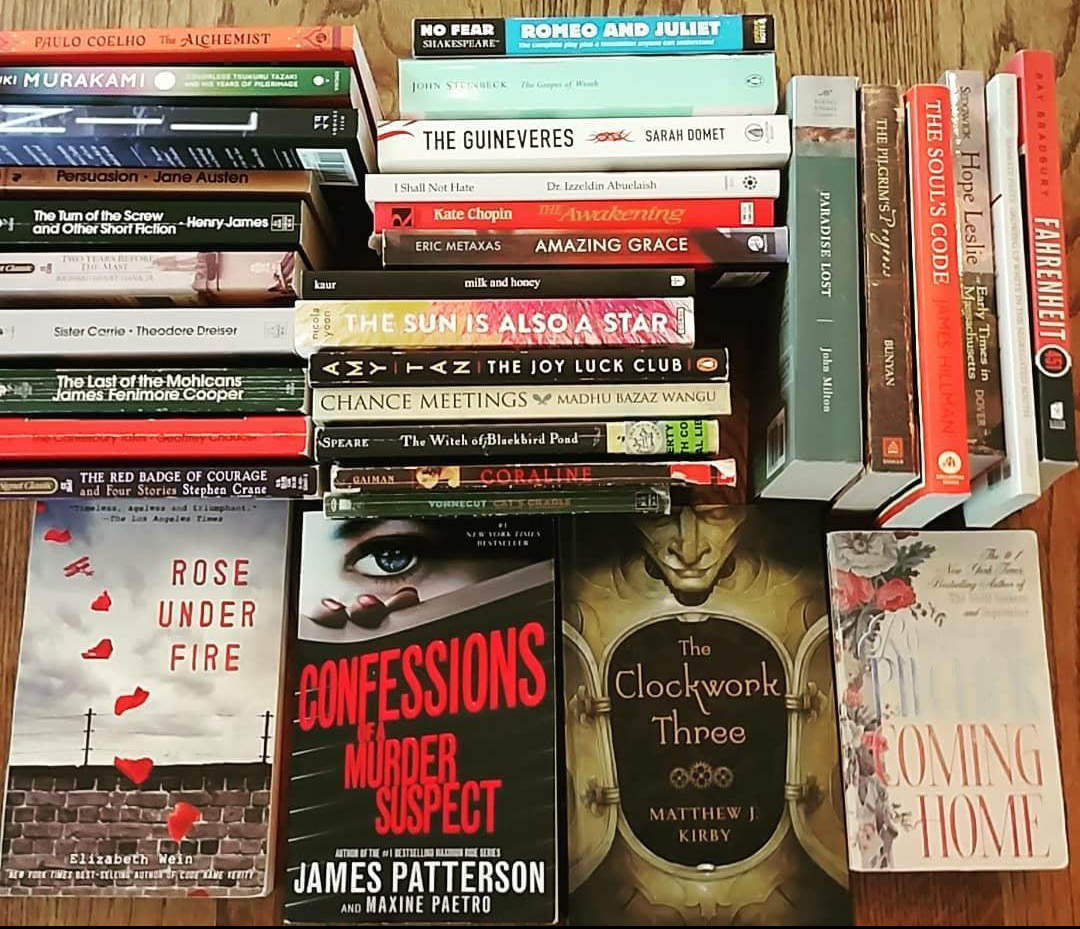
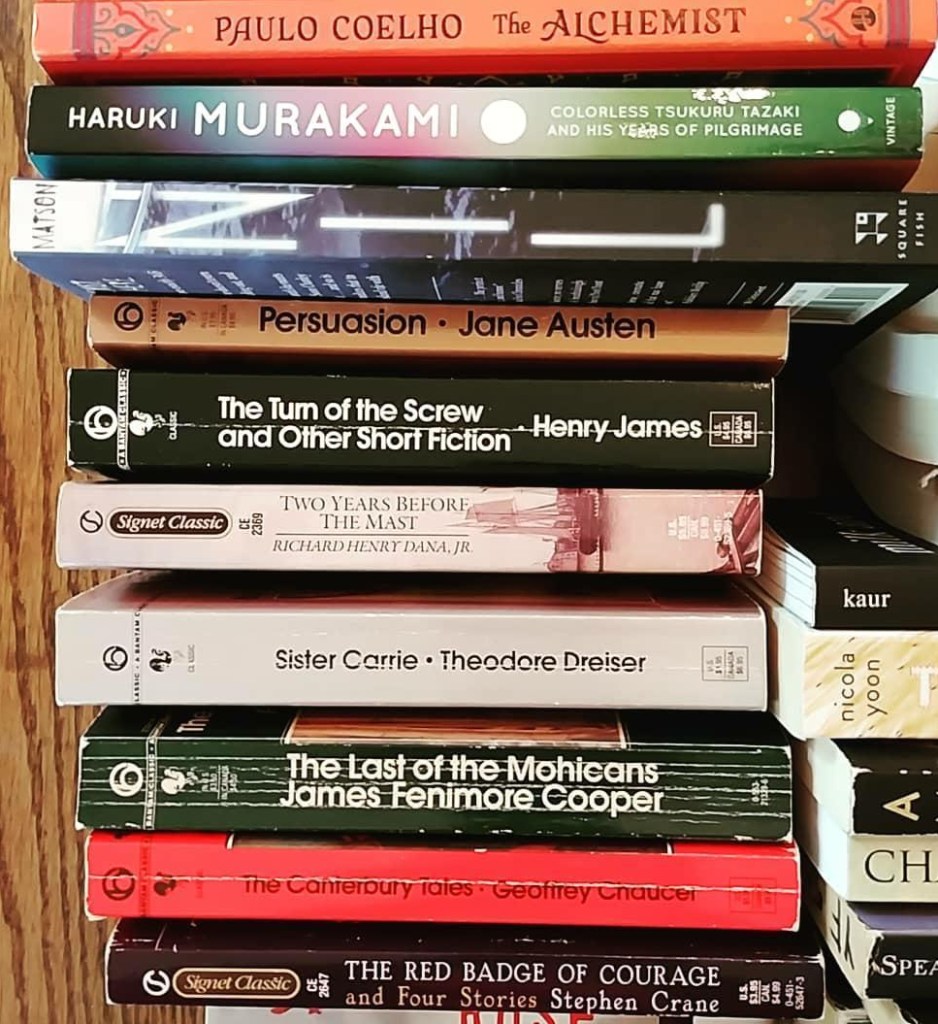
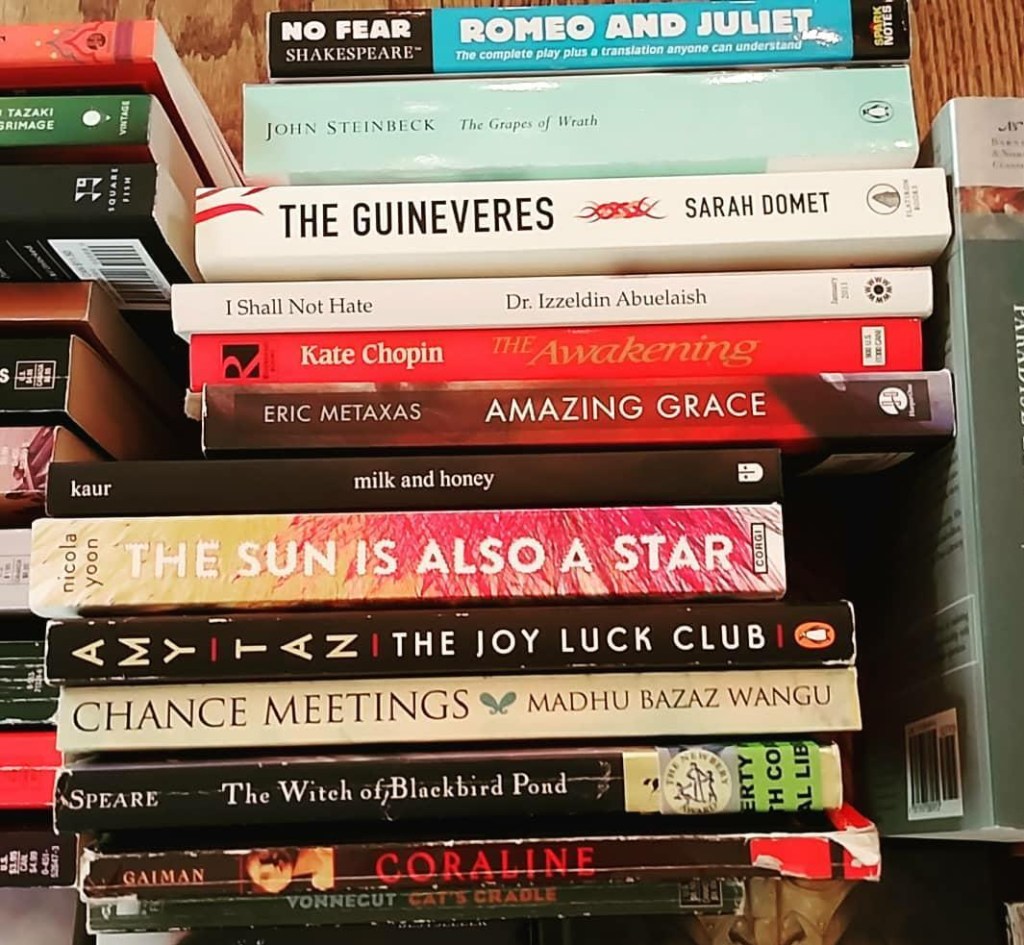
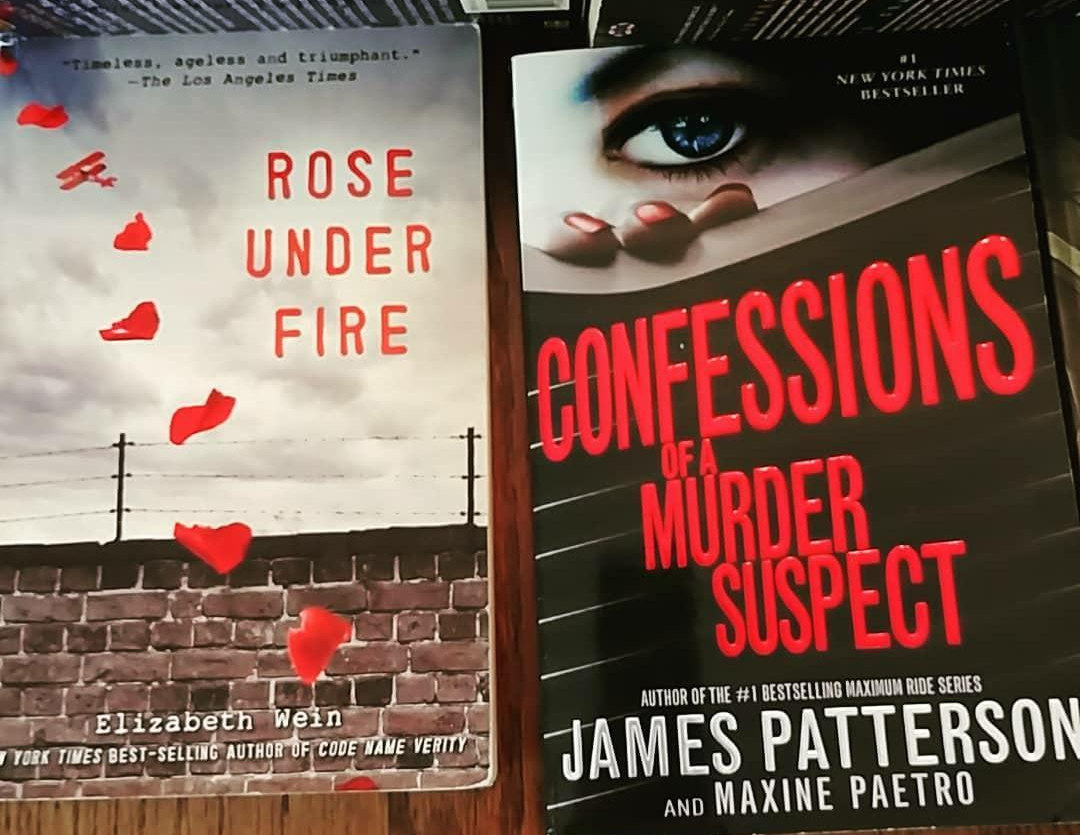
I still have quite a few NetGalley books to get through. However, I made a promise to myself that I would read books from my home library that I haven’t read yet-which I’m currently proactively doing. There are many books in this pile I have read before, and have read more than once. I’ve also made a promise to my daughter, a while back, to read books she read and enjoyed during her middle school and high school years. These piles consist of thirty-three books I’m hoping to read this year, or finish by next spring. I’m also considering annotating quite a few of these books. It’s important to re-read books, to read a variety of books, to keep on reading, to truly think about what you are reading and what the story conveys. Reading is knowledge and gives you the tools to keep ignorance at bay to say the least.

There are a few books in this pile that English majors are required to read. Keep in mind, all required reading material for English degrees vary and Professors do not adhere to the same lists. In a nut shell, be well read and be prepared. An English major is a whole lot more than just enjoying reading books. This subject is for another blog post, which I shall post in the near future.

Which of these titles shown, have you read? Have you read any of them more than once? What did you think of them? Would you consider reading them again and quite possibly experience something completely different the second time around?

Stephanie Hopkins

Should Speed Reading be Your Objective?

Introduction to exploring why we read and what methods we use.

The topic of speed reading has been around a long time. For a while now I’ve been meaning to explore why it is even a consideration.

The concept of speed reading according to Wikipedia is to improve one’s ability to read quickly. Reading further on the subject, I discovered that the term was coined by Evelyn Wood in the late 1950’s. She was a school teacher who wanted to understand why some people read faster, and to create a method to increase speed. Wood claimed her intentions were also to improve comprehension.

It is safe to say that most have heard of the speed reading. Does the method over shadow the main objective that comes with reading? Or should it even be something you try? How will it benefit you? Does it really improve comprehension? Is there value in the method? Would speed reading decrease your ability to be a critical thinker? Will there be important details you might miss? Do you speed read just to see how many books you can read within a limited time? Or to reduce your ever-growing pile of books? Those are a lot of questions to ponder.

I’ve looked at this from different angels and I’ve come to the conclusion that you might as well not read if speed reading is your main objective. The point of reading is broad and a matter to explore further. One of the points of reading is to expand your knowledge. I realize that everyone learns differently. What one method might work for some; it might not work for others.

When we take the time to appreciate and reflect upon the material we are reading, we add value. Especially if you apply it. Let’s face it, you’ll enjoy a book more or get more out of it by slowing down your pace. Of course, if you incorporate reading in your daily routine, you’ll find yourself consuming books faster.

I’m still wanting to write about this subject in more depth and to discuss the many important points of reading. Looking forward to it. Who knows where this might lead us?

Stephanie Hopkins