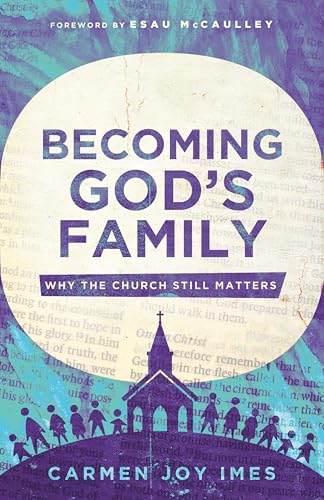
Book Review: Becoming God’s Family: Why the Church Still Matters by Carmen Joy Imes

Published Oct 28, 2025 by IVP Academic

Does the church still matter in our modern world?

After waves of disillusionment, #churchtoo movements, and political divides, it’s easy to question the value of investing in the church. Yet Carmen Joy Imes offers a profound answer that resonates through the pages of Becoming God’s Family. Exploring the familial and communal identity of the church, Imes traces the thread of God’s presence in the gathered community of faith across the entire Bible. She invites readers into a vision of the church that is rooted deeply in Scripture and speaks directly to the challenges we face today. Imes reminds us of a powerful truth—God delights in the global, inter-generational family He has created.

Through this book, you’ll discover that God keeps His promises. When God’s people gather together, God shows up. Whether you’re struggling to reconnect with the church, seeking a constructive vision for its role in our world, or longing to better understand its biblical foundations, this book offers clarity, hope, and encouragement.

Check out what Dr, Imes has to say about her book on her YouTube channel HERE

My thoughts:

Becoming God’s Family by Carmen Joy Imes is the third in her trilogy. The first two books are “Bearing God’s Name: Why Sinai Still Matters” and “Being God’s Image: Why Creation Still Matters.”  

Imes earned a PhD in Biblical Theology at Wheaton College, an MA in Biblical Studies from Gordon-Conwell Theological Seminary, and a BA from Multnomah University. She is currently an Associate Professor of the Old Testament at Biola University.

With an outstanding Biblical perspective, Imes writes about what the church is meant to be starting in Genesis and taking you through the Bible. Imes’s theological narrative and approach to God’s church is beautifully weaved and her writing style is refreshing and approachable and I had no problem understanding the text. Imes is a gifted Bible teacher and writer.

I must say, as I was reading, Imes has given me a new insight on this subject that has been on my mind for the last few years now. As I was reading, I felt a calmness wash over me and it was also like a light switched on in my soul. I am over-whelmed with thankfulness that Imes wrote this book. Becoming God’s Family needs to be in every church across the globe. Whether you’re a believer or non-believer or thinking about joining a church, this book is a must read.

At the end of each chapter Imes gives us the key ideas and book resources (Digging Deeper) which is a great help for study. She also has Scripture verses throughout and I recommend having your Bible open as you read this book. I did not have my Bible open this round but I will in my second round of reading…

I will definitely be purchasing a physical book for my home theological library and will be using it as reference for Biblical projects I’m working on.

A big thank you to IVP Academic and NetGalley for a review copy.

Stephanie  

Four quotes from “Becoming God’s Family.” (There are many more.)

“Christ has only one body, one bride, one temple, one kingdom. As we are united to Christ, we are untied to one another. “

 “As long as we see others as the enemy rather than as potential family members, we have not become the community God desires.”

“The true family of faith is marked by hospitality. God calls us to arrange our lives so that we have room for others.”

“Israel consists of twelve tribes; Jesus calls twelve disciples, reconstituting the nation himself.”

Stephanie

Carmen Joy Imes’s Links:

YOUTUBE

Substack newsletter

Blog

Amazon Author Page

Side Bar: I still have so many things to say about this book, giving examples of what Imes wrote that really impacted me. I will pulling topics and will be fleshing out topics (especially the global church) that I want to give my thoughts on.

I want to also makes sure that the readers know that the Old Testament and New Testament is a sweeping narrative and one must read the whole Bible. The New Testament helps you understand the Old Testament and vice versa.

Reader’s Log 055: Current and Upcoming Reads

I finished and reviewed, “The Lost Baker of Vienna by Sharon Kurtzman and enjoyed the story and now I’ve started reading a couple days ago, “Children of the Book: A Memoir of Reading Together” by Ilana Kurshan. I must confess I’m a little concern about the page length and how the theme will flow through the pages. That said, so far I’m enjoying reading about this family’s love for reading.  

I’m still reading, “The Curious Inheritance” of Blakely House and “Reflections on the Psalms by C. S. Lewis.” These two are wonderful and engaging reads and I’m taking my time with them though I’m getting close to finishing The Curious Inheritance. After I finish with Lewis’s book I’m going to start reading, “A Sacred Sorrow” by Michael Card. I have so much to say about lament and I look forward to sharing more on the subject at a later time. After I finish up with Curious Inheritance, I’m thinking about starting, “Daughter of Egypt” by Marie Benedict. I have an ARC of this book and I’m thrilled with the premise for this story. Also, I’ve been reading, “Babylon” by Paul Kriwaczek and while I don’t agree with everything he writes, I do find many aspects of the information he provides to be fascinating and I’ve learned few new details that I need for my research. Kriwaczek is a good writer and it makes his book easier to read which is refreshing and helpful!

Stephanie

Children of the Book: A Memoir of Reading Together by Ilana Kurshan

Not yet published Expected Aug 26, 2025 by St. Martin’s Press

In Children of the Book, Ilana Kurshan explores the closeness forged when family life unfolds against a backdrop of reading together. Kurshan, a mother of five living in Jerusalem, at first struggles to balance her passion for literature with her responsibilities as a parent. Gradually she learns how to relate to reading not as a solitary pursuit and an escape from the messiness of life, but rather as a way of teaching independence and forging connection. Introducing her children to sacred and secular literature—including the beloved classics of her childhood—helps her become both a better mother and a better reader.

Chief among the books Kurshan reads with her children is the Five Books of Moses, known as the Torah, which Jews the world over read in synchrony as part of the liturgical cycle. In the five parts of this memoir, Kurshan explores the surprising resonances between the biblical text and her experiences as a mother and a reader – from the first picture books that create the world through language for little babies, to the moment our children begin reading on their own leaving us behind, atop the mountain, as they enter new lands without us. A testament to the enduring power of shared texts, Children of the Book celebrates the deep pleasures of books.

Daughter of Egypt by Marie Benedict

Not yet published

Publish Date: Mar 24, 2026 by St. Martin’s Press

In the 1920s, archeologist Howard Carter and Lord Carnarvon of Highclere Castle made headlines around the world with the discovery of the treasure-filled tomb of the boy Pharaoh Tutankhamun. But behind it all stood Lady Evelyn Herbert—daughter of Lord Carnarvon—whose daring spirit and relentless curiosity made the momentous find possible.

Nearly 3,000 years earlier, another woman defied the expectations of her time: Hatshepsut, Egypt’s lost pharaoh. Her reign was bold, visionary—and nearly erased from history.

When Evelyn becomes obsessed with finding Hatshepsut’s secret tomb, she risks everything to uncover the truth about her reign and keep valued artifacts in Egypt, their rightful home. But as danger closes in and political tensions rise, she must make an impossible choice: protect her father’s legacy—or forge her own.

A Sacred Sorrow: Reaching Out to God in the Lost Language of Lament by Michael Card

Published February 1, 2005 by NavPress

It’s easy to praise God when things in your life are going well, but what about the other times? What happens when mountaintop experiences cascade into seasons of struggling, suffering, and loss in the valley? God desires for us to pour out our hearts to Him, whether in joy or pain. But many Christians don’t feel right expressing anger, frustration, grief, and sadness in prayer. Our personal worship experience is not complete unless we understand the lost language of lament.

In A Sacred Sorrow, author, musician, and Bible teacher Michael Card takes you through the Scriptures to show you what your worship and prayer life has been missing. Learn new ways to honor God and deepen your relationship with Him by:

Becoming more honest in worship

Trusting in His unchanging presence

Believing in His constant loving kindness

Sharing your sorrow as an act of worship

From Job to David to Jesus, men and women of Scripture understood the importance of pouring one’s heart out to the Father. Examine their stories and expand your definition of worship as you find healing. Let your pain, questions, and sorrow resound with praise to a God who is moved by your tears.

Reader’s Log 042: Books on Cyrus the Great

Ancient history is fascinating and so relevant to our present time. Once one takes a deep give into cultures and the rise and falls of civilizations, you see patterns of these events more clearly. This has been my experience since I’ve started this journey and I see so many events that are happening today in a different light. This has led me to read more about the Persian, Hellenistic, and the Hasmonean periods to the the beginning of the Roman period BC. Over my lifetime I feel like I’ve only done surface studies of these periods and I want to be more than just a generalist of these histories. Since I’ve decided to go this route, I realize I need to be a bit more methodical in my research. Which isn’t always easy since there are so many paths in the details one uncovers that can easily lead you down a rabbit hole!

Today, I thought I would share three books about Cyrus the Great that I have on my wish-list. I’ve always been intrigued by him, particularly because he freed the Jews from their Babylonian exile.

I’m curious about comparing these books as well as seeing what each writer has to say about Cyrus. Most likely, I will take my time with these readings and take breaks.

Stephanie

Discovering Cyrus: The Persian Conqueror Astride the Ancient World by Reza Zaghamee

Some of the most fascinating human epochs lie in the borderlands between history and mystery. So, it is with the life of Cyrus the Great, founder of the Persian Empire in the sixth century BCE. By conquest or gentler means, he brought under his rule a dominion stretching from the Aegean Sea to the Hindu Kush and encompassing some tens of millions of people. All across this immense imperium, he earned support and stability by respecting local customs and religions, avoiding the brutal ways of tyranny, and efficiently administering the realm through provincial governors. The empire would last another two centuries, leaving an indelible Persian imprint on much of the ancient world. The Greek chronicler Xenophon, looking back from a distance of several generations, wrote: “Cyrus did indeed eclipse all other monarchs, before or since.” The vision of the biblical prophet known as Second Isaiah anticipates Cyrus’ repatriation of Jews living in exile in Babylon with these words of the Lord: “He is my shepherd and will accomplish all that I please.”

Despite what he achieved and bequeathed, much about Cyrus remains uncertain. Persians of his era had no great respect for the written word and kept no annals. The most complete accounts of his life were composed by Greeks. More fragmentary or tangential evidence takes many forms – among them, archaeological remains, administrative records in subject lands, and the always tricky stuff of legend.

Given these challenges, Discovering Cyrus: The Persian Conqueror Astride the Ancient World is a remarkable feat of portraiture. In his vast sweep, Reza Zarghamee draws on sources of every kind, painstakingly assembling detail, and always weighing evidence carefully where contradictions arise. He describes the background of the Persian people, the turbulence of the times, and the roots of Cyrus’ policies. His account of the imperial era itself delves into religion, military methods, commerce, court life, and much else besides. The result is a living, breathing Cyrus standing atop a distant world that played a key role in shaping our own.

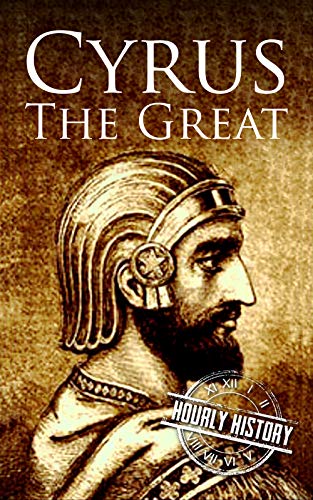
Cyrus the Great: A Life from Beginning to End by Hourly History

Cyrus II of Persia was one of the greatest leaders that the world had ever known; he was the one in whose footsteps other empire builders would follow. From Alexander the Great to countless Roman emperors and Ottoman sultans—it was the mighty shoes of Cyrus that they all attempted to fill.

More than merely a successful conqueror, Cyrus the Great is known just as much for being a great liberator as he is known for his conquests. He was even credited in the Bible as the one who freed the Jews from their long-held Babylonian exile. By the time of his death, Cyrus controlled more land and people than anyone before him. Under his dominion were countless principalities, nationalities, ethnicities, and religions of all kinds. In contrast to many other powerful rulers, Cyrus did not seek to oppress his subjects or interfere with their way of life, religions, or local customs. It is for this reason that, as great as his temporal conquests may have been, the benevolence of Cyrus the Great’s leadership stands as his greatest attribute of all.

The life of Cyrus the Great remains as an unparalleled testament in the annals of history.

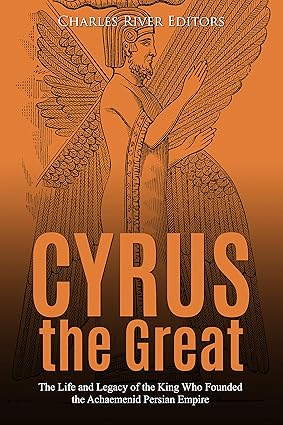
Cyrus the Great: The Life and Legacy of the King Who Founded the Achaemenid Persian Empire by Charles River Editors

“I am Cyrus the king, an Achaemenian.” – An inscription found at the Persian capital of Pasargadae

At one point in antiquity, the Achaemenid Persian Empire was the largest empire the world had ever seen, but aside from its role in the Greco-Persian Wars and its collapse at the hands of Alexander the Great, it has been mostly overlooked. When it has been studied, the historical sources have mostly been Greek, the very people the Persians sought to conquer. Needless to say, their versions were biased.

It was not until excavations in the region during the 20th century that many of the relics, reliefs, and clay tablets that offer so much information about Persian life could be studied for the first time. Through archaeological remains, ancient texts, and work by a new generation of historians, a picture can today be built of this remarkable civilization and their most famous leaders.

When considering this empire’s rulers, the two most often referenced are Xerxes, the leader of the Persian invasion of Greece which caused the heroic sacrifice of the Spartans and their allies at Thermopylae, or Cyrus the Great, the man who created the empire. While he was one of the most influential men in the ancient world, research on Cyrus the Great is simultaneously fascinating and frustrating. The Persians’ ancestors did not write (in fact, in their epic poems and myths, they claim that it was something taught to man by demons and therefore something to be avoided), and though the Iranians had taken up writing in their governmental and administrative functions by the time Cyrus lived, the kings still did not learn to write. Put simply, it was considered a functional skill, but not of the greatest importance.

As a result, while plenty of ancient sources mention the great Persian king, Persian sources themselves are rare, and those sources that do exist, such as the Babylonian Chronicle, are largely dry and state only the basic facts and large events. By contrast, Greek sources about Cyrus embrace the artistic aspect of their work so highly that the accuracy often comes into question, and sometimes deep scrutiny is necessary to attempt to separate the fact from the fiction. In the end, the full truth about Cyrus and his reign may never be truly understood.

Of course, this reality has deepened the mystique that surrounds Cyrus even to this day, and it has elevated his status from conqueror and king to enlightened humanist monarch and ideal ruler. In fact, a modern misconception based on the Cyrus Cylinder has labeled him the first proponent of civil rights, though this is somewhat of an exaggeration. The argument hinges on the Cylinder being a unique artifact in listing the ideology by which Cyrus intended to rule, but it equally ignores the fact that such declarations were commonplace among kings of the ancient Near East and more a tool of monarchal propaganda than a sweeping declaration of human rights.

That said, Cyrus was a fair and rational leader, particularly compared to the many brutal kings and warlords of ancient times. The high praise he received, even from his enemies, must certainly not be dismissed, and the admiration directed toward him came from many other exceptional individuals, including Alexander the Great, a bitter enemy of the empire Cyrus founded. Whatever the underlying issues, the incredible achievements of Cyrus distinguish him as one of the greatest kings in history, and his life, conquests, reforms, and rule continue to be of great interest over 2,500 years later.

Cyrus the Great: The Life and Legacy of the King Who Founded the Achaemenid Persian Empire looks at the life of the Persian leader and the major legacy he left. Along with pictures depicting important people, places, and events, you will learn about Cyrus the Great like never before.

Reader’s Log 034: Assyrians and Babylonians

Hello! I hope you all are having a lovely morning.

Having recently read, “Babylonia” by Costanza Casati and with my current studies of Biblical Culture backgrounds -which usually take years because I tend to go down rabbit holes with history studies-I decided to look at nonfiction reading of the history of the Assyrians and Babylonians. Now, growing up in Sunday School and reading the Bible, I’ve already learned quite a bit about them in the context of wars and interactions with the Hebrews one might say.

Here are three books I discovered and I’m currently reading the first one. I typically choose at least three books with subjects. I may add more the Babylonians once I’ve gotten through these. Also, Joel with Expedition Bible on YouTube has a great archaeological video on the discovery of Nineveh. Expedition Bible is among my favorite YouTube Channels. .

Have you read stories of the Assyrians and Babylonians?

Stephanie

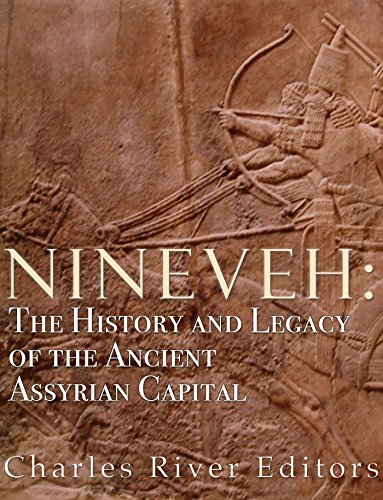
Nineveh: The History and Legacy of the Ancient Assyrian Capital by Charles River Editors

73 pages, Kindle Edition

Published- January 18, 2016 by Charles River Editors

*Includes pictures *Includes ancient descriptions of Nineveh *Includes debate over whether Nineveh was home of the Hanging Gardens of Babylon *Includes online resources and a bibliography for further reading *Includes a table of contents “I captured 46 towns…by consolidating ramps to bring up battering rams, by infantry attacks, mines, breaches and siege engines.” – Sennacherib When scholars study the history of the ancient Near East, several wars that had extremely brutal consequences (at least by modern standards) often stand out. Forced removal of entire populations, sieges that decimated entire cities, and wanton destruction of property were all tactics used by the various peoples of the ancient Near East against each other, but the Assyrians were the first people to make war a science. When the Assyrians are mentioned, images of war and brutality are among the first that come to mind, despite the fact that their culture prospered for nearly 2,000 years. Like a number of ancient individuals and empires in that region, the negative perception of ancient Assyrian culture was passed down through Biblical accounts, and regardless of the accuracy of the Bible’s depiction of certain events, the Assyrians clearly played the role of adversary for the Israelites. Indeed, Assyria (Biblical Shinar) and the Assyrian people played an important role in many books of the Old Testament and are first mentioned in the book of “And the beginning of his kingdom was Babel and Erech, and Akkad, and Calneh, in the land of Shinar. Out of that land went forth Ashur and built Nineveh and the city Rehoboth and Kallah.” (Gen. 10:10-11). Although the Biblical accounts of the Assyrians are among the most interesting and are often corroborated with other historical sources, the Assyrians were much more than just the enemies of the Israelites and brutal thugs. Among all the cities that thrived in the ancient Near East, few can match the opulence and ostentatiousness of Nineveh, the capital of the Assyrian Empire for much of the seventh century BCE. During that time, it became known for its mighty citadels, grand palaces, beautiful gardens, and even its zoos. In fact, the beauty of Nineveh, especially its gardens, impressed later writers so much that they assigned its gardens as one of the original Seven Wonders of the World, except unfortunately for Nineveh’s memory, the location was placed in Babylon. The confusion that assigned one of the Wonders of the World to Babylon instead of Nineveh is in fact a large part of Nineveh’s history – it was a great city during its time, but incessant warfare brought the metropolis to oblivion and eventually its history was forgotten or distorted. An examination of Nineveh demonstrates that in many ways it was the victim of the people who built it. When Nineveh was at its height, they controlled an empire that encompassed Egypt, Anatolia, Mesopotamia, and parts of Iran. Eventually, the Assyrians overextended themselves and their enemies overthrew them and destroyed much of their cities. Nineveh became lost for centuries, only mentioned in fragments by classical Greek historians, but modern archaeological methods were able to bring the lost city back to life in the nineteenth century. Today, through a combination of archaeological reports, classical Greek accounts, and ancient cuneiform inscriptions, the chronology of Nineveh can be reconstructed. An examination reveals that Nineveh played a vital role in the religious and political history of the ancient Near East and despite suffering immense damage at the hands of the Assyrians’ enemies, continued to function as an important city for several centuries after the Assyrian Empire collapsed.

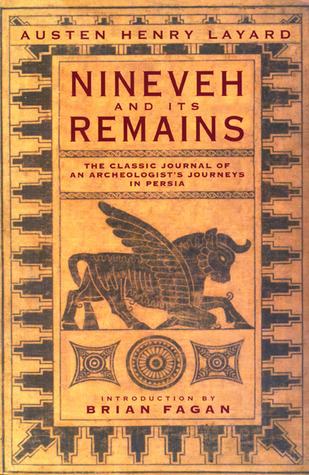
Nineveh and Its Remains by Austen Henry Layard, Brian M. Fagan (Introduction)

432 pages

First published January 1, 1849 by Lyons Pr

An intoxicating stew of compelling characters and sudden crises during the discovery of the ancient ruins of Nineveh by the foremost archeologist of his time.

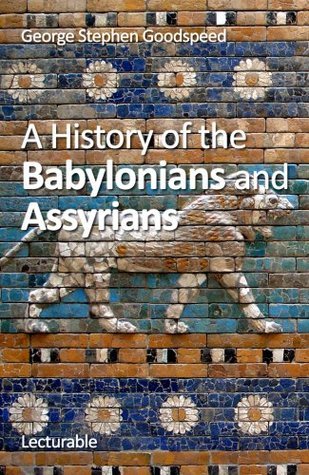
A History of the Babylonians and Assyrians by George Stephen Goodspeed

Format 295 pages, Kindle Edition

Published: January 24, 2013 by Lecturable

“Who were the people by whose energy this region was transformed into so fair and flourishing a land, at a time when elsewhere, with hardly an exception, the upward course of humanity did not yet reveal any trace of orderly and civilized conditions? What are their antecedents, and whence did they come to occupy the alluvial plain?” – George Stephen Goodspeed

“In these regions of Mesopotamia and Babylonia, so diversified in physical characteristics, the one essential unifying element was the rivers. To them a large section of the land owed its existence; the fertility and the prosperity of the whole was dependent upon them; they were the chief means of communication, the main channels of trade, the distributors of civilization. It was in recognition of this that the ancient inhabitants called the Euphrates ‘the life of the land,’ and the Tigris ‘the bestower of blessing.'” – G.S.G.

Introduction – The Lands of the Euphrates and Tigris. The Excavations in Babylonia and Assyria. The Language and Literature. Chronology and History. The City States of Babylonia and Their Unification under Babylon to 2000 B.C. – The Dawn of History. Movements toward Expansion and Unification. Civilization of Old Political and Social Life. Civilization of Old Literature, Science, Art, and Religion. The Times of Khammurabi of Babylon. 2300-2100 B.C. The Rise of Assyria and its Struggles with Kassite Babylonia – The Kassite Conquest of Babylonia and the Appearance of Assyria. 2000-1500 B.C. The Early Conflicts of Babylonia and Assyria. 1500-1150 B.C. Civilization and Culture in the Kassite Period. The Times of Tiglathpileser I. 1100 B.C. The Ascendancy of Assyria – The Ancient World at the Beginning of the First Millennium. 1000 B.C. Ashurnacirpal III and the Conquest of Mesopotamia. 885-860 B.C. The Advance into Syria and the Rise of from Shalmaneser II to the Fall Of His House. 860-745 B.C. The Assyrian Revival. Tiglathpileser III and Shalmaneser IV. 745-722 B.C. The Assyrian Empire at Its Height. Sargon II. 722-705 B.C. The Struggle for Imperial Unity. Sennacherib. 705-681 B.C. Imperial Expansion and Division. Esarhaddon. 681-668 B.C. The Last Days of Splendor. Ashurbanipal 668-626 B.C. The Fall of Assyria. 626-606 B.C. The New Babylonian (or Kaldean) Empire – The Heirs of Assyria. Nebuchadrezzar and His Successors. Babylonia under the Kaldeans. The Fall of Babylon.

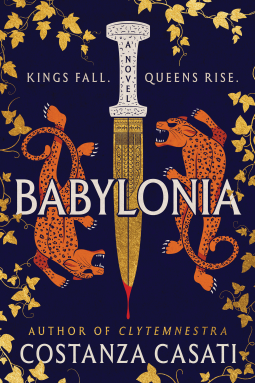
Book Review: Babylonia by Costanza Casati

Pub Date Jan 14 2025 bySOURCEBOOKS Landmark

When NetGalley added, “Babylonia” by Costanza Casati and I read the description, I was completely elated and was thrilled to be accepted a review copy. I knew when I first discovered this story, it would be special. Casati did not disappoint.

Semiramis was orphaned as a baby and grew up in Mari, a village located in Eber-Nari. Her upbringing was wrought with abuse by her adopted- father who shepherd of the village-and the boys of the town. She longed to escape the cruelty of life she was given. When she is at a marriageable age, she has a chance of escape when Onnes- the new governor- of Eber-Nari arrives to her village. Onnes notices something in Semiramis that has captivated him and he wants her to become his wife. He takes her to the capital of the Assyrian empire-Kalhu-and she soon discovers her life in the capitol will not be as easy to say the least.

Semiramis’s ascent to a throne was extraordinary told and when she becomes entangled in a love triangle of two powerful men-her husband and the King-and experiences war, politics and betrayal, she must fight for very survival.

Casati leads the reader through the tragic events unfolding and to the rise of power Assyria’s one and only female ruler. The blend of mythology and the ancient world of Assyria empire and the interactions with other kingdoms including the Babylonians is stunningly and beautifully told. The reader is transported to time and place and your senses are heightened by the sights and sounds of the characters daily lives, past experiences and the wars they wage on each other. You feel the character’s depth in their journey of life, love and conflicts with each other.

My only problem with the story is that I didn’t want it to end. I wanted to read about Semiramis’s time as ruler. I rated this this story five stars.

I highly recommend the reader to read the author’s notes at the end. I will most assuredly be adding a physical copy to my book stacks.

My thanks to the publishers for an ARC through NetGalley for an honest review.

Stephanie

Reader’s Log 033: Cultural and Biblical Background Studies Book Haul

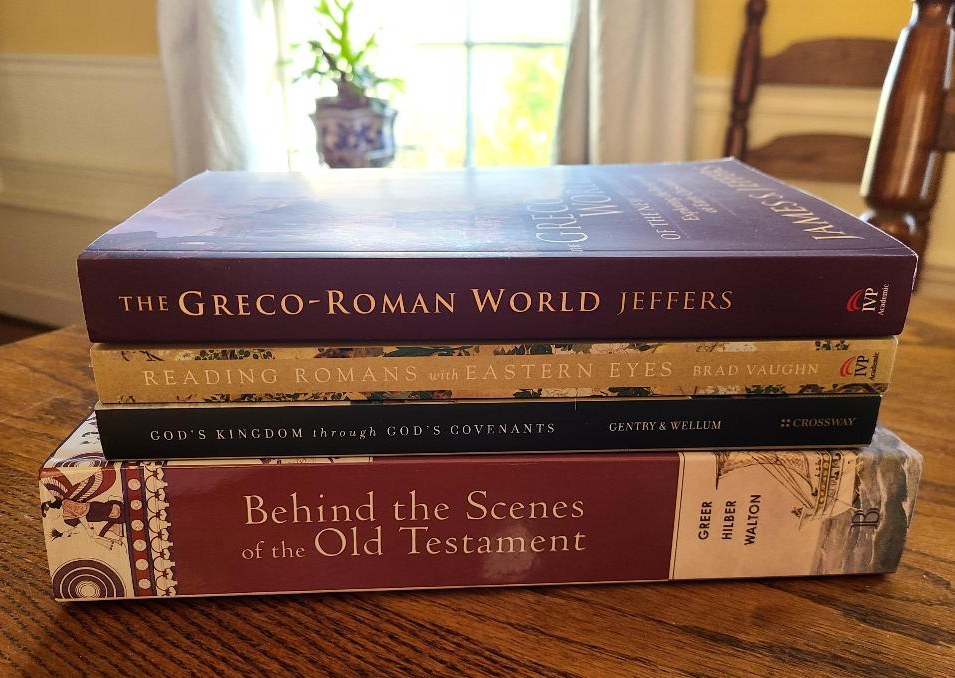
At Christmas time I got four books on my cultural and biblical background study wish-list and super excited about them. Some of you may know I have been studying biblical cultural backgrounds for a more in-depth look at the ancient world for a while now. As modern-day people we tend to look at biblical scripture, ancient society’s ideas and norms and beliefs with modern day eyes. It helps to have a better look at how things were for a clearer and richer understanding of the Bible and the early Christian’s lives. It is most likely that if you are a seminary student getting a BA in Religious Studies, you may be reading some if not all these books. If not, I highly recommend you read them.  

I’m currently reading the first book mention below and it is wonderful. There is so many facts I already know about the Greco-Roman period in the 1st and second 2nd period but they are being expanded on in this book. After I read and study all of these books, I will be ordering four more from my wish-list. Most likely it will be next year. However, I’m thinking about creating a master wish-list of books for these types of studies and post them. That may be a useful resource for those of you who are interested.

Side note: The Behind the Scenes of the Old Testament: Cultural, Social, and Historical Contexts book is heavy like a text book. Aren’t the covers lovely!

Stephanie

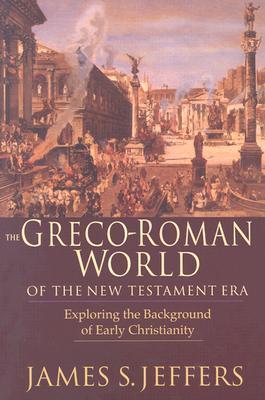
The Greco-Roman World of the New Testament Era: Exploring the Background of Early Christianity by James S. Jeffers

What was life like for first-century Christians? Imagine a modest-sized Roman home of a well-to-do Christian household wedged into a thickly settled quarter of Corinth. In the lingering light of a summer evening, men, women and children, merchants, working poor and slaves, a mix of races and backgrounds have assembled in the dimly lit main room are spilling into the central courtyard. This odd assortment of gathered believers–some thirty in number–are attentive as the newly arrived and travel-weary emissary from Paul reads from the papyrus scroll he has brought from their apostolic mentor. But if you were to be transported to this scene you would perhaps be overwhelmed by a flood of unexpected difference. The voice of the reader recedes as through open windows the din and clamor of the city assaults your ears. Hooves clunk and cart wheels grind and echo from the street while drivers shout, vendors call and neighbors gather and converse. And later, as you accompany a family through darkened and dangerous streets to their third-story tenement apartment, you might try to mask your shock at the cramped and unsafe conditions. In the Greco-Roman World of the New Testament Era James Jeffers provides an informative and scenic tour of daily life during the time of Jesus and the apostles. He affords “you-are-there” glimpses of everything from legal codes to dinner foods, from social hierarchy to apartment living, from education to family dynamics. His eye-opening book will advance your understanding of the New Testament and early Christianity and enrich your reading and application of the Bible.

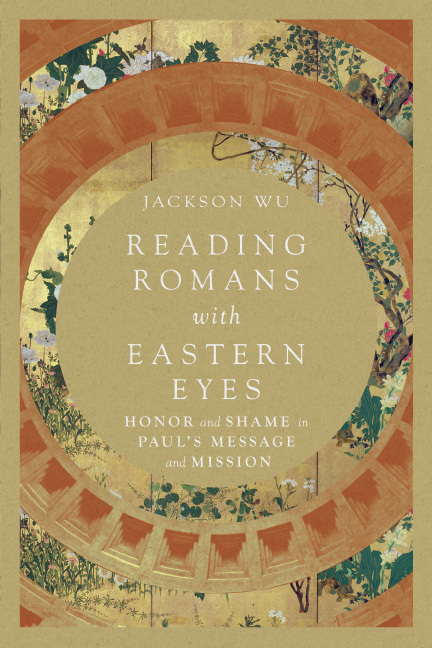
Reading Romans with Eastern Eyes: Honor and Shame in Paul’s Message and Mission by Jackson Wu

Combining research from Asian scholars with his many years of experience living and working in East Asia, Jackson directs our attention to Paul’s letter to the Romans. He argues that some traditional East Asian cultural values are closer to those of the first-century biblical world than common Western cultural values. In addition, he adds his voice to the scholarship engaging the values of honor and shame in particular and their influence on biblical interpretation.

As readers, we bring our own cultural fluencies and values to the text. Our biases and backgrounds influence what we observe—and what we overlook. This book helps us consider ways we sometimes miss valuable insights because of widespread cultural blind spots.

In Reading Romans with Eastern Eyes, Jackson demonstrates how paying attention to East Asian culture provides a helpful lens for interpreting Paul’s most complex letter. When read this way, we see how honor and shame shape so much of Paul’s message and mission.

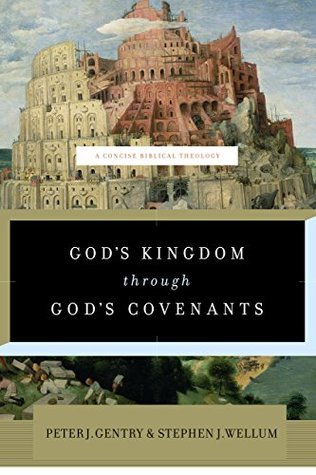
God’s Kingdom through God’s Covenants: A Concise Biblical Theology by Peter J. Gentry, Stephen J. Wellum

In this abridgement of the groundbreaking book Kingdom through Covenant, a biblical scholar and a theologian offer readers an accessible overview of the overarching structure of the Bible. Tracing the significance of the concept of “covenant” through both the Old and New Testaments, this book charts a middle way between covenant theology and dispensationalism―exploring the covenantal framework undergirding the history of redemption.

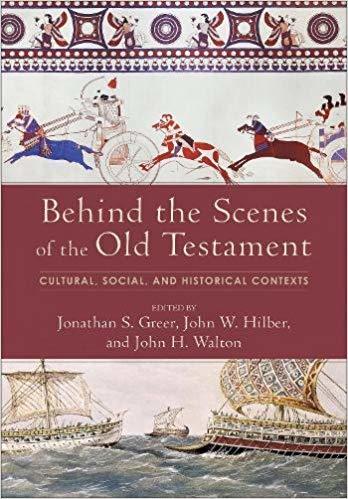
Behind the Scenes of the Old Testament: Cultural, Social, and Historical Contexts by Jonathan S. Greer (Editor), John W. Hilber (Editor), John H. Walton (Editor)

This authoritative volume brings together a team of world-class scholars to cover the full range of Old Testament backgrounds studies in a concise, up-to-date, and comprehensive manner. With expertise in various subdisciplines of Old Testament backgrounds, the authors illuminate the cultural, social, and historical contexts of the world behind the Old Testament. They introduce readers to a wide range of background materials, covering history, geography, archaeology, and ancient Near Eastern textual and iconographic studies.

Meant to be used alongside traditional literature-based canonical surveys, this one-stop introduction to Old Testament backgrounds fills a gap in typical introduction to the Bible courses. It contains over 100 illustrations, including photographs, line drawings, maps, charts, and tables, which will facilitate its use in the classroom.

Reader’s Log 029: Church History

For a while now, I’ve taken a deeper dive into Church history including the early church, Protestantism, Eastern Orthodoxy and other church denominations. I’ve also been study cultural backgrounds of ancient Judaism, the intertestamental period and Hellenistic Jews of the first century. It’s a lot to unpack. I know. I do happen to have a method and organization of my study and notes. Before I took this journey, I had mostly done surface studies and reading on these subjects.

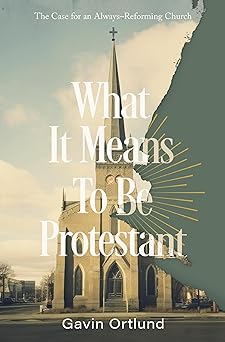
I’m currently reading/studying, “The Early Church: From Ignatius to Augustine by George Hodges and up next I be reading, “What It Means to Be Protestant: The Case for an Always-Reforming Church by Gavin Ortlund, I follow Ortlund’s teachings on YouTube and it is a goal of mine to read all his written works.  

I highly recommend this journey.

Stephanie Hopkins

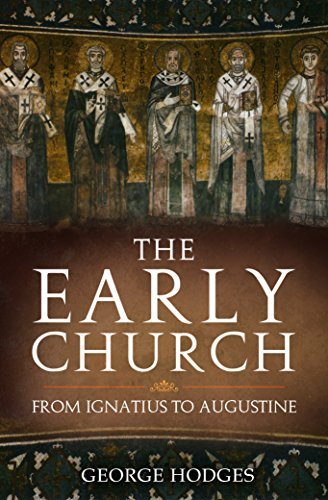
The Early Church: From Ignatius to Augustine by George Hodges

In the first century A.D., the roots of the early Church began to spread across the Roman world.

But who were its leaders?

And how did it survive through waves of hostility and oppression?

George Hodges, in this fascinating history, explains how the early Church developed from its lowly and persecuted origins of the first century through to becoming the main religion of the Roman Empire and the various kingdoms that succeeded it.

Hodges provides a full picture of the Roman Empire and its religion at this time, explaining how the Church was able to gain a foothold, how heresy nearly tore it apart and how many men and women sacrificed their own lives to protect the faith.

He uncovers why by the third century the Church began to develop into a settled and definite organization, with leaders, like Cyprian and Cyril, who assisted their followers, convened at gatherings like the Council of Nicaea to agree on doctrinal matters and how monasticism developed in both the East and West.

Finally, Hodges explains how the Church was able survive the collapse of the Roman Empire, a state that had begun to protect and support the Church after Constantine’s conversion in 312. The Church was forced to contend with the power vacuum of the tumultuous fourth and fifth centuries and to make allies and convert the pagans who were threatening them.

The Early Church: From Ignatius to Augustine is a brilliant history of the late Roman Empire and how the Christian Church developed within it.

George Hodges was an American theologian and dean of the Episcopal Theological School at Cambridge Massachusetts. The Independent stated that many of his works were reissued during his lifetime due to “the high esteem in which his religious messages are held by the reading public.” This work was first published in 1915 and he died in 1919.

What It Means to Be Protestant: The Case for an Always-Reforming Church by Gavin Ortlund

These days many evangelicals are exploring the more sacramental, liturgical, and historically-conscious church traditions, including Roman Catholicism and Eastern Orthodoxy. This hunger for historical rootedness is a welcome phenomenon–but unfortunately, many assume that this need can only be met outside of Protestant contexts.??

In What it Means to Be Protestant, Gavin Ortlund draws from both his scholarly work in church history and his personal experience in ecumenical engagement to offer a powerful defense of the Protestant tradition. Retrieving classical Protestant texts and arguments, he exposes how many of the contemporary objections leveled against Protestants are rooted in caricature. Ultimately, he shows that historic Protestantism offers the best pathway to catholicity and historical rootedness for Christians today??

In his characteristically charitable and irenic style, Ortlund demonstrates that the 16th century Reformation represented a genuine renewal of the gospel. This does not entail that Protestantism is without faults. But because it is built upon the principle of semper reformanda (always reforming), Protestantism is capable of reforming itself according to Scripture as the ultimate authority. This scholarly and yet accessible book breaks new ground in ecumenical theology and will be a staple text in the field for many years to come.

Reader’s Log 022: The Supernatural Genre and Spiritual Warfare

I woke up this morning reflecting on our world’s current events and my faith in God weighs the outcome on how I respond to these current events. The world’s troubles are always on my mind, like I’m sure it is for everyone. We are living in unsettling times. When I pray to God, I ask for peace and understanding. I pray for courage, strength, protection, healing, and stronger faith in my daily walk with Christ. I pray this for others as well. If it weren’t for my Christian Faith, I don’t believe I would have made it this far in life.

I’ve also been thinking a lot about how would I respond to the US elections outcome this coming November. Whatever the outcome, I pray for a peaceful transfer of power in our government and how our citizens and the world response. I pray that our government officials will truly care about the people’s welfare. These things have me thinking about spiritual warfare as well and how we as Christians should rest in God’s strength and stand on God’s promise, how important it is to know God’s word and to put on the full armor of God. When people come to know Christ as their Lord and savior, spiritual warfare can become intense. I’ve recently thought about books I’ve read on spiritual warfare. The Bible-of course-is number one.

As a reader, I love stories and I read many different genres. I believe it is important for people of Faith to read widely for many reasons. Some brothers and sisters in Christ may disagree with me on that score but I’m okay with that. God knows my heart and I firmly believe that reading widely makes us better people and as we expand our minds, we have a better understanding other people’s world views, struggles and situations in life. Reading enhances our critical thinking thus giving us the knowledge and the tools to help us in life with relationships to others. Anyhow, reading widely is another subject for another time.

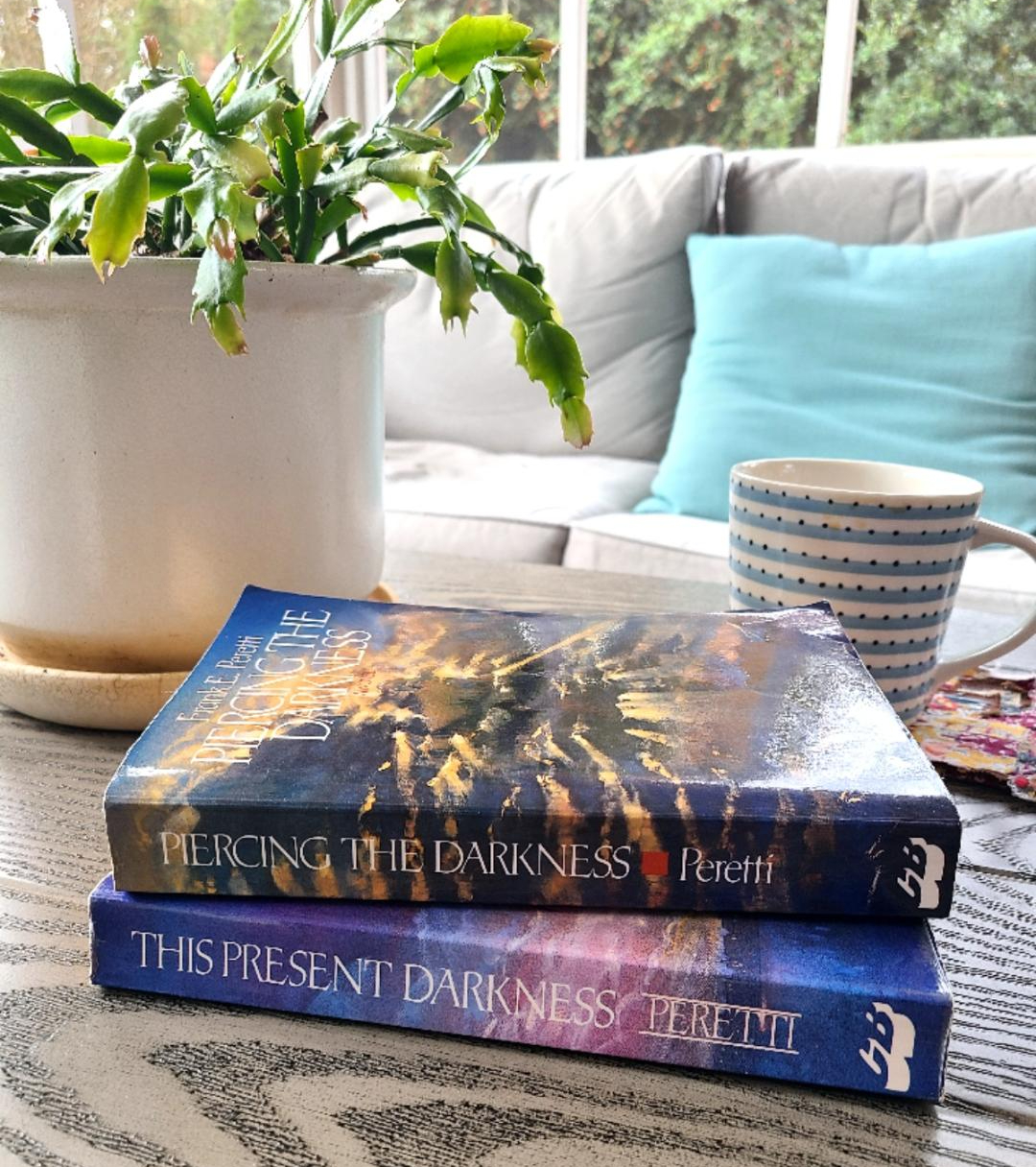
Today, I want to share two books I read in the early 90’s and again in the late 90’s on spiritual warfare by Frank E. Peretti. I have my father’s paperback copies. Since they are early editions, and have become a bit fragile, I’m having handle them carefully. Though I believe they will still be okay to read in and may do so again soon. If you haven’t read them, whether you are a Christ follower or not, I highly recommend you read these books. They are prevalent to our humanity and our society as a whole.

Stephanie

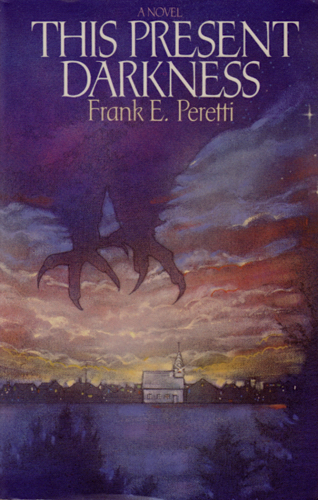
This Present Darkness by Frank E. Peretti

First Published – January 1, 1986 by Crossway Books

Ashton is just a typical small town. But when a skeptical reporter and a prayerful pastor begin to compare notes, they suddenly find themselves fighting a hideous New Age plot to subjugate the townspeople, and eventually the entire human race.

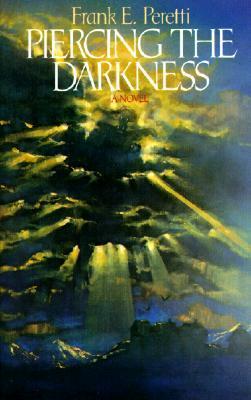
Piercing the Darkness by Frank E. Peretti

First published January 1, 1989

The light shines in the darkness, and the darkness has not overcome it.

John 1:5 (ESV)

It all begins in Bacon’s Corner, a tiny farming community far from the interstate . . . An attempted murder, a case of mistaken-or is it covered up? -identity, and a ruthless lawsuit against a struggling Christian school. Sally Beth Roe, a young loner, a burnout, a kind of “leftover hippie, “finds herself caught in the middle of these bizarre events, fleeing for her life while trying to recall her dark past.

Across a vast panorama of heart-stopping action, Sally Roe’s journey is a penetrating portrayal of our times, a reflection of our wanderings, and a vivid reminder of the redemptive power of the Cross. A companion volume to This Present Darkness, readers have purchased over two million copies of Piercing the Darkness since its publication in 1989.

**********

The Armor of God

10 Finally, be strong in the Lord and in his mighty power. 11 Put on the full armor of God, so that you can take your stand against the devil’s schemes. 12 For our struggle is not against flesh and blood, but against the rulers, against the authorities, against the powers of this dark world and against the spiritual forces of evil in the heavenly realms. 13 Therefore put on the full armor of God, so that when the day of evil comes, you may be able to stand your ground, and after you have done everything, to stand. 14 Stand firm then, with the belt of truth buckled around your waist, with the breastplate of righteousness in place, 15 and with your feet fitted with the readiness that comes from the gospel of peace. 16 In addition to all this, take up the shield of faith, with which you can extinguish all the flaming arrows of the evil one. 17 Take the helmet of salvation and the sword of the Spirit, which is the word of God.18 And pray in the Spirit on all occasions with all kinds of prayers and requests. With this in mind, be alert and always keep on praying for all the Lord’s people.

Ephesians 6:10-18 (NIV)

In Times of Trouble

There are seasons in our lives when our hardships often feel overwhelming and sometimes, we lose sight at what God’s plans has for us. We get caught up in our struggles, doubts, feelings of hopelessness, and then despair can seep in our hearts. We become consumed with tiredness and weakness in our burdens, our hearts can harden and we can lose sight and we become focused on the wrong things that are temporary. We become focused on self and our troubles and that leads us away from Him. Instead be encouraged to turn to God in faith, continual prayer for healing and trust in His time and plan for our lives. God wants and longs for us to turn to Him for everything. In Matthew chapter 11:28 says, “Come to me, all you who are weary and burdened, and I will give you rest. And in 1 Peter 5:7 says, “Cast all your anxiety on Him because He cares for you.” In 2 Corinthians 4:17-18 says, “For our light and momentary troubles are achieving for us an eternal glory that far outweighs them all. So, we fix our eyes not on what is seen, but on what is unseen. For what is seen is temporary, but what is unseen is eternal.

Prayer: O mighty God, you are our refuge and fortress in whom we trust. We praise you even in the time of trouble. You are loving and faithful. Hear our voice and be merciful to us O Lord, for our hope is in you. For your word says in Matthew 7:7-8, “Ask and it will be given to you; seek and you will find; knock and the door will be opened to you. For everyone who asks receives; the one who seeks finds; and to the one who knocks, the door will be opened.” We humbly ask you fill us with your Holy Spirit to protect us, guide us casting out all our doubts and sorrow for we give it all to you. We put our trust in you, O Lord. May we seek you in all of our ways. May your Spirit renew our minds, fill us your healing power and thanksgiving. May your Spirit surround us with deliverance for we stand on your promises. We ask all of these things in Jesus Holy name. Amen!

What has really helped me in my prayers and daily walk with Christ is to spend time with God in prayer and in His word. If there is something in your life that you are struggling with but you’re not sure how pray, the Bible can guide you with your prayers and help you build your relationship with God. Ask God to give you direction in your prayers. Ask Him to show you the way. We must become like children and seek Him with open hearts. He loves us so much.

Oftentimes, I like to write down my prayers and verses that help me in all areas of my life. There are so many passages and stories of overcoming hardships and thanksgiving in the Bible to help us.

Jesus answered, “It is written: ‘Man shall not live on bread alone, but on every word that comes from the mouth of God.” Matthew 4:4

“Your word is a lamp for my feet, a light on my path.” Psalms 119:105

“And we also thank God continually because, when you received the word of God, which you heard from us, you accepted it not as a human word, but as it actually is, the word of God, which is indeed at work in you who believe.” 1 Thessalonians 2:13

Stephanie

Wish-List: Books on the Christian Faith

I’ve been on the search for books on Systematic Theology, further Biblical teachings of Christ’s ministry and Christian application with a non-Calvinistic view point and came across Norman L. Geisler. I found information saying he is considered “moderate Calvinist,” and that he is not a “Five Point Calvinist.” I find that to be somewhat reassuring in my search for the reading material I’m looking for. I am definitely willing to give his books a read. You see, I’m not a Calvinist nor am I a protestant. That said, I am not closed minded from reading different viewpoints; I’m just looking for particular studies for the moment. Mater of fact, I respect and listen to a lot of what protestants have to say.

Also, I’m planning on reading the books in my father’s library on Systematic Theology as well as adding to my own library.

First, what is Systematic Theology according to Oxford Languages? The theology is “a form of theology in which the aim is to arrange religious truths in a self-consistent whole.” In a nutshell, the systematic view is to give an orderly format of the doctrines of Christian faith. And let me tell you, I have seen and heard many different viewpoints. Below are a few books by Geisler that I’m interested in reading.

The Big Book of Christian Apologetics: An A to Z Guide (A to Z Guides) 

The Big Book of Christian Apologetics is a comprehensive resource designed to equip motivated believers with information to help defend and explain their faith. Examining nearly every key issue, person, and concept related to Christian apologetics, this book clarifies difficult biblical passages, clearly explains various philosophical systems and concepts, examines contemporary issues and challenges, and offers classic apologetic arguments, all with the aim of giving readers the background to intelligently and persuasively talk about their Christian faith with skeptics. An expertly abridged version of the Baker Encyclopedia on Christian Apologetics, this resource brings leading apologist Norman L. Geisler’s seminal work to the masses.

A Popular Survey of the New Testament 

Understanding the New Testament is a daunting but exciting task. Our world is so different from that of the first century. Yet it is important to understand the context and content of the New Testament if we are to be faithful followers. Now in paper, this survey addresses the who, what, where, when, why, and how questions that readers of the Bible may have, such as: How can we tell if what is written in the New Testament is true history or just mythology? When were these books written and why? and What can today’s believers get out of letters addressed to people who lived two millennia ago? Written in an easy, informal style, this survey is accessible and enjoyable to anyone who wants to better understand the New Testament.

Defending Inerrancy: Affirming the Accuracy of Scripture for a New Generation

According to the authors, the doctrine of inerrancy has been standard, accepted teaching for more than 1,000 years. In 1978, the famous “Chicago Statement” on inerrancy was adopted by the Evangelical Theological Society, and for decades it has been the accepted conservative evangelical doctrine of the Scriptures. However, in recent years, some prominent evangelical authors have challenged this statement in their writings.

Now eminent apologist and bestselling author Norman L. Geisler, who was one of the original drafters of the “Chicago Statement,” and his coauthor, William C. Roach, present a defense of the traditional understanding of inerrancy for a new generation of Christians who are being assaulted with challenges to the nature of God, truth, and language. Pastors, students, and armchair theologians will appreciate this clear, reasoned response to the current crisis.

Note: Also, I would like to mention a book of his I’ve had on my wish-list and at first, the author’s name escaped my memory. I’m delighted to know he has written the book along with Frank Turek of whom I know his work.

I Don’t Have Enough Faith to Be an Atheist (Foreword by David Limbaugh) 

Geisler and Turek argue that Christianity requires the least faith of all worldviews because it is the most reasonable. A valuable aid to those interested in examining the reasonableness of the Christian faith.