
It is always a pleasure to have Author and history enthusiast Stuart S. Laing visit Layered Pages. He talks with me about the images he captures of Edinburgh and gives us a glimpse of it’s fascinating history!
Stuart, I have been enjoying the photos of Edinburgh you have been posting on social media. Even though I haven’t had the chance to visit the city, it is on my bucket list! When you find an image to photograph, what is going through your mind?

Stuart S. Laing
Thank you, and I would love to give you a guided tour around town one day. As to taking photos I think it just comes down to being in the moment. I love the architecture of the Old Town, the history surrounding you, and the energy of the people both local and visitors from all corners of the world. Trying to capture just a hint of that is such fun. But I am strictly of the point and click school of photography.
The architecture is certainly breathtaking! You really do have a great eye for imagery. Which I believe is part of your story telling in books. What do you characters have to say about that?
I think Robert Young would agree with you. He would point out that the more you can see, the more you can know. A shady character like Shug Nicholls would prefer people not go prying into what he and his old adversary, Sergeant MacIan of the Town Guard, get up too. What I try to achieve with words is to paint the reader into the scene so they can be there and feel the cobbled streets beneath their feet and catch a waft of the stink from open sewers or the sweet aroma of perfumed ladies as they pass by.
I notice you choose a black and white medium for your pictures. Is there a particular reason why?
I think the benefit of black and white is it brings an element of doubt into a picture, was it taken yesterday or 50 years ago? It’s my attempt to try to capture the timelessness of a city which seems to never change on the surface but in reality has been in constant motion as old buildings crumble and new ones rise. The thing which saves Edinburgh from the anonymity which besets so many city centres is the fact that in large the centre of town has managed to escape the concrete and glass monstrosities of so many other old cities.
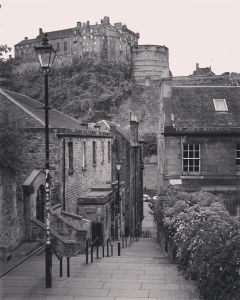 What do you love most about Edinburgh?
The simple answer is everything. As I mentioned earlier it’s the history, the buildings, the noise and the hustle and bustle. I know that many locals decry events which fill the centre of town such as the
Festival Fringe which draws tens of thousands daily throughout August but I actually love the crowds. I think that many forget that until the development of the New Town from the 1760s onwards, Edinburgh was largely shoehorned into a space smaller than many modern city parks. It was this which led to Edinburgh Old Town being home to the first skyscrapers as builders went up rather than out. So, for me, seeing those crowds is simply an echo of the past when the Royal Mile was home to shops, coffeehouse, stalls, animals, horses and carts all competing for space. These days there is little risk of having a cow squash your foot under its hoof so people probably should count their blessings
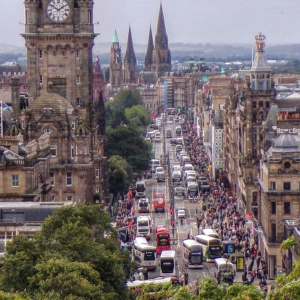 How often do you get a chance to visit the city?
I try to get across as often as possible, and normally at least several times a year. Having a membership of Historic Scotland allows me unlimited entry to Edinburgh Castle which provides another excuse to pop over.

Cowgate before the ‘improvements’ of the 1860s
What have you discovered on your adventures to be the most surprising?
Probably that despite all the changes Edinburgh has faced, urban planners, great fires, which destroyed a large area of the Royal Mile meaning that parts of the New Town are actually older than parts of the Old Town, is the fact that you can take the map of town drawn in the 1740s and use it to guide you through the streets, closes and wynds (alleyways) today. Even when regeneration meant the slum dwellings of the Cowgate were obliterated in the name of progress in the 1860s, the new homes and shops were all built on the footprint of what they replaced. It is still remarkably easy to walk from the Royal Mile to the south side of town following the exact same route you would have taken in the 15th, 16th, 17th or 18th century. That is what constantly inspires me to keep going back.
 Describe Edinburgh to me from your mind.
Edinburgh, to me, is a strange combination of what you see and what you feel. When I stand on the cobbles by St Giles Cathedral in the very heart of town I don’t only see the beauty of the church before me but, in my mind, I also see the tall, grim walls of the old Tolbooth which once stood here, its location marked by brass markers set in the cobbles. It was here that William Burke, one half of the murderous duo with William Hare, met his end in 1829 on gallows built where the Tolbooth had once stood. It was from the Tolbooth that Captain Porteous of the Town Guard was seized by a mob who would lynch him in the Grassmarket. However it was also here where stalls once stood ran by women selling their wares such as home weaving and hand knitted clothes, fresh wild flowers and vegetables to the people of town. Nearby the famous poet Allan Ramsay operated the first circulating library which opened in 1725. That is what fascinates me about Edinburgh, the constant mixture between beauty and darkness. It was the city of Enlightenment when Scotland led the world in the advancement of science while at the same time huge crowds would gather in good humoured revelry to watch the public hangings in the street. The city itself presents visitors with its split personality. On one hand you have the cramped, towering tenements with the warren of narrow alleys running under and between them where every Close tells its own story and where you can get a taste of how the city once looked and felt, and occasionally smelled as you venture down them. Meanwhile only a short walk away you discover the elegance, charm and open, broad streets of the Georgian New Town where upmarket retailers and fashionistas can be found sipping artisan coffees in the streets where Robert Louis Stevenson grew up. That is what keeps drawing me back again and again. The dual nature of a city where everything changes and nothing does. If that doesn’t make sense you need to visit and spend a day just walking the streets and let some of fair Edina’s spirit work its way into your heart.


Stuart, thank you!
And thank you for allowing me to share my love of Auld Reekie with you. And remember that invite for a guided tour is always open.
Thank you, everyone for visiting Layered Pages today. Stay tuned for our follow up post about History Surrounds Us coming soon here at Layered Pages! -Stephanie
More About Stuart:
Born and raised on the east coast of Scotland in the ancient Pictish Kingdom of Fife Stuart grew up looking across the Firth of Forth towards the spires and turrets of the city of Edinburgh and its castle atop its volcanic eyrie.
He has always been fascinated by the history of Auld Reekie and has spend most of his life studying Scottish history in all its aspects whenever he finds the time between family, work and the thousand and one other things that seek to distract him.
Despite the vast panorama of Scotland’s history he always find himself being drawn back to the cobbled streets of the Old Town. Those streets have provided the inspiration for his stories and characters.
He would urge all visitors to Scotland’s ancient capital to (briefly) venture into one of the narrow closes running down from the Royal Mile to get a flavour of how alive with mischief, mayhem, love and laughter these streets once were.
Stuart’s Facebook Pages where you can find more images from him and information about his stories HERE.
****
(All book reviews, interviews, guest posts and promotions are originals. In order to use any text or pictures from Layered Pages, please ask for permission from Stephanie Hopkins)


 Jessica Cale is a historian, editor, and Historical Romance author. Originally from Minnesota, she earned her B.A. (Hons) in Medieval History and MFA in Creative Writing from Swansea University while climbing castles and photographing mines for history magazines. She is the editor of Dirty, Sexy History and you can visit her
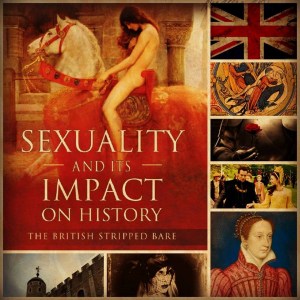
 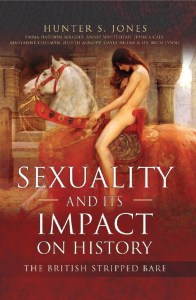 Sexuality and its Impact on History: The British Stripped Bare

 My first novel, A Greater World is set in Australia, but opens in England. Two characters, Elizabeth Morton, a middle-class woman approaching her thirties, unmarried after the death of her fiancé in the First World War, and Michael Winterbourne, a lead miner and war survivor, jilted by his fiancée, are each forced by personal tragedies to take a passage to Australia and a new life.
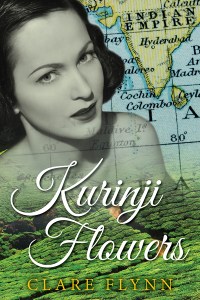 Ginny Dunbar in Kurinji Flowers, a London debutante, is destined for a ‘good marriage’ when an abusive relationship makes her the object of a society scandal. Rushed into a marriage of convenience, she is soon on a ship bound for India and a new life as a tea planter’s wife. India has a big effect on Ginny. She has nothing in common with most of the other expatriate Brits and their shallow lives which revolve around the club – tennis, bridge games, gossip and gymkhanas. She is fascinated but fearful of the indigenous Indian population and so is caught between two cultures – until a love affair and a growing passion for painting change her life.
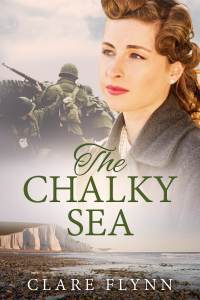
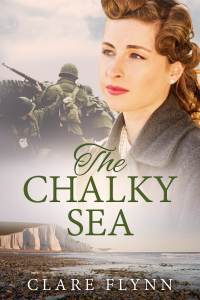 My latest novel, The Chalky Sea, is set in England in a small seaside town on the Sussex coast. For Gwen Collingwood, her home town becomes an alien place with the advent of World War 2, when the peaceful backwater becomes the front line in the Luftwaffe’s bombing campaigns. Gwen’s life transforms from that of bored housewife into a woman with a purpose. By the end of the novel she has discovered love, friendship, self-reliance and self-respect.
 My last extract is from Letters from a Patchwork Quilt. Jack Brennan is dragged off a ship as he is about to sail to America and instead finds himself in what feels like a hell on earth in industrial Middlesbrough.
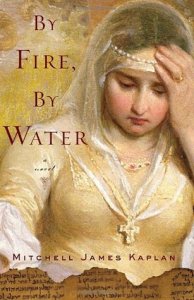 About By Fire, By Water:
 Two troubled people struggle to find their way in a turbulent world.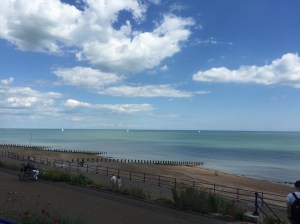

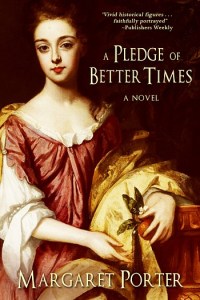 Lady Diana de Vere, the heroine of A Pledge of Better Times, was born into an aristocratic and prominent family of the late 17th century. Her father is an earl, a courtier and trusted advisor to Charles II, a position he retains—for a time—under James II. The landscape of Diana’s life, therefore, consists of the royal palace of Whitehall in London—her extended family’s dwellings lie within the palace complex. In a very real sense she’s closed off from the common citizen, from ordinary life, apart from her interaction with servants. Her world is one of opulence and privilege, and also one of restricted movements. A large part of my research was visiting sites were familiar to her during her lifetime, which allowed me to envision her in the actual spaces she had occupied and to imagine her in the ones that no longer exist.
 Because I was born into a family of readers and writers and scholars and travelers, there’s no mystery about how or why I found my profession. From a very early age I invented characters and composed scenes and stories in my head. At about 10 years old I first saw my own words printed–in the grammar school newsletter that I co-founded, typed, and published. Around the same time I decided to combine my theatrical and my writing ambitions, and adapted all my favourite youth novels into scripts.
 First, let me thank you for this series and the opportunity to discuss Characters in Motion. It was a fun exercise for me – especially since it was a topic I struggled with. I didn’t get to create the story from my characters, I had to create my characters from the story…and likable ones at that!

 Layered Pages