I’d like to welcome Author Janet R. Stafford today to talk with me about her stories. Janet, thank you for talking with me today. Please tell me about your, “Maggie Series”.
Thanks for interviewing me, Stephanie! I’m delighted to be working with you and LAP It Marketing.
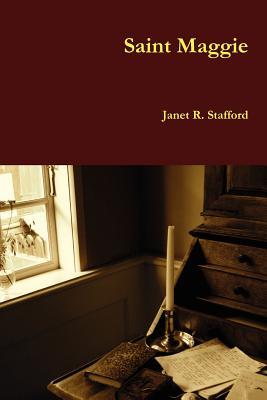
The Saint Maggie Series happened accidentally. When I wrote Saint Maggie, the first novel, I saw it as a single entity. But after visiting a few book clubs, I kept hearing the question, “What happens next?” People liked the characters and wanted more. So, I started to think about a follow up book… and the next thing I knew I was writing a series.
Essentially, the Saint Maggie Series takes an unconventional New Jersey family through the turbulent years of the American Civil War. Maggie’s family is unconventional in a few ways. Her boarding house is made up of men who can barely pay the rent but with whom she has developed familial relationships: a failed author, an old Irish immigrant (called Grandpa), a struggling young lawyer, and an undertaker’s apprentice. Maggie’s daughters are trending toward lifestyles outside a woman’s sphere: her youngest daughter, outspoken Frankie, has a growing interested in theology and ministry; and her older daughter, Lydia, is the family nurse – but, as the town doctor discovers, also has a gift for medicine. Maggie’s friendship with and eventual marriage to Eli Smith also causes consternation in the town. Eli publishes a penny weekly newspaper called the Gazette and is an abolitionist and a freethinker. Everybody readily knows his opinions. Finally, there is Maggie’s friendship with Emily and Nate Johnson. Nate owns a carpentry shop, while Emily works primarily as the cook at the boarding house. All that would be fine were it not for the fact that Nate and Emily are black, and Maggie is white, and Emily is not simply an employee, but has become Maggie’s closest friend. And then there are rumors about Maggie, Eli, and the Johnsons’ involvement in the Underground Railroad.
The series follows Maggie and the boarding house family through life during the American Civil War. They are subject to the war and its violence, the attendant anger and hatred, daily uncertainty, emerging societal changes, and more. The first book, set in the year before the war, focuses on a town scandal and forgiveness is a major theme. The second takes the family to Gettysburg. As Confederate troops invade the town, Maggie and family must answer the question “Who is my neighbor?” In the third book, the family remains in the Gettysburg area as they struggle to recover, forgive, and hold on to their values of mercy and compassion. And in the fourth novel, they return home to Blaineton to find that their town is changing: there is a woolen mill and uniform factory owned by a wealthy industrialist to its south, and to the north a hospital for the insane run by a compassionate superintendent. How “the least of these” are perceived and treated in the two settings are part of the story, as is Eli’s struggle with the trauma he suffered while serving as a news correspondent in Virginia.
Please tell me about your short stories?

Both “The Christmas Eve Visitor” and “The Dundee Cake” are Christmas stories. Set in 1863, “The Christmas Eve Visitor” starts with the family exhausted from their experience in Gettysburg, struggling with economics, and burdened with a mysterious fever that has stricken the young children in the family. Things are about as dark as an early winter night until a mysterious little peddler shows up at their door. Maggie invites him in from the cold and feeds him a bowl of soup. In gratitude, the stranger proceeds to give members of the family an array of odd gifts.
“The Dundee Cake,” set in December of 1852, finds a grieving widow Maggie struggling to pay bills and facing a bleak Christmas. The story recounts how Maggie and Emily become friends, and how Maggie moves beyond her sorrow and into joy.
“The Enlistment” is a novella that puts Frankie Blaine center stage. It is August of 1862 and Frankie’s beau Patrick (the undertaker’s assistant) has enlisted in the army. Frankie is afraid for Patrick (and her own heart) should he be injured or killed in battle, and wonders why only men can do the fighting. She wants to participate, not sit at home and sedately roll bandages. So, Frankie concocts a scheme to disguise herself as a boy and enlist in Patrick’s regiment. (Historical note: quite a few women actually “passed” as men and served as soldiers in both armies during the Civil War.) However, Frankie discovers she doesn’t have a Plan B when things don’t go as she expects. What to do next?
What writing project are you currently working on?
I’m working on the fifth book in the series. It is set in 1864 and tentatively titled “The Good Community.” The title comes from a class I took at the Theological School at Drew University (Madison, NJ). The Professor was the late Dr. David Graybeal and together we explored what it meant for a community to be “good,” and looked at different models of living communally. It came to me recently that the Saint Maggie Series is very much my own search for the good community and I wanted to honor Dr. Graybeal somehow. Even if the title of the novel changes, the spirit of his class is very much in the series – not to mention in the name of the house Maggie and family now live in (although spelled a bit differently): Greybeal House. The plot is still in the works.
Tell me a little about Maggie Blaine in your story, “Saint Maggie.”
Oh, my gosh, Maggie Blaine! I love the woman. I think she is what I aspire to be in my own time. Maggie is a nineteenth-century Methodist, and like many evangelical women of the 1800s she keeps a journal. She is serious about practicing what she believes and earnest, yet not so earnest that she has no sense of humor and does not enjoy life. In the first book, she experiences an overwhelming sense that she is an “outsider” not only to her community but also to her brother, from whom she is all but estranged. But one day at camp meeting (which is a religious camping experience lasting one or two weeks), Maggie has an epiphany. I’ll let her explain it: “I knew in my heart – and not merely in my head – that I was free and that the only one to whom I was accountable was God. I resolved then and there to live a life of love without regret and never mind what anyone said.” It is not an easy path to take; but Maggie is determined to follow it. She is balanced by husband Eli, is a lapsed Quaker who is full of doubts and questions, but who shares common values with Maggie: respect for all people, mercy, compassion, and a hunger for justice and truth. Thus, while I would like to be more like Maggie, I find that I often have more in common with Eli.
Why did you choose the 1860 period for your story and please share a little about the research that went in to that exploration.
The germ for the first novel came from a research paper I wrote while pursuing a Ph.D. in North American Religion and Culture (Drew University, again). My essay involved a young Methodist minister by the name of Jacob Harden who was appointed to a church in Warren County, New Jersey in 1856. He reportedly was handsome, charismatic, and a fine preacher. He also liked the ladies. However, when one of the local families invited him to spend New Year’s Eve at their house, they all vanished upstairs and went to bed, leaving him alone with their eligible daughter, Louisa. For a man and a woman to be left unchaperoned was a huge no-no, especially if that man was a clergyman. Long story short, Harden ended up in an unhappy shotgun marriage. Sadly, the Rev. Harden responded in a manner that was more than a bit inappropriate. In fact, it was so inappropriate that he was arrested, put on trial, and hanged in 1860.
As I worked on the first novel and learned more about the period of 1860-1861, I began to see connections between the Civil War era and our own point in time. There was a great deal of divisiveness in the antebellum years. It carried over everywhere, even into the churches. For instance, the issue of slavery divided the Methodist Church in 1844, and the Baptist Church split over it in 1845. Abolition and slavery were the “hot button” topics of the day. While many Northerners pointed their finger at the institution of slavery in the South, they turned a blind eye to the fact that until the early 1800s slavery was also legal in the North. Black people living in the North were not treated as equals, either. Many areas of New Jersey, including Hunterdon and Warren Counties, were “copperhead” strongholds – that is the majority were anti-war and anti-abolition. When the nation was physically divided in 1861, in addition to being emotionally and intellectually divided, the fighting began.
The divisiveness of the era, the “hot button” topics, the disjuncture between what was believed or said and what was done, and the difficulty in navigating such an environment resonates with my experience of living in late- 20th and early-21st century America. In addition, I am intrigued by the other challenges of the 1800s: women’s rights, race relations, industrialization, urbanization, technological revolutions, advances in medicine, and traces of the emerging the Gilded Age. It’s fascinating. While the 1800s does not line up exactly with our currently situation, its echoes are eerily similar. Perhaps that is because as a nation we have not come to terms with the 1800s generally and with the Civil War particularly. Or maybe it’s just my way of trying to process life now by exploring life in another century.
Will there be more stories in this series?
There probably will be a few more. I’ve been thinking of ending the Saint Maggie series after 1865. Some readers have indicated that they would like me to “spin off” a couple of the other characters, particularly Frankie and Lydia. In fact, I wrote “The Enlistment” to see if Frankie could carry a complete story, which she can. I feel the same way about Lydia. They are both strong characters. In addition, Frankie’s desire to serve as a pastor and Lydia’s growing competence as a physician presage the movement of women into these fields in the later 19th and 20th centuries.
I love the title for your book “Heart Soul & Rock ‘N’ Roll: A Mid-Life Love Story. I’m sure you had lots of fun writing it. What are some of your readers saying about this story and is there a message you would like your readers to grasp?
 That was a fun book to write. I mean, the band in the story is seriously goofy most of the time. But the book also takes a serious turn about half way in.
I started Heart Soul to give myself a break from the nineteenth century. My central character, Lins Mitchell, is an assistant minister in a central New Jersey church. As a college student she fronted a rock band, but gave it up when she was called into ministry. Now, at the age of 40, she is having a mid-life crisis and wonders if she’s not being called to something new. I drew her environment directly from my experience as an assistant minister in the United Methodist Church. And, yes, I really do serve a church in central New Jersey, but no, I am way beyond the age of 40 and never have fronted a rock band in my life – although I did go through a singer/song writer phase in my 20s, and I do love rock, the harder the better! In the story Lins’ good friend Patti invites her to Point Pleasant Beach for a vacation to clear her mind. At the Shore, Lins meets Neil, front man for a bar band called the Grim Reapers. Neil is a divorced dad who lives in a studio apartment over the music store that he manages. He comes with a load of baggage, the least of which is his agnosticism and antagonism toward the church.
I’ve had some interesting comments from readers and prospective readers. Strangely enough, I’ve had two men tell me that they loved it, which to me is kind of strange since the book is a romance and men are supposed to run screaming away from romance novels. Both the guys said it made them cry. Without giving too much of the plot away, Neil has a troubled sister and feels pulled between his sister’s issues and his ability to have a sustainable relationship. Maybe the fact Lins is the strong one and Neil is the vulnerable one touched a chord with my male readers. I wish I had had the presence of mind to ask, “Okay, precisely what did you like so much? What made you cry?” I didn’t, though. My loss!
In addition, I had one prospective reader buy the book because she was in seminary and her husband was in a rock band, and another bought it because although she attended a church, her husband was an agnostic. They saw my art as imitating their lives!
As for a message, Christians are perceived negatively these days. However, the circles in which I travel are far from the bigoted, tribal, intolerant stereotypes out there. The church people in the book are like the people I know. They care, they listen, they try to help. But they don’t walk around with halos over their heads, much less pretend even to have halos! So, it’s no surprise I made Lins like that, too. She looks for the good in people, she listens, she cares. She finds another community in the band, but it pulls her out of her comfort zone. And maybe that’s a message in the book – we are invited to leave our comfort zones. When we do, we encounter challenges, but also encounter God and one another in a deeper way than imagined.
What is your writing process and where in your home do you write?
My writing process… do I have one? Just kidding. To start with, for the Saint Maggie series, I get a general idea for a story, which may or may not survive the writing process. I then will research an idea or issue. I wish I had the money and the time to install myself in an archival collection and research for a week, but that’s not possible. Instead, the internet has become my friend, as is any online place where I can purchase books for research.
Next, I write scenes in which my characters interact with one another. Sometimes they set the tone and help me find the storyline. After that I will write a broad outline, which can (and usually does) get jettisoned at any point during the writing!
Bit by bit the story grows until I have it where it should be. Although, when I was working on Seeing the Elephant, toward the end I had trouble figuring out just where the core of the story was. So, I closed my eyes and asked myself about it. In my imagination, up pops Eli, who grabs my shoulders and yells, “It’s my story, dammit!” The guy apparently had been hijacking the novel all along. But in all seriousness, it made complete sense. It was primarily Eli’s story.
There’s always LOTS if editing involved, but once I get to the point that I feel I’m shuffling words around, I know it’s time to let others read the book. I give or send drafts to three or four beta readers. They then invariably and lovingly let me know when a character is not acting as they should be acting, when something should be cut, when peaches are or are not in season in Gettysburg, etc. It’s a messy process, but it works for me.
I write in the family room. Usually, I have the TV or a movie on. If I really need to work out something difficult, I’ll write in silence. Sometimes, as in the case of Heart Soul, I might create a play list and listen to that as I write.
How has your journey been in the self-publishing industry and what advice could you give to others who are considering self-publishing?
I went from knowing nothing about self-publishing in 2011 to learning to use publishing platforms, running a small company, writing blurbs, designing covers, publicizing my work, and much more. I’m not great at everything, not by a long shot. Marketing and publicity have always been difficult because I’m not good at tooting my own horn. Also, I already have a career in the church, in addition to the writing – or is that the other way around? Using social media to market my work can be a whole other career! I discovered social media could cause me to lose hours of precious writing time. Since it is still impossible to clone oneself, I was relieved when you, Stephanie, created LAP It Marketing. It answered my need to get the word out. Next, I’d like to hire a good copy editor and proofer to go over my work after the beta readers are through. I need one more set of eyes to get things right.
So, the biggest thing I’ve learned in doing self-publishing is to identify the areas where I need help and to try to find that help. Amazing, isn’t it? It only took me six years to learn that!
To someone who is considering self-publishing, I’d say don’t expect to become a best seller. I’m not being Debbie Downer, but very few people get there. You’re writing because you have a story to tell. So, tell it. Then, if you cannot afford to hire an editor, find people to be beta readers who will tell you the truth. Learn to use social media until you can afford to get someone to help you with marketing. In old-time traditional publishing, the author had all sorts of help: editors, printers, developers, designers, you name it. But self-publishing puts all that on you. Learn where your strengths are and get help with the rest.
Now a little general advice. First, learn to write. That sounds obvious, but the drive to tell a story is one thing and the writing of it is another. Reading helps immensely. Although I have written all my life, I also was a voracious reader, especially when I was young. Reading teaches you how to write. Writing also teaches you how to write, as does having other people read and comment on what you have written. Second, collect stories. They’re everywhere. That’s why I love history. Once you get past the events and dates, it’s about people’s lives. Third, be observant. Become a people watcher. That will help you develop characters. Quirks and qualities are beautiful things. They are what set your characters apart from one another.
Where can readers buy your books?
I haven’t cracked the brick and mortar bookstores that I know of, so everything right now is online. You can find my novels at Amazon in both paperback and Kindle format. My publishing/printing platforms (Lulu and Amazon) also distribute my books to other places, like Barnes and Noble online.
Finally, you can go to Squeaking Pigs , my micro-publishing company. Copies of all my novels are there as well as links to Amazon paperback, Kindle, and Lulu.
Thank you again, Stephanie, for all the great questions and the opportunity to introduce myself! I’m looking forward to working with you throughout 2018!
A pleasure, Janet and I look forward to working with you! Thank you!
About Author:

Janet Stafford is a Jersey girl, book lover and lifelong scribbler. She readily confesses to being overly-educated, having received a B.A. in Asian Studies from Seton Hall University, as well as a Master of Divinity degree and a Ph.D. in North American Religion and Culture from Drew University. Having answered a call to vocational, but non-ordained ministry, Janet has served six United Methodist Churches, working in spiritual formation, communications, and ministries with children, youth, and families. She also was an adjunct professor for six years, teaching college classes in interdisciplinary studies and world history.
Writing, history, and religion came together for Janet when she authored Saint Maggie, an historical novel set in 1860-61 and based on a research paper written during her Ph.D. studies. She thought the book would be a single novel, but kept hearing readers ask, “What happens next?” In response, Janet created a series that follows the unconventional family from the first book through three other novels and three short stories, all set in the traumatic years of the American Civil War. Janet also ventured into the contemporary romance genre, going closer to home (the church) for her source material. Heart Soul & Rock ’n’ Roll tells the story of 40-year-old Lindsay Mitchell, who led a rock band in college but for the past fifteen years has worked as an assistant minister. Besieged by mid-life crisis, Lins wonders if perhaps she isn’t called to something new. But could that “something new” be a relationship with Neil, a man with a messy life and a bar band called the Grim Reapers?
Links:
Website
Amazon Profile Page
Facebook
Twitter: @JanetRStafford




 Layered Pages