Reader’s Log 042: Books on Cyrus the Great

Ancient history is fascinating and so relevant to our present time. Once one takes a deep give into cultures and the rise and falls of civilizations, you see patterns of these events more clearly. This has been my experience since I’ve started this journey and I see so many events that are happening today in a different light. This has led me to read more about the Persian, Hellenistic, and the Hasmonean periods to the the beginning of the Roman period BC. Over my lifetime I feel like I’ve only done surface studies of these periods and I want to be more than just a generalist of these histories. Since I’ve decided to go this route, I realize I need to be a bit more methodical in my research. Which isn’t always easy since there are so many paths in the details one uncovers that can easily lead you down a rabbit hole!

Today, I thought I would share three books about Cyrus the Great that I have on my wish-list. I’ve always been intrigued by him, particularly because he freed the Jews from their Babylonian exile.

I’m curious about comparing these books as well as seeing what each writer has to say about Cyrus. Most likely, I will take my time with these readings and take breaks.

Stephanie
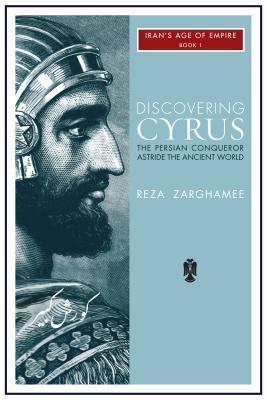
Discovering Cyrus: The Persian Conqueror Astride the Ancient World by Reza Zaghamee

Some of the most fascinating human epochs lie in the borderlands between history and mystery. So, it is with the life of Cyrus the Great, founder of the Persian Empire in the sixth century BCE. By conquest or gentler means, he brought under his rule a dominion stretching from the Aegean Sea to the Hindu Kush and encompassing some tens of millions of people. All across this immense imperium, he earned support and stability by respecting local customs and religions, avoiding the brutal ways of tyranny, and efficiently administering the realm through provincial governors. The empire would last another two centuries, leaving an indelible Persian imprint on much of the ancient world. The Greek chronicler Xenophon, looking back from a distance of several generations, wrote: “Cyrus did indeed eclipse all other monarchs, before or since.” The vision of the biblical prophet known as Second Isaiah anticipates Cyrus’ repatriation of Jews living in exile in Babylon with these words of the Lord: “He is my shepherd and will accomplish all that I please.”

Despite what he achieved and bequeathed, much about Cyrus remains uncertain. Persians of his era had no great respect for the written word and kept no annals. The most complete accounts of his life were composed by Greeks. More fragmentary or tangential evidence takes many forms – among them, archaeological remains, administrative records in subject lands, and the always tricky stuff of legend.

Given these challenges, Discovering Cyrus: The Persian Conqueror Astride the Ancient World is a remarkable feat of portraiture. In his vast sweep, Reza Zarghamee draws on sources of every kind, painstakingly assembling detail, and always weighing evidence carefully where contradictions arise. He describes the background of the Persian people, the turbulence of the times, and the roots of Cyrus’ policies. His account of the imperial era itself delves into religion, military methods, commerce, court life, and much else besides. The result is a living, breathing Cyrus standing atop a distant world that played a key role in shaping our own.
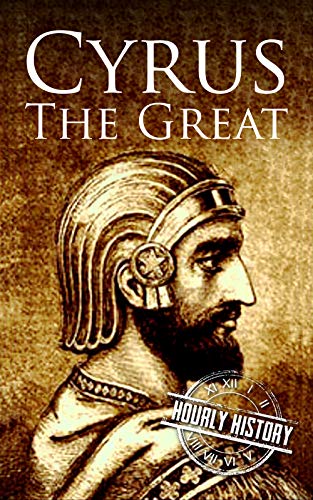
Cyrus the Great: A Life from Beginning to End by Hourly History

Cyrus II of Persia was one of the greatest leaders that the world had ever known; he was the one in whose footsteps other empire builders would follow. From Alexander the Great to countless Roman emperors and Ottoman sultans—it was the mighty shoes of Cyrus that they all attempted to fill.

More than merely a successful conqueror, Cyrus the Great is known just as much for being a great liberator as he is known for his conquests. He was even credited in the Bible as the one who freed the Jews from their long-held Babylonian exile. By the time of his death, Cyrus controlled more land and people than anyone before him. Under his dominion were countless principalities, nationalities, ethnicities, and religions of all kinds. In contrast to many other powerful rulers, Cyrus did not seek to oppress his subjects or interfere with their way of life, religions, or local customs. It is for this reason that, as great as his temporal conquests may have been, the benevolence of Cyrus the Great’s leadership stands as his greatest attribute of all.

The life of Cyrus the Great remains as an unparalleled testament in the annals of history.
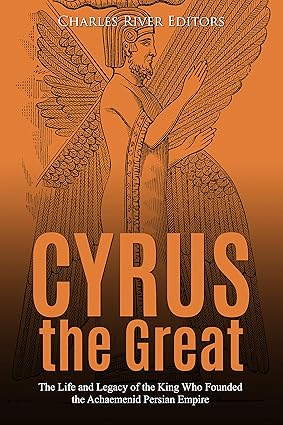
Cyrus the Great: The Life and Legacy of the King Who Founded the Achaemenid Persian Empire by Charles River Editors

“I am Cyrus the king, an Achaemenian.” – An inscription found at the Persian capital of Pasargadae

At one point in antiquity, the Achaemenid Persian Empire was the largest empire the world had ever seen, but aside from its role in the Greco-Persian Wars and its collapse at the hands of Alexander the Great, it has been mostly overlooked. When it has been studied, the historical sources have mostly been Greek, the very people the Persians sought to conquer. Needless to say, their versions were biased.

It was not until excavations in the region during the 20th century that many of the relics, reliefs, and clay tablets that offer so much information about Persian life could be studied for the first time. Through archaeological remains, ancient texts, and work by a new generation of historians, a picture can today be built of this remarkable civilization and their most famous leaders.

When considering this empire’s rulers, the two most often referenced are Xerxes, the leader of the Persian invasion of Greece which caused the heroic sacrifice of the Spartans and their allies at Thermopylae, or Cyrus the Great, the man who created the empire. While he was one of the most influential men in the ancient world, research on Cyrus the Great is simultaneously fascinating and frustrating. The Persians’ ancestors did not write (in fact, in their epic poems and myths, they claim that it was something taught to man by demons and therefore something to be avoided), and though the Iranians had taken up writing in their governmental and administrative functions by the time Cyrus lived, the kings still did not learn to write. Put simply, it was considered a functional skill, but not of the greatest importance.

As a result, while plenty of ancient sources mention the great Persian king, Persian sources themselves are rare, and those sources that do exist, such as the Babylonian Chronicle, are largely dry and state only the basic facts and large events. By contrast, Greek sources about Cyrus embrace the artistic aspect of their work so highly that the accuracy often comes into question, and sometimes deep scrutiny is necessary to attempt to separate the fact from the fiction. In the end, the full truth about Cyrus and his reign may never be truly understood.

Of course, this reality has deepened the mystique that surrounds Cyrus even to this day, and it has elevated his status from conqueror and king to enlightened humanist monarch and ideal ruler. In fact, a modern misconception based on the Cyrus Cylinder has labeled him the first proponent of civil rights, though this is somewhat of an exaggeration. The argument hinges on the Cylinder being a unique artifact in listing the ideology by which Cyrus intended to rule, but it equally ignores the fact that such declarations were commonplace among kings of the ancient Near East and more a tool of monarchal propaganda than a sweeping declaration of human rights.

That said, Cyrus was a fair and rational leader, particularly compared to the many brutal kings and warlords of ancient times. The high praise he received, even from his enemies, must certainly not be dismissed, and the admiration directed toward him came from many other exceptional individuals, including Alexander the Great, a bitter enemy of the empire Cyrus founded. Whatever the underlying issues, the incredible achievements of Cyrus distinguish him as one of the greatest kings in history, and his life, conquests, reforms, and rule continue to be of great interest over 2,500 years later.

Cyrus the Great: The Life and Legacy of the King Who Founded the Achaemenid Persian Empire looks at the life of the Persian leader and the major legacy he left. Along with pictures depicting important people, places, and events, you will learn about Cyrus the Great like never before.

Reader’s Log 022: The Supernatural Genre and Spiritual Warfare

I woke up this morning reflecting on our world’s current events and my faith in God weighs the outcome on how I respond to these current events. The world’s troubles are always on my mind, like I’m sure it is for everyone. We are living in unsettling times. When I pray to God, I ask for peace and understanding. I pray for courage, strength, protection, healing, and stronger faith in my daily walk with Christ. I pray this for others as well. If it weren’t for my Christian Faith, I don’t believe I would have made it this far in life.

I’ve also been thinking a lot about how would I respond to the US elections outcome this coming November. Whatever the outcome, I pray for a peaceful transfer of power in our government and how our citizens and the world response. I pray that our government officials will truly care about the people’s welfare. These things have me thinking about spiritual warfare as well and how we as Christians should rest in God’s strength and stand on God’s promise, how important it is to know God’s word and to put on the full armor of God. When people come to know Christ as their Lord and savior, spiritual warfare can become intense. I’ve recently thought about books I’ve read on spiritual warfare. The Bible-of course-is number one.

As a reader, I love stories and I read many different genres. I believe it is important for people of Faith to read widely for many reasons. Some brothers and sisters in Christ may disagree with me on that score but I’m okay with that. God knows my heart and I firmly believe that reading widely makes us better people and as we expand our minds, we have a better understanding other people’s world views, struggles and situations in life. Reading enhances our critical thinking thus giving us the knowledge and the tools to help us in life with relationships to others. Anyhow, reading widely is another subject for another time.

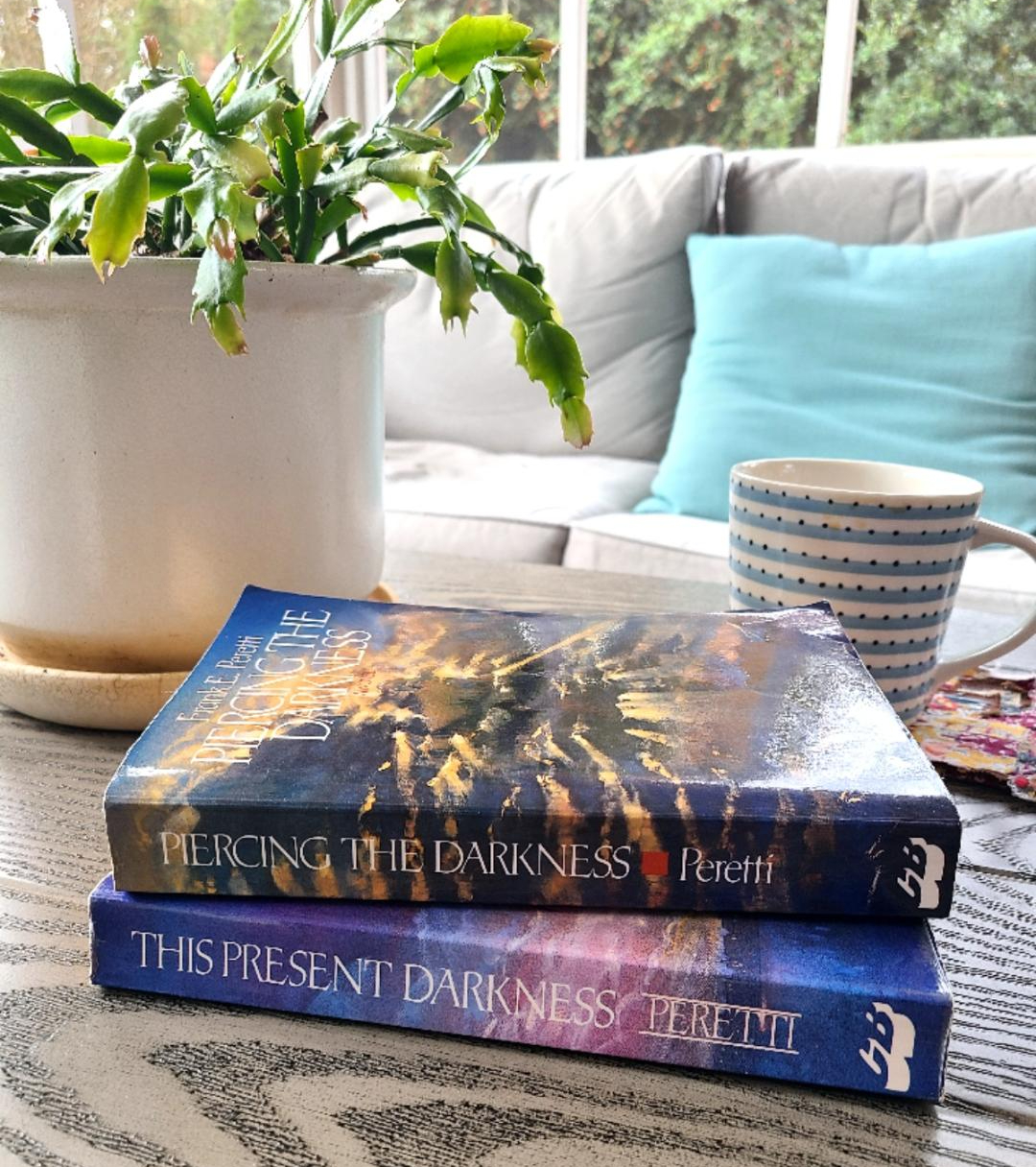
Today, I want to share two books I read in the early 90’s and again in the late 90’s on spiritual warfare by Frank E. Peretti. I have my father’s paperback copies. Since they are early editions, and have become a bit fragile, I’m having handle them carefully. Though I believe they will still be okay to read in and may do so again soon. If you haven’t read them, whether you are a Christ follower or not, I highly recommend you read these books. They are prevalent to our humanity and our society as a whole.

Stephanie

This Present Darkness by Frank E. Peretti

First Published – January 1, 1986 by Crossway Books

Ashton is just a typical small town. But when a skeptical reporter and a prayerful pastor begin to compare notes, they suddenly find themselves fighting a hideous New Age plot to subjugate the townspeople, and eventually the entire human race.

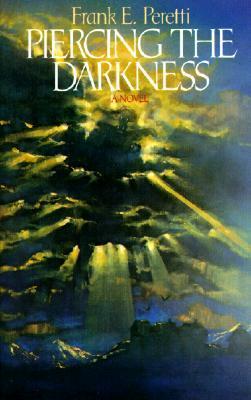
Piercing the Darkness by Frank E. Peretti

First published January 1, 1989

The light shines in the darkness, and the darkness has not overcome it.

John 1:5 (ESV)

It all begins in Bacon’s Corner, a tiny farming community far from the interstate . . . An attempted murder, a case of mistaken-or is it covered up? -identity, and a ruthless lawsuit against a struggling Christian school. Sally Beth Roe, a young loner, a burnout, a kind of “leftover hippie, “finds herself caught in the middle of these bizarre events, fleeing for her life while trying to recall her dark past.

Across a vast panorama of heart-stopping action, Sally Roe’s journey is a penetrating portrayal of our times, a reflection of our wanderings, and a vivid reminder of the redemptive power of the Cross. A companion volume to This Present Darkness, readers have purchased over two million copies of Piercing the Darkness since its publication in 1989.

**********

The Armor of God

10 Finally, be strong in the Lord and in his mighty power. 11 Put on the full armor of God, so that you can take your stand against the devil’s schemes. 12 For our struggle is not against flesh and blood, but against the rulers, against the authorities, against the powers of this dark world and against the spiritual forces of evil in the heavenly realms. 13 Therefore put on the full armor of God, so that when the day of evil comes, you may be able to stand your ground, and after you have done everything, to stand. 14 Stand firm then, with the belt of truth buckled around your waist, with the breastplate of righteousness in place, 15 and with your feet fitted with the readiness that comes from the gospel of peace. 16 In addition to all this, take up the shield of faith, with which you can extinguish all the flaming arrows of the evil one. 17 Take the helmet of salvation and the sword of the Spirit, which is the word of God.18 And pray in the Spirit on all occasions with all kinds of prayers and requests. With this in mind, be alert and always keep on praying for all the Lord’s people.

Ephesians 6:10-18 (NIV)

In Times of Trouble

There are seasons in our lives when our hardships often feel overwhelming and sometimes, we lose sight at what God’s plans has for us. We get caught up in our struggles, doubts, feelings of hopelessness, and then despair can seep in our hearts. We become consumed with tiredness and weakness in our burdens, our hearts can harden and we can lose sight and we become focused on the wrong things that are temporary. We become focused on self and our troubles and that leads us away from Him. Instead be encouraged to turn to God in faith, continual prayer for healing and trust in His time and plan for our lives. God wants and longs for us to turn to Him for everything. In Matthew chapter 11:28 says, “Come to me, all you who are weary and burdened, and I will give you rest. And in 1 Peter 5:7 says, “Cast all your anxiety on Him because He cares for you.” In 2 Corinthians 4:17-18 says, “For our light and momentary troubles are achieving for us an eternal glory that far outweighs them all. So, we fix our eyes not on what is seen, but on what is unseen. For what is seen is temporary, but what is unseen is eternal.

Prayer: O mighty God, you are our refuge and fortress in whom we trust. We praise you even in the time of trouble. You are loving and faithful. Hear our voice and be merciful to us O Lord, for our hope is in you. For your word says in Matthew 7:7-8, “Ask and it will be given to you; seek and you will find; knock and the door will be opened to you. For everyone who asks receives; the one who seeks finds; and to the one who knocks, the door will be opened.” We humbly ask you fill us with your Holy Spirit to protect us, guide us casting out all our doubts and sorrow for we give it all to you. We put our trust in you, O Lord. May we seek you in all of our ways. May your Spirit renew our minds, fill us your healing power and thanksgiving. May your Spirit surround us with deliverance for we stand on your promises. We ask all of these things in Jesus Holy name. Amen!

What has really helped me in my prayers and daily walk with Christ is to spend time with God in prayer and in His word. If there is something in your life that you are struggling with but you’re not sure how pray, the Bible can guide you with your prayers and help you build your relationship with God. Ask God to give you direction in your prayers. Ask Him to show you the way. We must become like children and seek Him with open hearts. He loves us so much.

Oftentimes, I like to write down my prayers and verses that help me in all areas of my life. There are so many passages and stories of overcoming hardships and thanksgiving in the Bible to help us.

Jesus answered, “It is written: ‘Man shall not live on bread alone, but on every word that comes from the mouth of God.” Matthew 4:4

“Your word is a lamp for my feet, a light on my path.” Psalms 119:105

“And we also thank God continually because, when you received the word of God, which you heard from us, you accepted it not as a human word, but as it actually is, the word of God, which is indeed at work in you who believe.” 1 Thessalonians 2:13

Stephanie

Christian Theology

In my last blog post, I mentioned that I was deeply involved in Bible studies-such as theology and the early Christian church history and other history research. In the latter, I meant to say my additional research, or study if you will, was centered on ancient cultural backgrounds. Last year I was gifted by my father the NIV Cultural Backgrounds Study Bible. This is my third study Bible I have acquired and I am thrilled to have this edition to my growing theology library. My father also gifted me the Holman Illustrated Guild to Biblical Geography (reading the Land) by Paul H, Wright. In addition, I am blessed to be studying from my father’s theology library as well. Including his NIV commentaries of each book of the Bible.

When I was a child my first Bible was the King James version and on June 14, 1994, I received my first NIV study Bible from my parents. That particular version is the NIV Disciple’s Study Bible.

What I love about the NIV Cultural Backgrounds Study Bible I was gifted last year, is a richer look behind the scenes that I was looking for with my current Bible studies. I will most likely acquire the New King James version at some point in time. I can’t wait! Another version I want to read is the Geneva Bible. This Bible is significant of the Bible into English during the 16th century English Protestantism. Thankfully my father has a copy.

Recently I’ve also started to use my Bible App as another form of Bible reading. To listen through the Bible in a year and then repeat every year. At times, I will read along with one of my Bibles. I find that helps me with staying in the word and memorization. Other tools that help me for a better understanding during my Bible studies and research are the Oxford Bible Atlas and Holman’s Bible Dictionary. In a later post I will be sharing other theological and cultural books I’m studying from. If you are interested in historical backgrounds and a better or deeper understanding of context, I highly recommend the books above to start with.

Stephanie Hopkins

Christian Theology

It has been quite a while since I’ve last read books on Christian Theology and I feel even more compelled today to come back to this genre.

I’m curious about the books I have listed below and will be reading them at some point in time. Have you heard of these books? Have you read any of them?

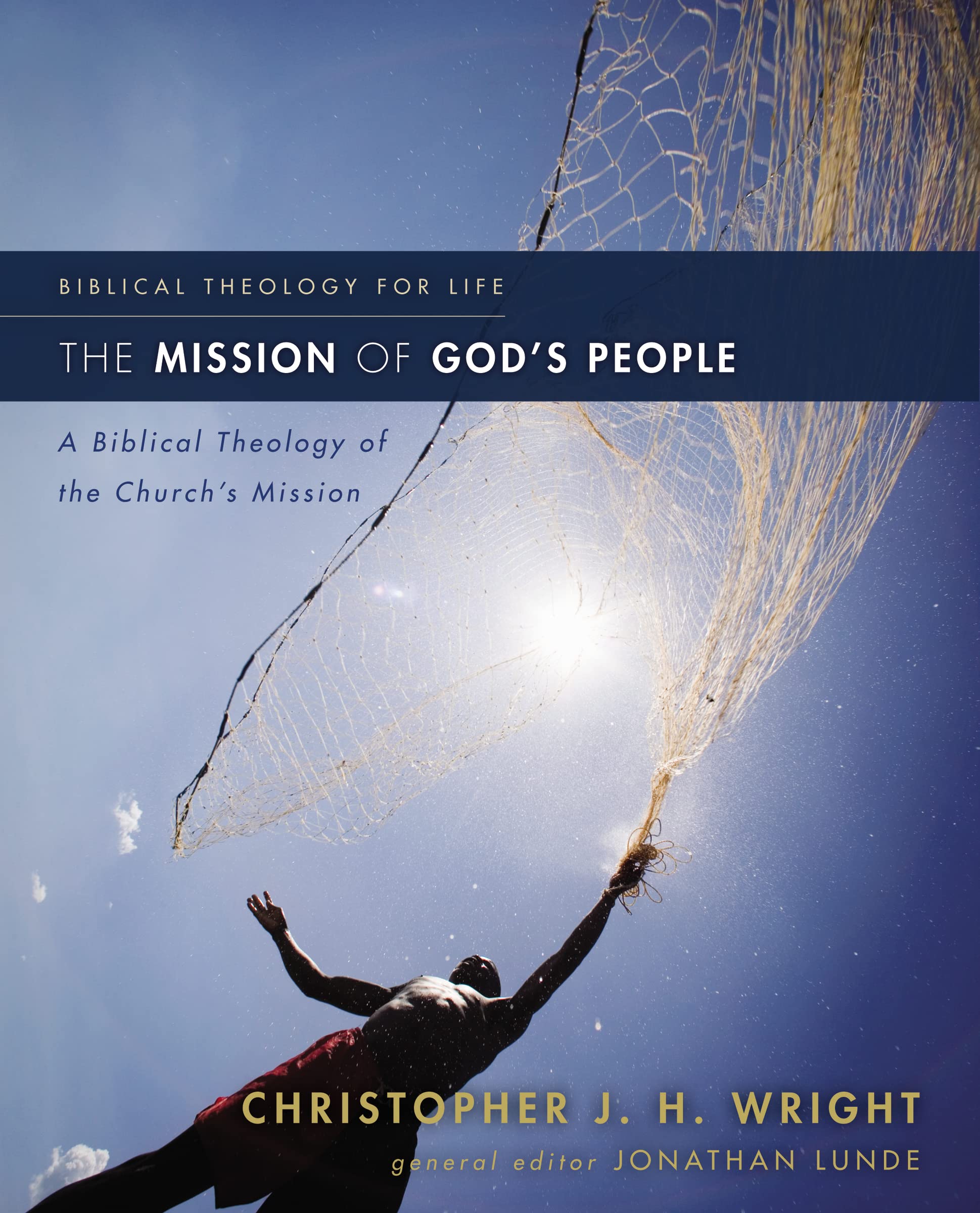
The Mission of God’s People: A Biblical Theology of the Church’s Mission (Biblical Theology for Life) by Christopher J. H. Wright

In, The Mission of God’s People, Wright shows how God’s big-picture plan directs the purpose of God’s people, the church. Wright emphasizes what the Old Testament teaches Christians about being the people of God. He addresses questions of both ecclesiology and missiology with topics like “called to care for creation,” “called to bless the nations,” “sending and being sent,” and “rejecting false gods.” As part of the Biblical Theology for Life Series, this book provides pastors, teachers, and lay learners with first-rate biblical study while at the same time addressing the practical concerns of contemporary ministry. The Mission of God’s People promises to enliven and refocus the study, teaching, and ministry of those truly committed to joining God’s work in the world.

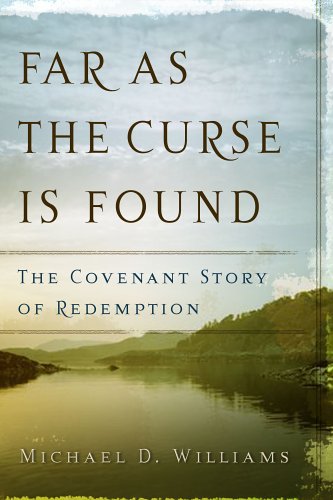
Far as the Curse Is Found: The Covenant Story of Redemption by Michael D. Williams

God’s covenant with his people is an unfolding historical drama with personal and earthly dimensions that are often overlooked. In this study of the meaning and scope of the covenant, Michael D. Williams highlights the goodness of the physical realm and God’s redemptive intentions for his creation.

The Attributes of God by A.W. Pink

This classic work of Arthur W. Pink invites readers to discover the truth about seventeen attributes of God, including his sovereignty, immutability, patience, love, faithfulness, and much more.

More about The Attributes of God:

Bible scholar Arthur W. Pink became a prolific and highly influential evangelical author over the course of the twentieth century, beginning with his monthly magazine Studies in Scriptures. Many of his books began as articles in this small publication, including The Attributes of God. In this work, Pink sets out to reveal the true character of God. He believes that in order to truly know God, we must first submit to God and follow in his footsteps. The people that do know their God shall be strong (Dan. 11:32).

It is the author’s hope that those who listen to these words shall be blessed and see their lives transformed by the power of God.

Cover Crush: The Well by Stephanie Landsem

About the cover: I’ve examined this cover so much that I’m second guessing myself on if I have shared this one already or not. If so, refreshers are good.

If I were to rate the book cover, I’d give it five stars, maybe more. You can see the woman’s face! Well, her profile but that is a lot better than seeing her back. The landscape is stunning and the colors vibrant and evoking. I love everything about this cover design. Including the title, oh, and the author has a beautiful name. Hint, hint.

About the book: I have mixed feelings about Biblical re-telling’s and Christian fiction in general. Often times they are unrealistic water-downed (no pun intended) and one must always remember that these re-telling’s are fictional that draw from details and facts from the Bible. Or the reader hopes so… If you’re not certain, it’s best to go straight to the source. As I said above, I have mixed feelings about this medium of story- telling, however, as a story enthusiast, person of faith and my love for history, I’m highly interested in this one.

If you are a reader of the Bible, you will know the story of Jacob’s well in the New Testament. If I recall, the passage is in the book of John. The well and where it is situated is a notable and historic site today. The story of Jacob goes all the way back to the Old Testament.

As The Well goes, Landsem takes us to the Samaritan Village and introduces us to a woman and her family who is shunned for their mother’s sins. Then one day, two men arrive to their village, one of them is Jesus. His teachings of faith and belief in God sending His son to save us, service, love, forgiveness, kindness and hope are about Christian life.

Not everything turns out the way we want them to and bad things happen but I firmly believe in redemption and a higher purpose to our strife in life. I look forward to reading this story. – Stephanie Hopkins

Grungy abstract inspired by the landscape in the background of the book cover. -by Stephanie Hopkins

More about the story:

Paperback, 304 pages

Published June 4th 2013 by Howard Books

In the rich tradition of Francine Rivers’s Lineage of Grace series, comes a beautiful retelling of the biblical story of the woman at the well—bringing to life this poignant young woman struggling to survive love and heartbreak.

For the women of the Samaritan village of Sychar, the well is a place of blessing—the place where they gather to draw their water and share their lives—but not for Mara and her family. Shunned for the many sins of her mother, Mara struggles against the constant threats of starvation or exile.

But Mara and her mother, Nava’s lives are forever changed with the arrival of two men: Shem, a mysterious and wealthy young man from Caesarea, and Jesus, a Jewish teacher. Nava is transformed by Jesus, with his talk of forgiveness, but his teachings come too late and she is stoned by the villagers for her past sins. Desperate to save her mother, Mara and Shem embark on a journey to seek Jesus’ help—a journey that brings unexpected love and hope, despite great difficulties.

In The Well, debut novelist Stephanie Landsem brings to life the culture and people of Jesus’ day, skillfully demonstrating how redemption can bring about the life-changing effects of forgiveness and love. 

Be sure to check out my Mixed Media Art Gallery and Instagram to see more of my art journey!

A Time of Celebration

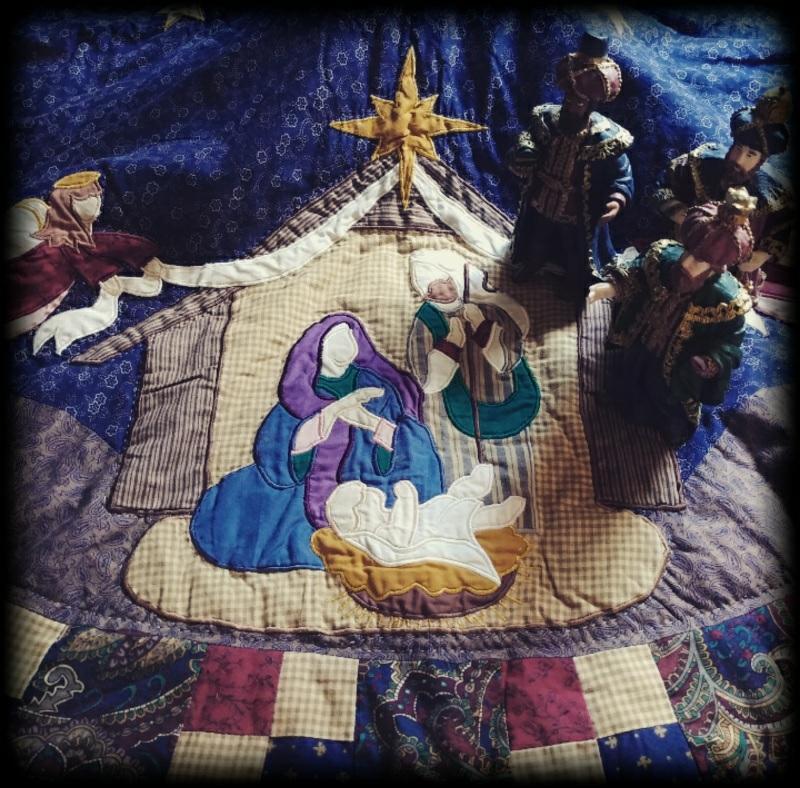
Quilted Christmas Tree Skirt

Once in a Manger

Once in a manger, a long time ago,

Before there was Santa and reindeer and snow,

A star shone down on humble beginnings below

Of a baby just born who the world would soon know.

Never before had there been such a sight.

Would the Son of a King have to suffer this plight?

Are there no armies to lead? Are there no battles to fight?

Shouldn’t He conquer the world and demand His birthright?

No, this frail little infant asleep in the hay

Would change the whole world with the words He would say.

Not about power or demanding His way,

But mercy and loving and forgiving God’s way.

For only through humbleness would the battle be won,

As shown by the actions of God’s only true son.

Who gave up His life for the sins of everyone,

Who saved the whole world when His journey was done.

Many years have now passed since that night long ago

And now we have Santa and reindeer and snow

But down in our hearts the true meaning we know,

It is the birth of that child that makes Christmas so.

–By Tom Krause

See you all again on the 28th!

Honoring Christ My Savior

Christmas is a special time of year in honoring our Savior’s birth. My faith in Christ means hope, forgiveness, acceptance and salvation. I want to wish you all a Merry Christmas and many blessings to come. -Stephanie

John 1:9-14  “The true light, which gives light to everyone, was coming into the world.  He was in the world, and the world was made through him, yet the world did not know him.  He came to his own, and his own people did not receive him. But to all who did receive him,  who believed in his name,  he gave the right  to become  children of God, who were born,  not of blood  nor of the will of the flesh nor of the will of man, but of God.  And the Word became flesh and dwelt among us, and we have seen his glory, glory as of the only Son from the Father, full of  grace and  truth.”

2019 Christmas TreeSilent night! Holy night!
All is calm, all is bright
’round yon virgin mother and child!
Holy infant, so tender and mild,
sleep in heavenly peace,
sleep in heavenly peace.

Silent night! Holy night!
Shepherds quake at the sight.
Glories stream from heaven afar,
heav’nly hosts sing: “Alleluia!
Christ the Savior is born!
Christ the Savior is born..!”