Biographies & Memoirs

On January 19th I posted about a few selected non-fiction books I have added to my wish-list. There are too many to count and not enough time in the hours of a day that direct our attention elsewhere! A bibliophile’s struggle one might often say. This topic is an enjoyable pastime to discuss among fellow book lovers and I’m delighted to be sharing this book blog entry with you.

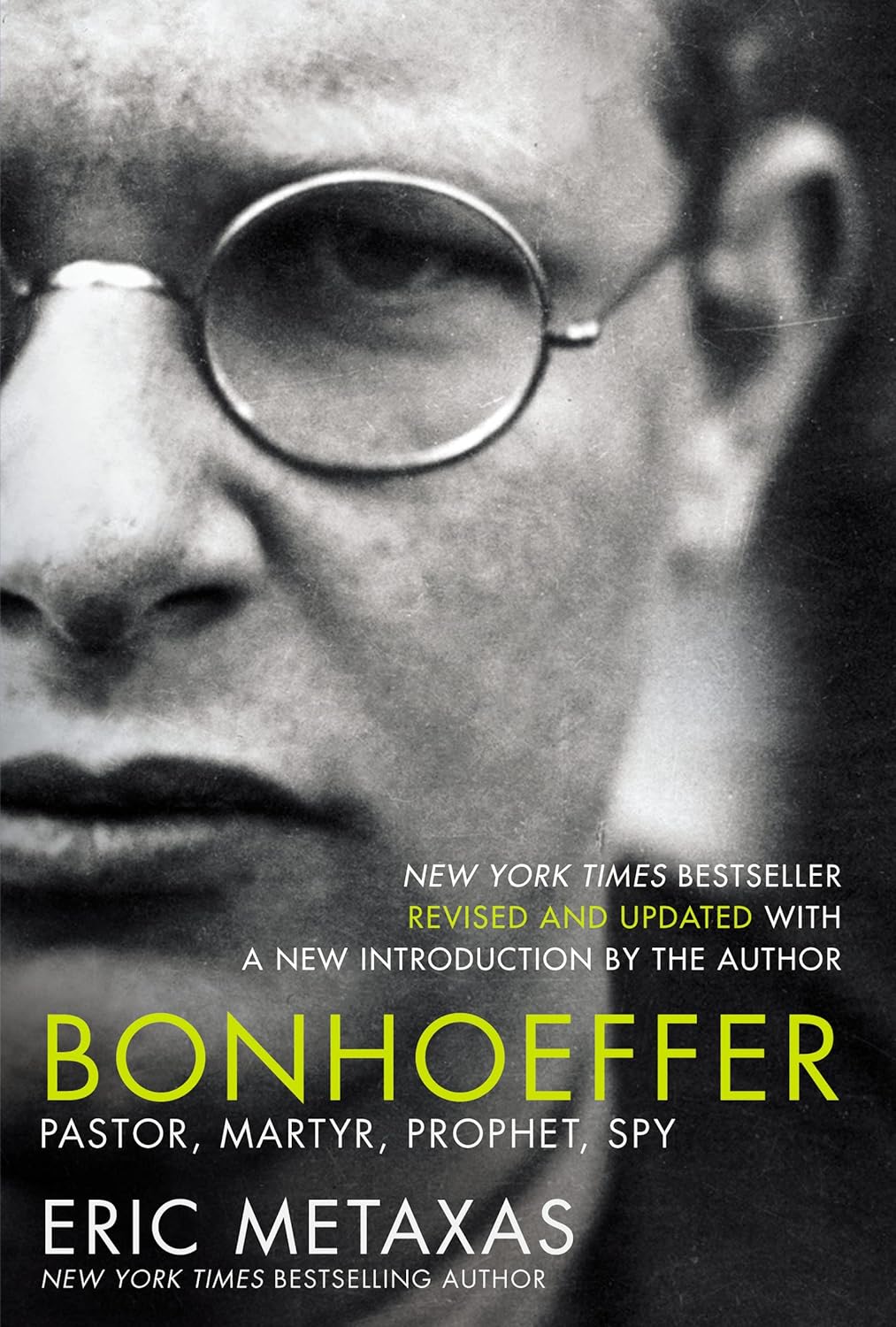
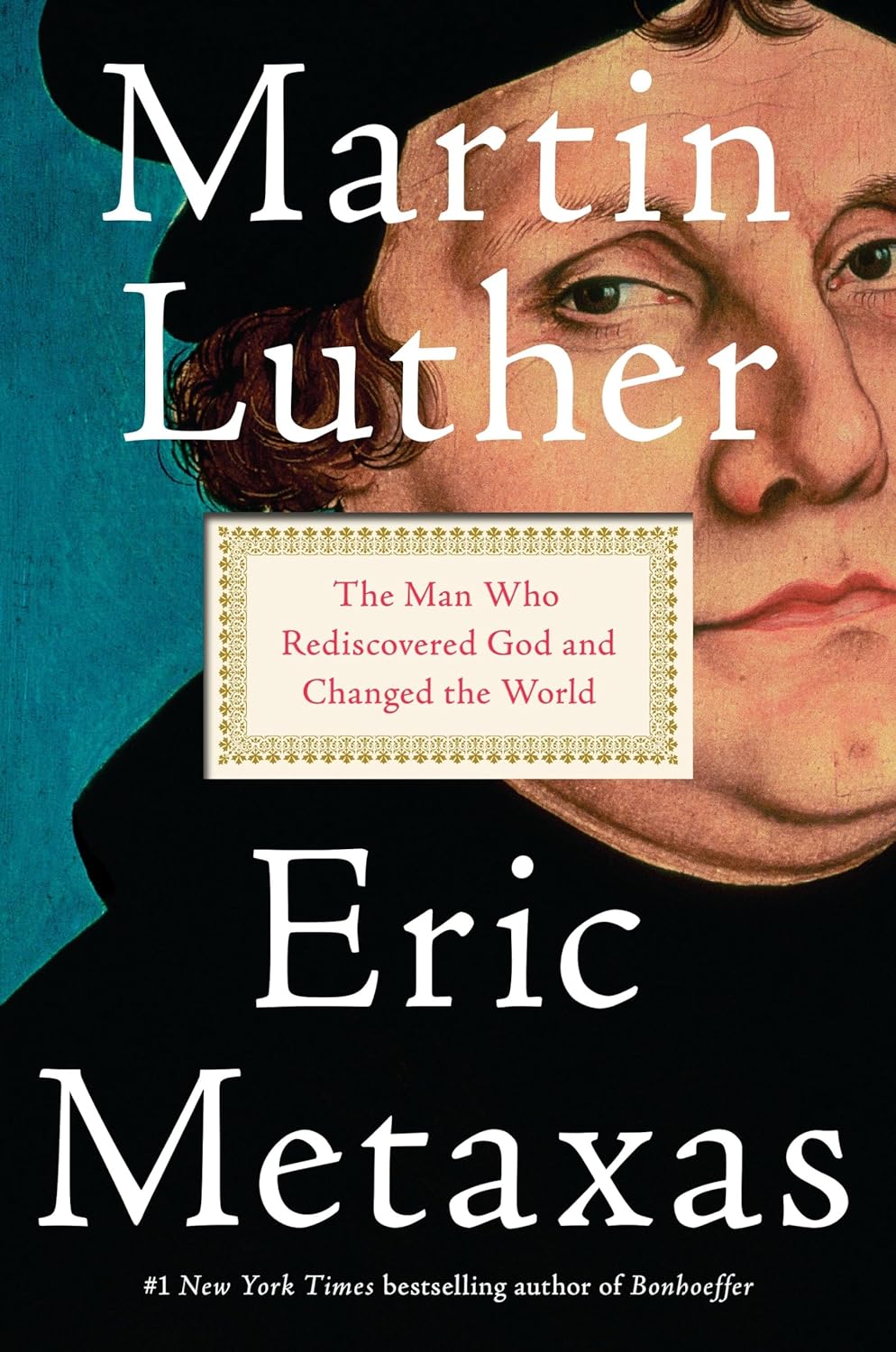
This past weekend I began reading Martin Luther by Eric Metaxas and I’m enjoying his telling of Luther a great deal. I wanted to read a highly regarded biography on Luther and was delighted to find a copy at Half Price Books. I was fortunate to obtain a hardback that is in excellent condition. Below you will find the description of the Luther book and a few other titles that may pique your interest.

Martin Luther: The Man Who Rediscovered God and Changed the World by Eric Metaxas

 Description

On All Hallow’s Eve in 1517, a young monk named Martin Luther posted a document he hoped would spark an academic debate, but that instead ignited a conflagration that would forever destroy the world he knew. Five hundred years after Luther’s now famous Ninety-five Theses appeared, Eric Metaxas, acclaimed biographer of the bestselling Bonhoeffer: Pastor, Martyr, Prophet, Spy and Amazing Grace: William Wilberforce and the Heroic Campaign to End Slavery, paints a startling portrait of the wild figure whose adamantine faith cracked the edifice of Western Christendom and dragged medieval Europe into the future. Written in riveting prose and impeccably researched, Martin Luther tells the searing tale of a humble man who, by bringing ugly truths to the highest seats of power, caused the explosion whose sound is still ringing in our ears. Luther’s monumental faith and courage gave birth to the ideals of liberty, equality, and individualism that today lie at the heart of all modern life.

Ben & Me

In Search of a Founder’s Formula for a Long and Useful Life by Eric Weiner

Pub Date 11 Jun 2024 

Description

New York Times bestselling author Eric Weiner follows in the footsteps of Benjamin Franklin, mining his life for inspiring and practical lessons in a book that’s part biography, part travelogue, part personal prescription.

Ben Franklin lingers in our lives and in our imaginations. One of only two non-presidents to appear on US currency, Franklin was a founder, statesman, scientist, inventor, diplomat, publisher, humorist, and philosopher. He believed in the American experiment, but Ben Franklin’s greatest experiment was…Ben Franklin. In that spirit of betterment, Eric Weiner embarks on an ambitious quest to live the way Ben lived.

Not a conventional biography, Ben & Me is a guide to living and thinking well, as Ben Franklin did. It is also about curiosity, diligence, and, most of all, the elusive goal of self-improvement. As Weiner follows Franklin from Philadelphia to Paris, Boston to London, he attempts to uncover Ben’s life lessons, large and small. We learn how to improve a relationship with someone by inducing them to do a favor for you—a psychological phenomenon now known as The Ben Franklin Effect. We learn about the printing press (the Internet of its day), early medicine, diplomatic intrigue and, of course, electricity. And we learn about ethics, persuasion, humor, regret, appetite, and so much more.

At a time when history is either neglected or contested, Weiner argues we have much to learn from the past and that we’d all be better off if we acted and thought a bit more like Ben did, even if he didn’t always live up to his own high ideals. Engaging, smart, moving, quirky, Ben & Me distills the essence of Franklin’s ideas into grounded, practical wisdom for all of us.

Drawn Testimony

My Four Decades as a Courtroom Sketch Artist

by Jane Rosenberg

Pub Date 13 Aug 2024

Description

A penetrating, compulsively readable memoir about the four-decade career of America’s top courtroom sketch artist, for fans of Lab Girl and Working Stiff

Jane Rosenberg is America’s pre-eminent courtroom sketch artist. For over forty years, she’s been at the heart of the story, covering almost every major trial that has passed through the New York justice system. From mob bosses to fallen titans of finance, terrorists and sex abusers, corrupt cops and warring entertainment icons, she has drawn them all.

In Drawn Testimony, Rosenberg brings us into the high-stakes, dramatic world of her craft, where art, psychology and courtroom drama collide. Over the course of her legendary career, Jane has had a front row seat to some of the most iconic and notorious moments in our nation’s recent history, sketching everything from Tom Brady’s deflate-gate case, to John Lennon’s murder trial to cases against Ghislaine Maxwell, John Gotti, Harvey Weinstein and most recently, the indictment against former President Donald Trump. Readers will learn how she has honed her unique powers of perception, but also what her portraits reveal, not only about her subjects, but about the human condition in general.

Fearless, fascinating and gorgeously written, Drawn Testimony captures the unique career of an artist whose body of work depicts history as it’s happening.

My Roman History

A Memoir

by Alizah Holstein

Pub Date 25 Jun 2024 

Description

In this exquisite and profound memoir, a medieval historian traces her lifelong obsession with Rome and the encounters with the city’s past and present that became fulcrum points in her life

From the time she first felt called to its gates as a high school student fascinated by Dante and Italian thanks to a life-changing teacher, Rome has been a fixed star around which Alizah Holstein’s life has rotated—despite the fact that she bears no Italian heritage, and has never lived there long enough to call it home. 

In this kaleidoscopic yet intimate memoir, her shifting relationship to a vibrant city layered with human history becomes a lens on why we look to the past, on the mysteries of affinity and desire, and on what it means to grow up. Holstein weaves the stories of Romans past and present, and encounters with the city of historical figures from Petrarch to Freud, into the narrative of her evolution from a curious student abuzz with the thrill of discovery, to a lonely researcher in a city to which she feels she belongs despite knowing no one, to an ambitious young historian struggling to find her place in the halls of academia. Following a trail of memories—that first taste of a tartufo cioccolato in Piazza Navona, the ancient walls of the Via Appia blurring from the back of a motorcycle, the smudge of ink on a manuscript left by a scribe’s hand over seven hundred years before—she explores what it means to be romana, Roman—and to find solace and self-knowledge in the presence of the past.

An enveloping, original, and deeply resonant account, set against one of the world’s most beguiling cities, of the unexpected things that give our lives meaning, My Roman History is a profound depiction of the winding path to self-realization, which—much like history itself—is mysterious, captivating, and ever-unfolding.

Stories of World War II

A few years ago now, Atria Books sent me an ARC of The Princess Spy by Larry Loftis to review and I immensely enjoyed the story. Since then I haven’t had a chance to look at Loftis other works and I’ve recently discovered another book by him I would like to read and have added it to my reading wish-list plus, The Hiding Place by Corrie Ten Boom. I can’t wait to read them! They look so good. I have a feeling I will be shedding quite a few tears reading them. World War II stories do that to me. Let me know in the comment area if you’ve read these stories!

Stephanie Hopkins

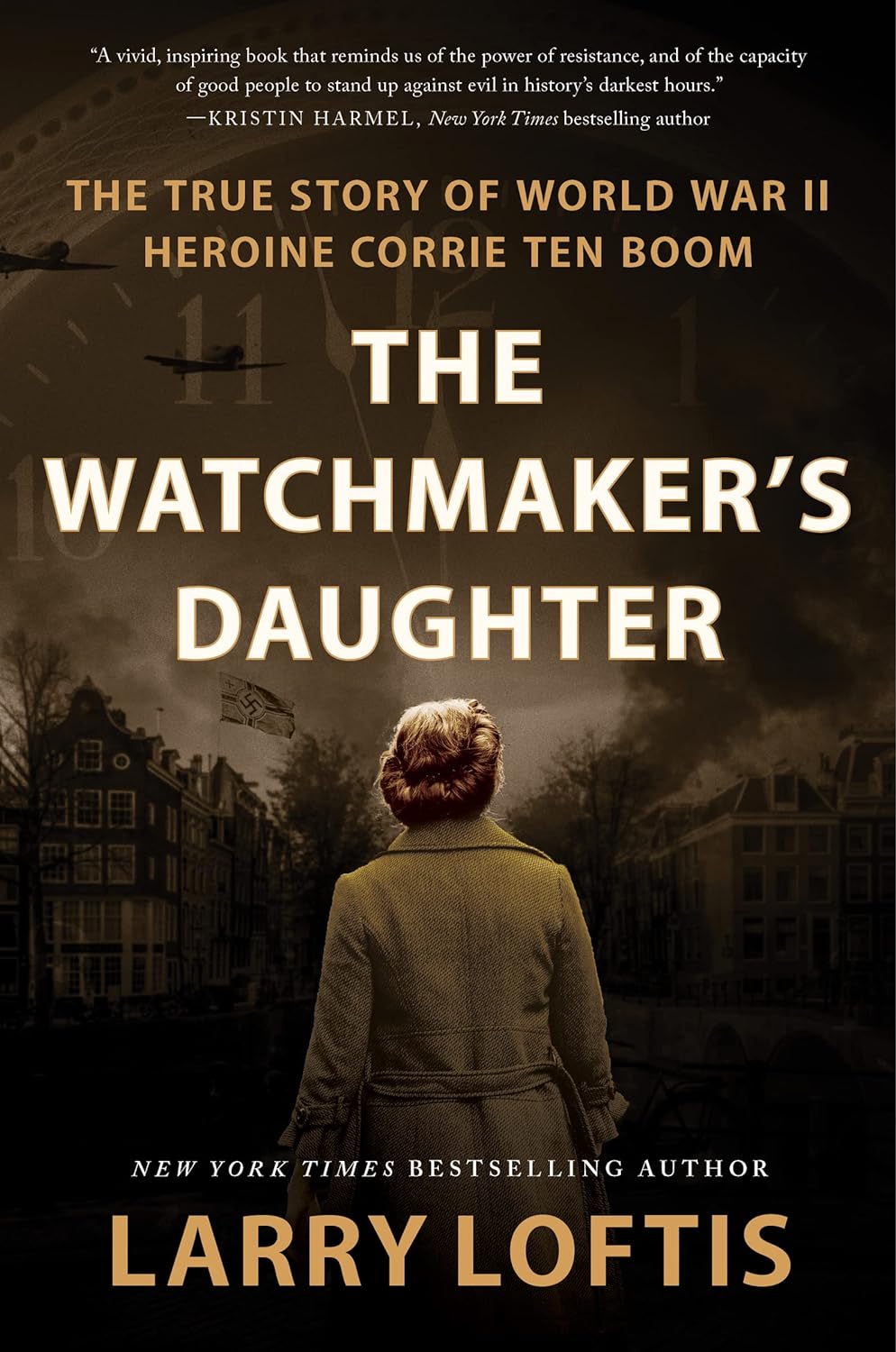
The Watchmaker’s Daughter: The True Story of World War II Heroine Corrie ten Boom by Larry Loftis

About the book:

INTERNATIONAL BESTSELLER

New York Times bestselling author and master of nonfiction spy thrillers Larry Loftis writes the first major biography of Corrie ten Boom, a Dutch watchmaker who saved the lives of hundreds of Jews during WWII—at the cost of losing her family and being sent to a concentration camp, only to survive, forgive her captors, and live the rest of her life as a Christian missionary.

The Watchmaker’s Daughter is one of the greatest stories of World War II that readers haven’t heard: the remarkable and inspiring life story of Corrie ten Boom—a groundbreaking, female Dutch watchmaker, whose family unselfishly transformed their house into a hiding place straight out of a spy novel to shelter Jews and refugees from the Nazis during Gestapo raids. Even though the Nazis knew what the ten Booms were up to, they were never able to find those sheltered within the house when they raided it.

Corrie stopped at nothing to face down the evils of her time and overcame unbelievable obstacles and odds. She persevered despite the loss of most of her family and relied on her faith to survive the horrors of a notorious concentration camp. But even more remarkable than her heroism and survival was Corrie’s attitude when she was released. Miraculously, she was able to eschew bitterness and embrace forgiveness as she ministered to people in need around the globe. Corrie’s ability to forgive is just one of the myriad lessons that her life story holds for readers today.

Reminiscent of Schindler’s List and featuring a journey of faith and forgiveness not unlike Unbroken, The Watchmaker’s Daughter is destined to become a classic work of World War II nonfiction.

The Hiding Place by Corrie Ten Boom, Elizabeth Sherrill, and John Sherrill

“Every experience God gives us . . . is the perfect preparation for the future only He can see.”–Corrie ten Boom

About the book:

Corrie ten Boom was a Dutch watchmaker who became a heroine of the Resistance, a survivor of Hitler’s concentration camps, and one of the most remarkable evangelists of the twentieth century. In World War II she and her family risked their lives to help Jews and underground workers escape from the Nazis, and for their work they were tested in the infamous Nazi death camps. Only Corrie among her family survived to tell the story of how faith ultimately triumphs over evil.

Here is the riveting account of how Corrie and her family were able to save many of God’s chosen people. For 35 years millions have seen that there is no pit so deep that God’s love is not deeper still. Now The Hiding Place, repackaged for a new generation of readers, continues to declare that God’s love will overcome, heal, and restore.


Christian Church History

In a post not too long ago, I mentioned that I’m deeply involved in Bible studies-such as theology and the early Christian church history and other history research. In the latter for example, I’m focusing much on ancient cultural backgrounds; including the Old Testament and New Testament.

What led me to do a deep dive study in early Christianity history was a YouTube video by AOC Network. The channel has a video on the early Christians and it inspired me and deeply moved me to learn more about Christians in the first and second century AD. I approached my father about this subject and we talked about specifics and he handed me a book, Church History in Plain English by Bruce L. Shelley. He also printed off summaries of information on several saints during that time. I believe from his Logos  Bible study subscription. Such a great resource that many ministers, students of theology and laypeople use. Logos in Greek means word. I also asked him if he could give me more information on the Reformers. Since then I have added quite a few books about the Reformers to my reading pile. That subject is for other blog post topics.

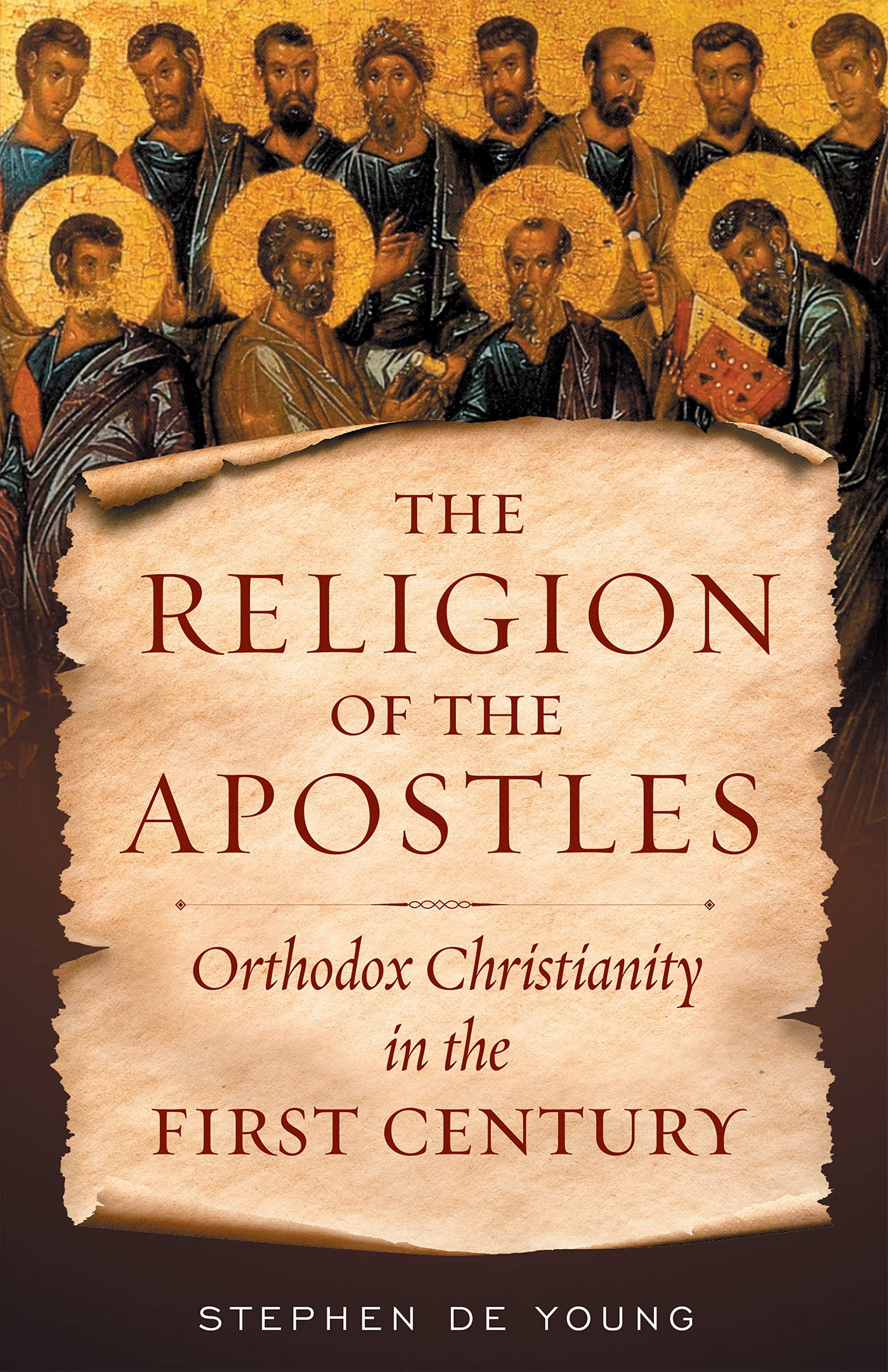
As I started reading Church History in Plain English and read about the Saints, I felt a strong feeling of emotion within me and I began to other sources of research on the Christian Orthodox Church. I look forward to sharing more of my spiritual journey with you all in this endeavor. For now, check out the book description for Church History in Plain English and another book on, The Religion of the Apostles (Orthodox Christianity in the First Century) by Stephen De Young I have added to my to-read pile.Many of you might be inspired to check them out.

Stephanie Hopkins

God Bless

Church History in Plain English by Bruce L. Shelley

With more than 275,000 copies sold, this is the story of the Church for today’s readers. The third edition of Shelley’s classic one-volume history of the church brings the story of Christianity into the twenty-first century. This latest edition of the book takes a close look at the rapid growth of evangelical and Pentecostal Christianity in the southern hemisphere, addresses the decline in traditional mainline denominations, examines the influence of technology on the spread of the gospel, and discusses how Christianity intersects with other religions in countries all over the world.

The concise book provides an easy-to-read guide to church history, with intellectual substance. The new edition of Church History in Plain Language promises to be the new standard for readable Church History.

The Religion of the Apostles (Orthodox Christianity in the First Century) by Stephen De Young

Rev. Dr. Stephen De Young, creator of the popular The Whole Counsel of God blog and podcast, traces the lineage of Orthodox Christianity back to the faith and witness of the apostles, which was rooted in a first-century Jewish worldview. The Religion of the Apostles presents the Orthodox Christian Church of today as a continuation of the religious life of the apostles, which in turn was a continuation of the life of the people of God since the beginning of creation.

Biographies & Memoirs

This past Sunday, I met a dear friend at a local coffee shop and what a treat it was! We talked about many topics and our mutual love for nonfiction. My friend is currently listening to Braiding Sweetgrass: Indigenous Wisdom, Scientific Knowledge and the Teachings of Plants by Robin Wall Kimmerer and she highly recommend it to me. Later on, when I got home, I sent her a picture of the nonfiction book I’m reading. The title is, The Neighborhood Project by David Sloan Wilson. I received the book as an ARC many years ago.  

This led me to further explore more nonfiction books to add to my to-read wish-list. Below are five new titles I have added. My wish is for you to be encouraged and inspired to read more and to explore nonfiction in a broader sense-if you haven’t already.

Stephanie Hopkins

The Book-Makers

A History of the Book in Eighteen Lives

by Adam Smyth

Description

The five-hundred-year history of printed books, told through the people who created them

Books tell all kinds of stories—romances, tragedies, comedies—but if we learn to read the signs correctly, they can tell us the story of their own making too. The Book-Makers offers a new way into the story of Western culture’s most important object, the book, through dynamic portraits of eighteen individuals who helped to define it.  
 
Books have transformed humankind by enabling authors to create, document, and entertain. Yet we know little about the individuals who brought these fascinating objects into existence and of those who first experimented in the art of printing, design, and binding. Who were the renegade book-makers who changed the course of history?  
 
From Wynkyn de Worde’s printing of fifteenth-century bestsellers to Nancy Cunard’s avant-garde pamphlets produced on her small press in Normandy, this is a celebration of the book with the people put back in. 

Twenty Years

Hope, War, and the Betrayal of an Afghan Generation

by Sune Engel Rasmussen

Description

An intimate history of the Afghan war—and the young Afghans whose dreams it enabled and dashed.

No country was more deeply affected by 9/11 than Afghanistan: an entire generation grew up amid the upheaval that began that day. Young Afghans knew the promise of freedom, democracy, and safety, fought with each other over its meaning—and then witnessed its collapse. In Twenty Years, the Wall Street Journal correspondent Sune Engel Rasmussen draws on more than a decade of reporting from the country to tell Afghanistan’s story from a new angle. Through the eyes of newly empowered women, skilled entrepreneurs, driven insurgents, and abandoned Western allies, we see the United States and its partners bring new freedoms and wealth, only to preside over the corruption, war-lordism, and social division that led to the Taliban’s return to power.

Rasmussen relates this history via two main characters: Zahra, who returns from abroad with high hopes for her liberated county, where she must fight to escape a brutal marriage and rebuild her life; and Omari, who joins the Taliban to protect the honor of his village and country and winds up wrestling with doubt and the trauma of war after achieving victory. We also meet Parasto, who risks her life running clandestine girls’ schools under the new Taliban regime, and Fahim, a rags-to-riches tycoon who is forced to flee. With intimate access to these and other characters, Rasmussen offers deep insight into a country betrayed by the West and Taliban alike.

Warsaw Testament

by Rokhl Auerbach, Translated by Samuel Kassow

Description

Born in Lanowitz, a small village in rural Podolia, Rokhl Auerbach was a journalist, literary critic, memoirist, and a member of the Warsaw Yiddish literary community before the Holocaust. Upon the German invasion and occupation of Poland in 1939, she was tasked by historian and social activist Emanuel Ringelblum to run a soup kitchen for the starving inhabitants of the Warsaw Ghetto and later to join his top-secret ghetto archive, the Oyneg Shabes. One of only three surviving members of the archive project, Auerbach’s wartime and postwar writings became a crucial source of information for historians of both prewar Jewish Warsaw and the Warsaw Ghetto. After immigrating to Israel in 1950, she founded the witness testimony division at Yad Vashem and played a key role in the development of Holocaust remembrance. Her memoir Warsaw Testament, based on her wartime writings, paints a vivid portrait of the city’s prewar Yiddish literary and artistic community and of its destruction at the hands of the Nazis.

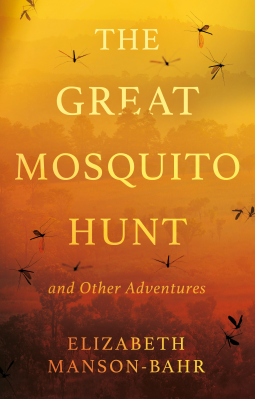
The Great Mosquito Hunt and Other Adventures

by Elizabeth Manson-Bahr

Description

This book is the author’s answer to the question Who do you think you are? set in China, Russia, Egypt, Kenya, Fiji and the US during the 18th to 20th centuries. It describes the battle to discover the causes of malaria. Sir Patrick Manson, the author’s great-grandfather, known as Mosquito Manson, was the first scientist to prove that insects were vectors of disease, a discovery which led to the detection of the malarial parasite. He founded the Chinese Medical School in Hong Kong and the London School of Tropical Medicine. Among his pupils was Sun Yat-sen, the first President of modern China.

It is the story too of plagues and pandemics, of Scottish and German merchants who made their fortunes in 19th century Egypt and 18th century Russia. The author’s mother, orphaned by the Spanish flu, made her way to Africa where she served as a FANY in 1942, marrying Clinton, the third in the family line of tropical medical specialists. The chapters are interspersed with the author’s own childhood memories growing up in Fiji and Kenya.

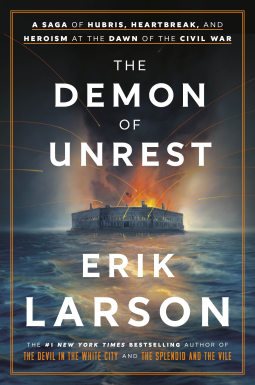
The Demon of Unrest

A Saga of Hubris, Heartbreak, and Heroism at the Dawn of the Civil War

by Erik Larson

Description

The #1 New York Times bestselling author of The Splendid and the Vile brings to life the pivotal five months between the election of Abraham Lincoln and the start of the Civil War—a simmering crisis that finally tore a deeply divided nation in two.

One of Time’s Most Anticipated Books of the Year


On November 6, 1860, Abraham Lincoln became the fluky victor in a tight race for president. The country was bitterly at odds; Southern extremists were moving ever closer to destroying the Union, with one state after another seceding and Lincoln powerless to stop them. Slavery fueled the conflict, but somehow the passions of North and South came to focus on a lonely federal fortress in Charleston Harbor: Fort Sumter.

Master storyteller Erik Larson offers a gripping account of the chaotic months between Lincoln’s election and the Confederacy’s shelling of Sumter—a period marked by tragic errors and miscommunications, enflamed egos and craven ambitions, personal tragedies and betrayals. Lincoln himself wrote that the trials of these five months were “so great that, could I have anticipated them, I would not have believed it possible to survive them.”

At the heart of this suspense-filled narrative are Major Robert Anderson, Sumter’s commander and a former slave owner sympathetic to the South but loyal to the Union; Edmund Ruffin, a vain and bloodthirsty radical who stirs secessionist ardor at every opportunity; and Mary Boykin Chesnut, wife of a prominent planter, conflicted over both marriage and slavery and seeing parallels between them. In the middle of it all is the overwhelmed Lincoln, battling with his duplicitous secretary of state, William Seward, as he tries desperately to avert a war that he fears is inevitable—one that will eventually kill 750,000 Americans.

Drawing on diaries, secret communiques, slave ledgers, and plantation records, Larson gives us a political horror story that captures the forces that led America to the brink—a dark reminder that we often don’t see a cataclysm coming until it’s too late.

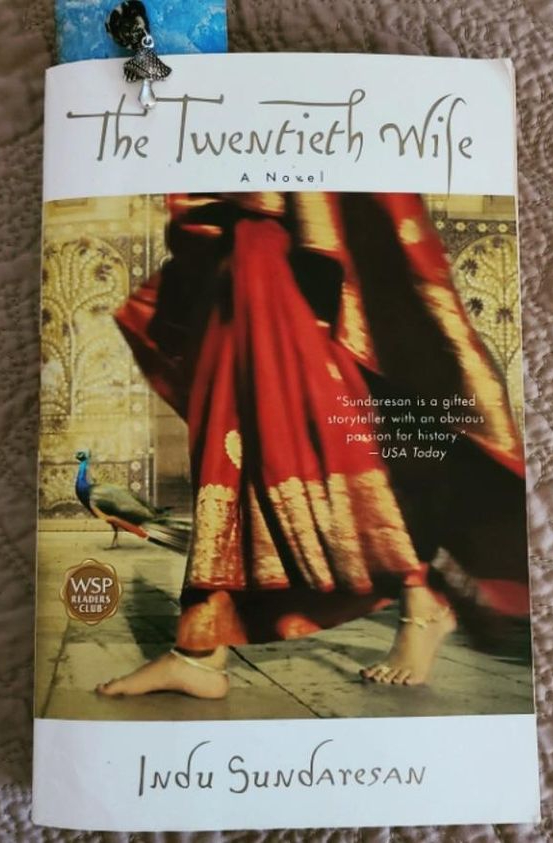
Current Read: The Twentieth Wife by Indu Sundaresan

About the Book:

An enchanting historical epic of grand passion and adventure, this debut novel tells the captivating story of one of India’s most controversial empresses — a woman whose brilliance and determination trumped myriad obstacles, and whose love shaped the course of the Mughal Empire. Skillfully blending the textures of historical reality with the rich and sensual imaginings of a timeless fairy tale, The Twentieth Wife sweeps readers up in Mehrunnisa’s embattled love with Prince Salim, and in the bedazzling destiny of a woman — a legend in her own time — who was all but lost to history until now.

My thoughts:

I picked up this novel a few days ago and at first, I was completely immersed in Sundaresan’s world of India and the Mughal Empire. I didn’t want to pull away from the pages and as I became acquitted with the characters lives, I began to feel their inner struggles were not quite fleshed out to reflect their actions. I’m not entirely sure it’s because of culture standards or if it’s a flaw in the writing. That said, it is often that our inner feelings don’t meet the decisions we make in life. As you can see, I’m torn with these emotions about the characters. Maybe it is because I haven’t quite put my figure on it yet despite knowing something is missing.

Despite my misgivings about the characters, I quite like the story thus far, and I’m fully invested in the final outcome. I’m delighted to have chosen to read, The Twentieth Wife. What are you currently reading? Do share!

Stephanie Hopkins

Disclaimer: I do not support, control or endorse the adds that are showing on my blog.

My Journey of Continual Education

My current reads and for the next few years, my main reading focus is nonfiction and studying diverse cultures-how they evolve in-depth- government entities, world history and economics.

I’ve studied and read quite a few books on American history (particular 19th Century) but lately I’ve discovered so much I’ve sorely missed out on. That said, one’s education should be a life long journey. I’m looking forward to reading and studying these books.

The Americans, Vol 1: The Colonial Experience

(The Americans #1) by Daniel J. Boorstin

Winner of the Bancroft Prize. “A superb panorama of life in America from the first settlements on through the white-hot days of the Revolution.” – Bruce Lancaster, Saturday Review

The Americans, Vol 2: The National Experience Paperback – by Daniel J. Boorstin

This second volume in “The Americans” trilogy deals with the crucial period of American history from the Revolution to the Civil War. Here we meet the people who shaped, and were shaped by, the American experience—the versatile New Englanders, the Transients and the Boosters.  Winner of the Francis Parkman Prize.

The Americans, Vol 3: The Democratic Experience Paperback by Daniel J. Boorstin

Winner of the Pulitzer Prize. A study of the last 100 years of American history.

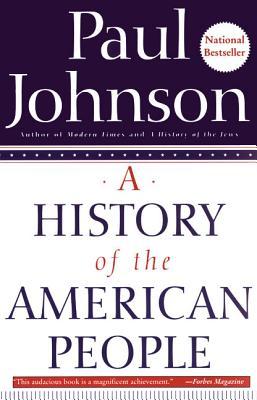
A History of the American People by Paul Johnson

“The creation of the United States of America is the greatest of all human adventures,” begins Paul Johnson. “No other national story holds such tremendous lessons, for the American people themselves and for the rest of mankind.”

In his prize-winning classic, Johnson presents an in-depth portrait of American history from the first colonial settlements to the Clinton administration. This is the story of the men and women who shaped and led the nation and the ordinary people who collectively created its unique character. Littered with letters, diaries, and recorded conversations, it details the origins of their struggles for independence and nationhood, their heroic efforts and sacrifices to deal with the ‘organic sin’ of slavery and the preservation of the Union to its explosive economic growth and emergence as a world power. Johnson discusses contemporary topics such as the politics of racism, education, the power of the press, political correctness, the growth of litigation, and the influence of women throughout history. He sees Americans as a problem-solving people and the story of their country as “essentially one of difficulties being overcome by intelligence and skill, by faith and strength of purpose, by courage and persistence… Looking back on its past, and forward to its future, the auguries are that it will not disappoint humanity.”

Sometimes controversial and always provocative, A HISTORY OF THE AMERICAN PEOPLE is one author’s challenging and unique interpretation of American history. Johnson’s views of individuals, events, themes, and issues are original, critical, and in the end admiring, for he is, above all, a strong believer in the history and the destiny of the American people.

Other recent relevant posts:

Cultural Nonfiction Books

A Better Understanding of Political and Social Controversies of Our Times

I’m looking forward to sharing more books I’ve discovered and as I read them, I will be writing down my thoughts on them in future posts.

Stephanie Hopkins

Cultural Nonfiction Books

I recently read Educated by Tara Westover and I must say, I have quite a bit to say about the story. I was debating on how to break down my thoughts but after I talked it over with a friend, she encouraged me to focus what topic in the story that was important to me and what would, basically make an impact. Not her words but that was the gest of the conversation. The memoir did strike a chord with me to focus more of my attention to social and cultural issues of our time and throughout recent history.

In my last post, I shared-on a small scale-about what I’m currently reading, and about my experience with Thomas Sowell’s’ work thus far. This particular journey has me wanting to study further in-depth cultural societies, economics and government entities around the world. Perhaps, you may have titles to recommend me to read.

Stephanie Hopkins

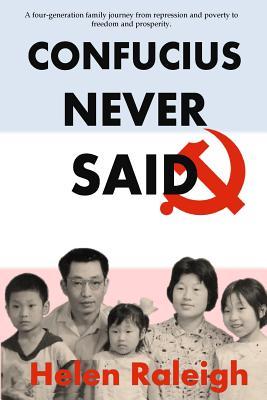
Confucius Never Said by Helen Raleigh

This book is a four-generation family journey from repression and poverty in China to freedom and prosperity in the United States. Their lives overlap with many significant historical events taking place in China, such as the founding of Communist China in 1949, the Great Chinese Famine from 1958-1960, the Cultural Revolution from 1966-1976 and the Economic Reform starting from 1980.The author recounts the enormous suffering her family had to endure under Communist China’s radical social experiment. Her great-grandfather was denounced by the Chinese Communist Party and his neighbors simply because he owned land. He died in poverty, and his dying wish was never granted. Her grandfather loaned his fishing boat to the Communist Party, and ended up losing his independence and becoming a janitor. Her father escaped his village to get educated and thus survived the Great Famine. He became highly educated, but never joined the Communist Party . . . and was sent to a re-education labor camp because of it. The author herself grew up in China and immigrated to the United States as a young adult. She sought freedom and the American Dream, and found both. This book is about freedom-and about what happens when we let people take our freedom away. 

The Inconvenient Indian: A Curious Account of Native People in North America by Thomas King

The Inconvenient Indian is at once a “history” and the complete subversion of a history—in short, a critical and personal meditation that the remarkable Thomas King has conducted over the past 50 years about what it means to be “Indian” in North America.

Rich with dark and light, pain and magic, this book distills the insights gleaned from that meditation, weaving the curiously circular tale of the relationship between non-Natives and Natives in the centuries since the two first encountered each other. In the process, King refashions old stories about historical events and figures, takes a sideways look at film and pop culture, relates his own complex experiences with activism, and articulates a deep and revolutionary understanding of the cumulative effects of ever-shifting laws and treaties on Native peoples and lands.

This is a book both timeless and timely, burnished with anger but tempered by wit, and ultimately a hard-won offering of hope—a sometimes inconvenient, but nonetheless indispensable account for all of us, Indian and non-Indian alike, seeking to understand how we might tell a new story for the future.

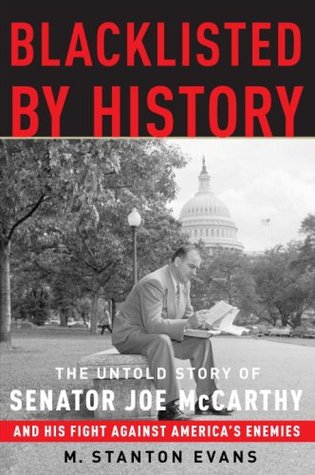
Blacklisted by History: The Untold Story of Senator Joe McCarthy and His Fight Against America’s Enemies by M. Stanton Evans

Accused of creating a bogus Red Scare and smearing countless innocent victims in a five-year reign of terror, Senator Joseph McCarthy is universally remembered as a demagogue, a bully, and a liar. History has judged him such a loathsome figure that even today, a half century after his death, his name remains synonymous with witch hunts.
But that conventional image is all wrong, as veteran journalist and author M. Stanton Evans reveals in this groundbreaking book. The long-awaited “Blacklisted by History,” based on six years of intensive research, dismantles the myths surrounding Joe McCarthy and his campaign to unmask Communists, Soviet agents, and flagrant loyalty risks working within the U.S. government. Evans’s revelations completely overturn our understanding of McCarthy, McCarthyism, and the Cold War.

Drawing on primary sources–including never-before-published government records and FBI files, as well as recent research gleaned from Soviet archives and intercepted transmissions between Moscow spymasters and their agents in the United States–Evans presents irrefutable evidence of a relentless Communist drive to penetrate our government, influence its policies, and steal its secrets. Most shocking of all, he shows that U.S. officials supposedly guarding against this danger not only let it happen but actively covered up the penetration. All of this was precisely as Joe McCarthy contended.

“Blacklisted by History” shows, for instance, that the FBI knew as early as 1942 that J. Robert Oppenheimer, the director of the atomic bomb project, had been identified by Communist leaders as a party member; that high-level U.S. officials were warned that Alger Hiss was a Soviet spy almost a decade before the Hiss case became a public scandal; that a cabal of White House, Justice Department, and State Department officials lied about and covered up the Amerasia spy case; and that the State Department had been heavily penetrated by Communists and Soviet agents before McCarthy came on the scene.
Evans also shows that practically everything we’ve been told about McCarthy is false, including conventional treatment of the famous 1950 speech at Wheeling, West Virginia, that launched the McCarthy era (“I have here in my hand . . .”), the Senate hearings that casually dismissed his charges, the matter of leading McCarthy suspect Owen Lattimore, the Annie Lee Moss case, the Army-McCarthy hearings, and much more.

In the end, Senator McCarthy was censured by his colleagues and condemned by the press and historians. But as Evans writes, “The real Joe McCarthy has vanished into the mists of fable and recycled error, so that it takes the equivalent of a dragnet search to find him.” “Blacklisted by History” provides the first accurate account of what McCarthy did and, more broadly, what happened to America during the Cold War. It is a revealing expose of the forces that distorted our national policy in that conflict and our understanding of its history since. 

A Better Understanding of Political and Social Controversies of Our Times

I’ve known about Thomas Sowell for a few years now and have listened to many of his interviews’ and recently started listening to his audio books on YouTube. I first became interested in his work on two scores. The first, his research on the history of slavery and two, his journey with Marxism in his twenties. His clear cut, intellectual thoughts are enlightening to say the least. He reacts on information rather than feelings. Sowell’s writings should be mandatory study in the school system.

His lectures on the history of slavery validated a passage I read on the subject over fifteen years ago. I was over at a friend’s house, scrap-booking and mentioned what I had read about slavery in Africa and the said “friend” proceeded to shut me down and was appalled at what I had stated. I was taken back by her reaction and to my dismay, I dropped the subject entirely. It is as if she thought I had some sort of agenda in what I said and refused to have an objective conversation. Though, I dare say, she did not have an intelligent response at anytime. In hindsight, I should have asked her about her sources and why she is dismissing my discovering.

I’m currently re-reading, The Communist Manifesto by Karl Marx & Engels (which is pure propaganda in my opinion but an important to read) and have just started, The Naked Communist by W. Cleaon Skousen. After I read those books and finish listening to Sowell’s audio books, I want to purchase a few of his physical books for further study.

Here are the titles I want to acquire by Sowell:

Intellectuals and Society

Economic Facts and Fallacies

The Housing Boom and Bust

A Conflict of Visions: Ideological Origins of Political Struggles

Black Rednecks and White Liberals

The Quest for Cosmic Justice

Bio:

Thomas Sowell is an American economist, social commentator, and author of dozens of books. He often writes from an economically laissez-faire perspective. He is currently a senior fellow of the Hoover Institution at Stanford University. In 1990, he won the Francis Boyer Award, presented by the American Enterprise Institute. In 2002 he was awarded the National Humanities Medal for prolific scholarship melding history, economics, and political science.

Sowell was born in North Carolina, where, he recounted in his autobiography, A Personal Odyssey, his encounters with Caucasians were so limited he didn’t believe that “yellow” was a hair color. He moved to Harlem, New York City with his mother’s sister (whom he believed was his mother); his father had died before he was born. Sowell went to Stuyvesant High School, but dropped out at 17 because of financial difficulties and a deteriorating home environment. He worked at various jobs to support himself, including in a machine shop and as a delivery man for Western Union. He applied to enter the Civil Service and was eventually accepted, moving to Washington DC. He was drafted in 1951, during the Korean War, and assigned to the US Marine Corps. Due to prior experience in photography, he worked in a photography unit.

After his discharge, Sowell passed the GED examination and enrolled at Howard University. He transferred to Harvard University, where he graduated magna cum laude with a Bachelor of Arts degree in Economics. He received a Master of Arts in Economics from Columbia University, and a Doctor of Philosophy in Economics from the University of Chicago. Sowell initially chose Columbia University because he wanted to study under George Stigler. After arriving at Columbia and learning that Stigler had moved to Chicago, he followed him there.

Sowell has taught Economics at Howard University, Cornell University, Brandeis University, and UCLA. Since 1980 he has been a Senior Fellow of the Hoover Institution at Stanford University, where he holds a fellowship named after Rose and Milton Friedman.

Bio and picture used from goodreads

Exploration of Journal Making

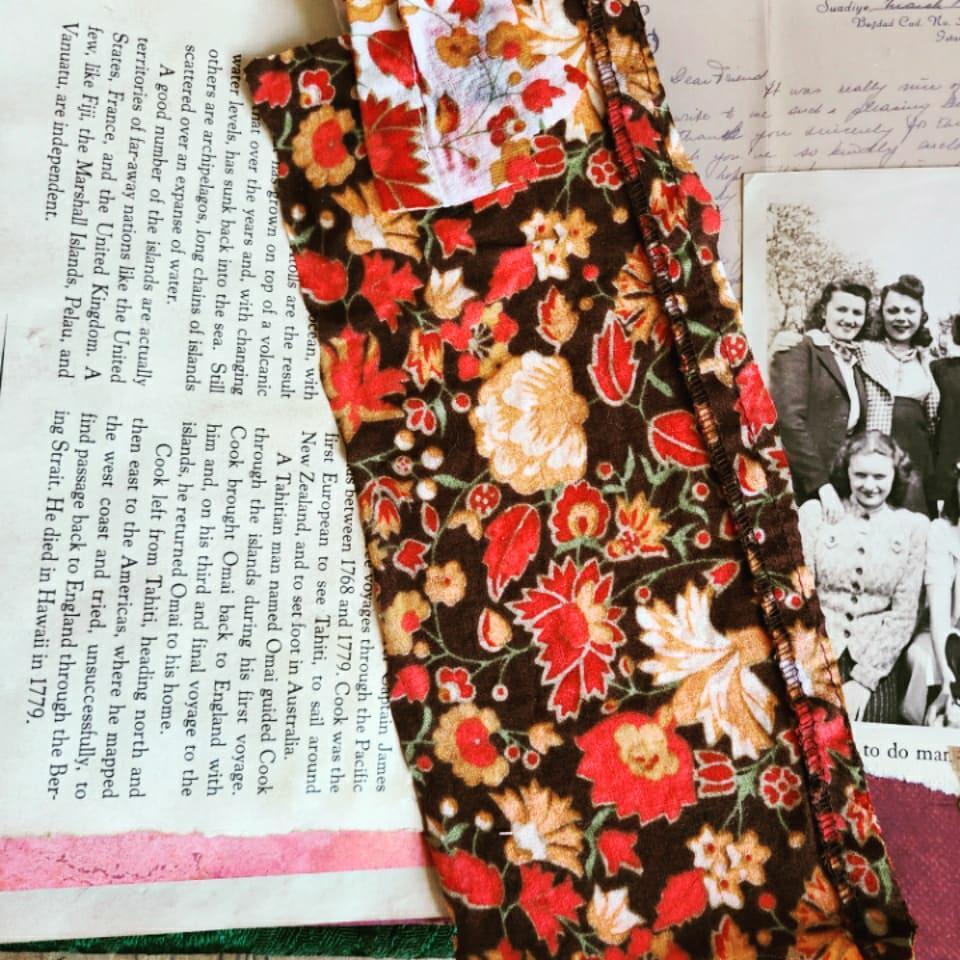
A page in my new fall journal I’m currently working in. I’ll show the whole journal once it’s completed. I really enjoyed putting this page together and the bookmark I made for the book. The bookmark is made from an image out of a magazine, scrapbook paper and a piece of left-over fabric.

The journal page is simple with a touch of paper collage, postcard and a authentic 1940s photo of a group of ladies. I’ll add a journal label to the bottom left of the page. The actual page I’m working on is from my 12” x 12” scrap-booking paper stash from the early 2000s and what a great way to use those big sizes of paper! I wonder who those ladies are and what their story is or was.

Journaling fills one’s soul with gratitude and healing calmness. It’s an appreciation for the old and the newness of life’s journey.

Happy crafty Friday!

Stephanie Hopkins
Mixed Media Artist/Abstract Painter/Book Maker/Book Blogger

Good Time Coming by C.S. Harris

I want to share something with you about C.S. Harris’s story Good Time Coming. I still think about the story and my interview with her. I went over to Amazon so I can order a physical copy of her book to add to my collections of books I most admire. I read the reviews and I feel people are misunderstanding the story by saying it’s one-sided and this and that. It is far from that and she wrote a story that is rarely or if at all talked about. If these readers truly appreciated and studied history and were avid historical fiction readers of the period, they would know this. We need more stories about civilians’ experiences in the south. I also feel that she wasn’t conveying that all union soldiers are bad like what one reviewer stated. I did not get that impression at all when I read the book. I wish people would leave their modern-day sensibilities out of history so that they can truly learn history in its raw form. Harris beautifully and heart wrenchingly portrayed how horrible the war was for the women left unprotected, while their men and sons were off fighting and dying by the hundreds of thousands. Nothing wrong in giving a southern view of the experience. I wish people would be more objective and open to hearing all sides because you cannot learn or teach history without it. We need to take the good, the bad and ugly and discuss it openly without prejudice. To blame a wrong solely on a group of people is counterproductive and causes further divide. After-all, honest talk is only how we will learn human experiences and heal as a community. So please, stop bringing political correctness into everything. It is polarizing, damaging and complete utter nonsense!

“The army that marched against the South was the same army that perpetrated the massacres of Native American women and children at Sacramento River and Harvey and countless other sites, a well-understood reality that terrified Southern civilians.” – C.S. Harris

The link to my interview with C.S. Harris will give readers a better sense of what the author was conveying with Good Time Coming. I highly recommend reading the book and to read the interview in full. One of the best civil war related stories I’ve read and that says a lot because this period in our countries history, interest me the most.

-Stephanie

About the book:

It’s the beginning of the American Civil War, and the Union army is sailing down the Mississippi, leaving death and destruction in its wake.

The graceful river town of St. Francisville, Louisiana, has known little of the hardships, death, and destruction of the War. But with the fall of New Orleans, all changes. A Federal fleet appears on the Mississippi, and it isn’t long before the depredations and attacks begin.

For one Southern family the dark blue uniform of the Union army is not the only thing they fear. A young girl stops a vicious attack on her mother and the town must pull together to keep each other safe. But a cryptic message casts doubt amongst the townsfolk. Is there a traitor in the town and can anybody be trusted?

Twelve-year-old Amrie and her family have never felt entirely accepted by their neighbors, due to their vocal abolitionist beliefs. But when Federal forces lay siege to the nearby strongholds of Vicksburg and Port Hudson, the women and children of St. Francisville find themselves living in a no mans land between two warring armies. Realizing they must overcome their differences and work together to survive, they soon discover strengths and abilities they never knew they possessed, and forge unexpected friendships.

As the violence in the area intensifies, Amrie comes to terms with her own capacity for violence and realizes that the capacity for evil exists within all of us. And when the discovery of a closely guarded secret brings the wrath of the Federal army down on St. Francisville, the women of St. Francisville, with whom Amrie and her mother have shared the war years many deprivations and traumas, now unite and risk their own lives to save them.